
Learn How to Make a Baby Bed Canopy Safely with This Guide
This post contains affiliate links. As an Amazon Associate we earn from qualifying purchases.
To make a baby bed canopy, you need a breathable fabric like cotton muslin and a secure mounting point like a ceiling hook or a curtain holdback. The goal is a decorative drape that never encloses the sleeping space, poses no entanglement risk, and uses only washable, flame-retardant materials. For a cot, a purpose-made product like the Content & Calm Cot Canopy meets the EN 716:2008 safety standard for dimensions and ventilation.
That standard isn’t a suggestion. It’s the line between a cute nursery accent and a product that could trap heat or pose a strangulation hazard if used incorrectly. The EN 716:2008 spec governs the size and safety of cots and folding cots, and any canopy attached to one must play by those rules.
What follows breaks the project into two paths: buying a tested, certified canopy for a crib, or building a purely decorative one for a toddler bed. We’ll cover the four fabrics that work, the two that don’t, and the mounting mistake that turns a weekend project into a safety recall.
Key Takeaways
- Never enclose the sleep space. A canopy must drape openly from a single central point; walls of fabric around a crib impede airflow and increase the risk of overheating and re-breathing.
- Fabric breathability is non-negotiable. Stick to natural fibers like cotton, linen, or muslin. Avoid vinyl, plastic sheeting, or heavy non-breathable fabrics that trap heat and moisture.
- Mounting security is everything. Any hardware must be anchored into a ceiling joist or wall stud. A canopy that relies on adhesive hooks or tension rods will eventually fall.
- Keep it out of reach. The lowest point of the draped fabric should be well above where a standing child in the bed could grab, pull, or become entangled.
- Wash everything first. Pre-wash all fabric to remove chemical finishes and account for shrinkage before you cut or hem.
The First Decision: Crib Canopy or Toddler Bed Canopy?
This choice dictates your entire approach. The safety requirements for a sleeping infant are categorically different from those for a mobile toddler in a low bed.
A canopy for a crib or cot must be treated as nursery equipment, not decor. Its attachment points, fabric weight, and proximity to the mattress are regulated for a reason. The only safe route here is a product specifically designed and tested for this use, like the Content & Calm Cot Canopy. Its manual states it’s for cots up to 130cm long and 110cm high that conform to EN 716:2008. It has permanent top vents and a spring-plastic frame that clamps to the cot rail.
Where this goes sideways: Using a DIY fabric drape intended for a bed on a crib. The fabric can easily slip inside the rails, creating a loose, hazardous material in the sleep space that violates every safe sleep guideline.
For a toddler bed, the canopy is a visual treat, not a piece of sleep equipment. The child is older, the bed is lower, and the risk profile changes. Here, a well-secured decorative canopy is fine. The focus shifts to ensuring the fabric is lightweight, securely mounted high above the bed, and that the child cannot use it as a climbing aid.
| Scenario | Safe Approach | Key Safety Guard | Product Example |
|---|---|---|---|
| Crib / Cot (0-24 months) | Use a tested, certified product only. | Product must meet crib safety standards (EN 716). | Content & Calm Cot Canopy |
| Toddler Bed (2+ years) | DIY decorative canopy is acceptable. | Mounting point must be into a stud/joist; fabric must be breathable. | Curtain holdback + cotton muslin drape |
Fabric Choice Is a Safety Choice
The right fabric looks gentle and allows air to move. The wrong one looks pretty but acts like a plastic bag, trapping humidity and heat around your child.
Your shortlist is cotton, linen, muslin, and batiste. These are natural, breathable, and easy to wash. Cotton muslin is the standout for baby projects—it’s gauzy, lightweight, and becomes softer with every wash. A good set of breathable swaddle blankets is often made from the same material, which tells you everything you need to know about its safety profile.
Tulle or sheer polyester can be used sparingly as a decorative overlay, but never as the primary fabric. It doesn’t breathe well and can be surprisingly abrasive against skin.
The one to avoid: Vinyl, oilcloth, or any non-porous decorative fabric. These trap moisture, promote mold growth on the wall behind them, and are a fire hazard. They have no place in a child’s room.
Your fabric needs to be wide enough to drape generously. For a standard single toddler bed, the Sewing.org bed canopy guide calls for 10 1/4 yards of 45″-60″ wide sheer fabric. A simpler approach using a flat sheet or duvet cover, as noted in our research, requires a piece at least 140cm wide and 200cm long. Always buy extra to account for shrinkage and hems.
The 4-Step Curtain Holdback Method (No Tools Required)
This is the simplest, safest method for a toddler bed canopy. It uses a single curtain holdback (a decorative wall hook) and a long rectangle of fabric. There’s no sewing required if you use iron-on hem tape.
Step 1: Find Your Mounting Point
Center the holdback on the wall, about 32 inches above the top of the mattress. This height keeps the fabric out of the way during bedtime stories and makes it impossible for a child to reach from the bed. You must screw this hook directly into a wall stud. Drywall alone will not hold the weight, especially if a child tugs on it.
Step 2: Prepare Your Fabric
Pre-wash and dry your fabric. If using a flat sheet, you may already have finished edges. If using raw fabric, create a simple hem on all four sides using a sewing machine or fabric glue. For a lined, finished look, you can sew two pieces of fabric together along their long edges, right sides together, then turn it right side out—like a giant pillowcase.
Step 3: Drape and Arrange
Drape the center of your long fabric panel over the holdback. Let the ends fall evenly down each side of the bed. Adjust the gathers until you like the shape. The center seam or point should sit hidden on top of the hook.
Step 4: The Final Safety Check
Get on the bed. Sit up, lean back, pretend to read a story. Does the fabric brush your face? If so, raise the hook. Have your child stand on the bed. Can they touch or grab the fabric? If yes, the canopy is too low and needs to be re-mounted higher.
This method creates a classic, flowing canopy that feels magical without enclosing the space. It pairs perfectly with a comfortable set of soft crib sheets for babies and a safe and supportive crib mattress for a complete cozy setup.
The Embroidery Hoop Canopy (A Sewing Project)
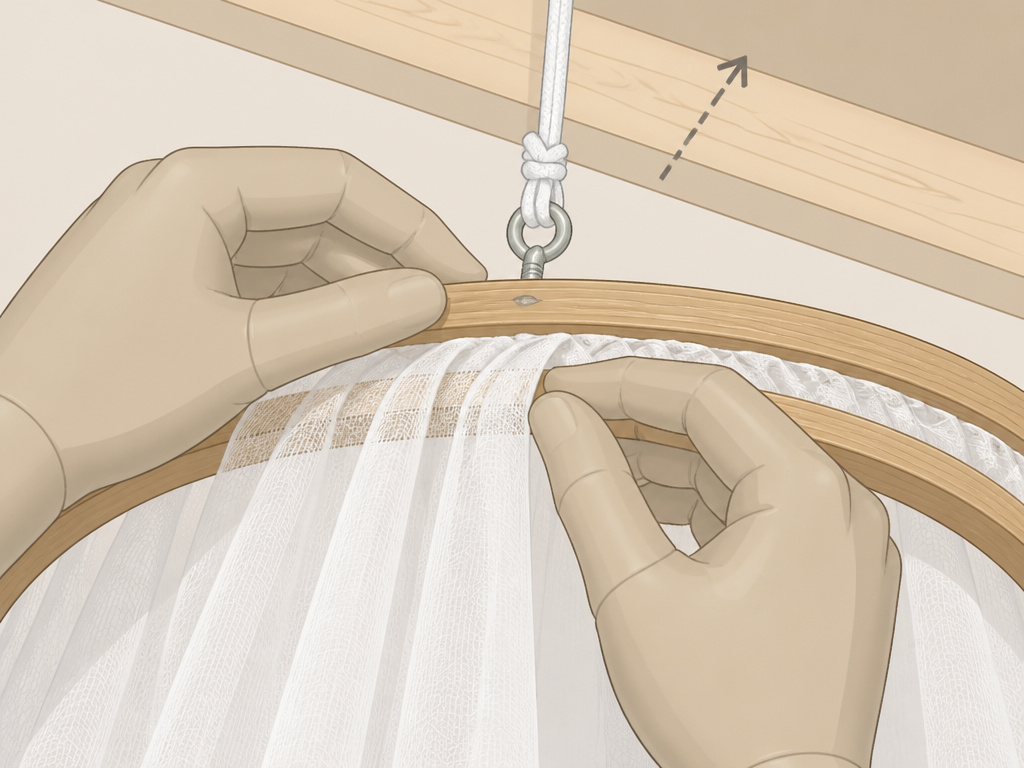
For a more structured, “floating” look, an embroidery hoop canopy is a beautiful option. It’s a bit more involved but offers a defined shape.
You’ll need a large wooden embroidery hoop (14-18 inches), several yards of sheer fabric, cord, and a sturdy ceiling hook anchored into a joist.
The process involves gathering the top of your fabric panels and securing them between the two rings of the hoop. The cords from the hoop then converge through a large wooden bead and attach to the ceiling hook. The Sewing.org bed canopy guide provides detailed instructions for this method, including how to add a decorative frill.
Common mistake: Suspending the hoop from a hook screwed only into drywall. The leverage from a wide hoop makes it much heavier than a simple fabric drape. It will pull out, possibly crashing down. Find the joist.
This style works well in a room with higher ceilings and when paired with other handmade touches, like eco-friendly crib sheets.
Understanding the Commercial Canopy: The Content & Calm Example
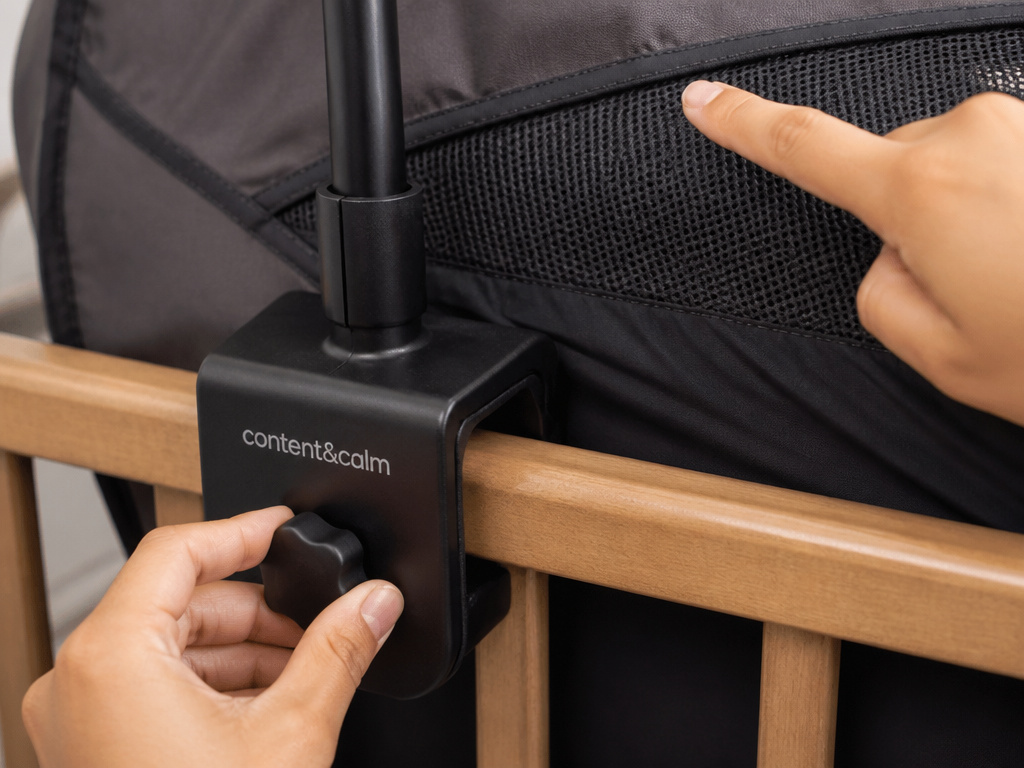
If you’re using a canopy on an actual crib, the DIY rules go out the window. You must follow the manufacturer’s instructions to the letter. The Content & Calm Cot Canopy manual is a masterclass in specific safety.
It’s not just a fabric drape. It’s a system: a spring-plastic frame that clamps to the cot rail, a mesh canopy with permanent top vents, and fabric outer panels. The manual specifies it’s for one child only, the cot must conform to EN 716:2008, and the cot’s top rail cannot be thicker than 4.5cm.
The manual also contains a non-commodity gem: “It takes about 3-5 attempts to get used to the set up and pack away technique. If folded incorrectly, the spring plastic may twist but can be adjusted back into shape by tracing the curve of the vent to the twisted spot.”
This is a real, documented failure mode with a fix. It’s the kind of detail you only get from a primary source, not a blog summary.
The warnings are equally precise: never block the top vents, always leave at least one outer panel open (so only the dark mesh layer is closed), and tighten the clamp regularly. This product exemplifies how a nursery canopy must prioritize function and safety over pure aesthetics.
Mounting Hardware: What Actually Works
Your canopy is only as safe as its weakest link. That link is almost always the hardware.
- For Wall-Mounted Hooks (Holdbacks): Must be screwed into a wall stud. Use a stud finder. The screw that comes with the holdback is often too short; replace it with a longer, thicker screw (at least 2 inches) for a secure bite.
- For Ceiling-Mounted Hooks: Must be screwed into a ceiling joist. Again, use a stud finder. A toggle bolt in drywall is not sufficient for a dynamic load (something that can be pulled or swung).
- What to Ban: Adhesive hooks, tension rods, or temporary hanging strips. They are marketed for lightweight decor, not for anything a child might interact with. They will fail.
Once your secure hook is in place, the connection to the fabric should be simple and non-adjustable. A basic knot or a sewn loop is better than a complex pulley system a child could fiddle with. The goal is a permanent, “set it and forget it” installation.
Frequently Asked Questions
Can I use a bed canopy for a newborn?
No. You should never add any soft bedding, drapes, or fabric hangings to a newborn’s sleep space. It increases the risk of Sudden Infant Death Syndrome (SIDS) through entrapment, suffocation, or overheating. The American Academy of Pediatrics recommends a bare crib for infants. Decorative canopies are only for toddler beds, and even then, they must be securely mounted and out of reach.
How do I wash a baby bed canopy?
Wash it often, especially if it’s in a toddler’s room where dust and germs collect. For a DIY fabric canopy, remove it from the hook and wash it according to the fabric care label—usually a gentle cycle with mild detergent. Tumble dry on low or hang to dry. For a product like the Content & Calm canopy, the manual states it can be machine washed in a delicates bag at 30°C.
What’s the best fabric that doesn’t require sewing?
Pre-hemmed flat sheet or a duvet cover is your best no-sew option. The edges are already finished, and the dimensions are often perfect for a single bed canopy. For a more sheer look, a large piece of chiffon or voile can have its edges finished with fabric glue or iron-on hem tape, though this bond may not withstand heavy washing.
Is it safe to put fairy lights on a bed canopy?
It is not recommended. Even LED fairy lights can overheat if left on for extended periods or if the wires become damaged. If you absolutely want the effect, use battery-operated lights specifically designed for children’s rooms, ensure all wires are completely inaccessible, and never leave them on unsupervised or while the child is sleeping. The safest approach is to keep lights on the wall, not on the fabric.
How much fabric do I need for a twin bed canopy?
For a generous drape using the curtain holdback method, you’ll need a piece of fabric at least 60 inches wide (the width of a standard flat sheet) and about 120 inches long. This allows for a beautiful pool of fabric on the floor on each side. Always measure from your specific mounting point down to where you want the fabric to end, then add extra for the drape over the hook.
The Bottom Line
A baby bed canopy is a project where charm must bow to caution. For a crib, buy a tested product and follow its manual exactly. For a toddler bed, keep it simple: a breathable cotton muslin draped from a hook screwed deep into a wall stud. The magic isn’t in the complexity of the design, but in the security of the mount and the peace of mind that comes from using the right, safe materials. That’s how you build a cozy corner that’s truly fit for a little dreamer.
