
The Truth Revealed: Do Preemie Babies Actually Sleep More?
This post contains affiliate links. As an Amazon Associate we earn from qualifying purchases.
Do preemie babies sleep more? Yes, preterm infants spend significantly more time asleep than full-term babies, up to 90% of their day in the earliest weeks. This isn’t just extra napping; it’s a biological imperative driven by an immature brain that is working overtime on development. The sleep is also qualitatively different, dominated by active sleep and indeterminate sleep, which are crucial for neural wiring but easily disrupted by the NICU environment.
That 90% figure is the headline, but it masks the real story. The type of sleep, its fragility, and what it means for your baby’s brain growth are what actually matter. Getting this wrong, thinking it’s just “more sleep”, means missing the cues that protect their development.
What follows: a breakdown of the three sleep states that make up a preemie’s day, the NICU factors that fracture them, and the five evidence-backed moves that can shield your baby’s sleep at home, drawn straight from hospital care standards.
Key Takeaways
- Preterm infants can sleep up to 90% of the day, but much of that is in fragile Active Sleep (AS) or disorganized Indeterminate Sleep (IS), not the restorative Quiet Sleep (QS) that promotes growth.
- The NICU environment, with its constant light and noise, directly fights the natural sleep-wake rhythm development that studies show begins as early as 25 weeks gestation.
- Cycled light (12 hours on, 12 hours off) is one of the most powerful, low-cost interventions shown to improve sleep consolidation and weight gain in preemies over 32 weeks corrected age.
- Your baby’s sleep organization is a direct window into brain maturation. Smooth transitions between sleep states indicate healthy neurological development.
- At home, your most effective tools are mimicking NICU best practices: darkness for sleep, swaddling, and controlled noise levels, not trying to keep the house silent.
The Short Answer: Yes, But It’s Complicated
The direct answer is yes, preemie babies do sleep more. A lot more. Research summaries indicate preterm infants can spend as much as 90% of their time in sleep. For comparison, a healthy term newborn sleeps about 16-17 hours a day. So, a preemie might log several extra hours of sleep daily.
But here’s the critical nuance: not all sleep is equal. A preemie’s sleep is predominantly Active Sleep (AS), which is the immature equivalent of REM sleep. It’s a lighter, more easily disturbed state filled with tiny twitches and rapid eye movements. This time is when their brain is busy building neural connections. The deep, restorative Quiet Sleep (QS) that helps consolidate memory and release growth hormone is harder for them to achieve and sustain.
Preterm infants spend more time asleep, are more likely to initiate a sleep cycle in active sleep, have longer quiet sleep latency, and have decreased quiet sleep duration compared to term infants. This altered architecture is a hallmark of prematurity.
This difference in sleep quality is why the raw “hours slept” number can be misleading. A preemie might be “asleep” for 20 hours but spend only a fraction of that in truly restorative sleep. The goal is better-organized sleep.
How Preemie Sleep is Different (It’s Not Just More)
To understand your preemie’s sleep, you need to forget the two-stage model (light and deep) you know. Theirs is a three-state system, and the third one is the key to understanding their challenges.
Active Sleep (AS): This is the default. Think of it as the brain’s construction zone. It’s characterized by irregular breathing, fluttering eyelids, and small body movements. These muscle twitches are now believed to be essential feedback for developing the sensory and motor maps in the brain. It’s busy, important work, but it’s fragile. A sound spike of just 5-10 decibels, the difference between a whisper and normal speech, can triple the likelihood of an awakening from this state.
Quiet Sleep (QS): This is the coveted deep sleep. Breathing becomes regular and abdominal, movements nearly cease, and the brain shows a discontinuous, burst-suppression pattern on an EEG. This is when the brain shifts from construction to maintenance, synaptic pruning, hormone release, and energy conservation. Preemies have less access to this state, and it takes them longer to reach it after falling asleep.
Indeterminate Sleep (IS): This is the wild card. The baby’s eyes are closed, but their brainwave patterns and physical signs don’t clearly align with either AS or QS. It’s a disorganized, transitional state that reflects the immaturity of their nervous system. At 30-31 weeks gestation, a preemie can spend 50% of their sleep time in IS. By term age, that should drop to around 20%. High amounts of IS can signal that the brain is struggling to organize its sleep-wake cycling.
| Sleep State | Preemie Prevalence | Role in Development | Ease of Disruption |
|---|---|---|---|
| Active Sleep (AS) | Very High (40-60% of sleep) | Neural circuit formation, sensory-motor mapping | Very High – easily disturbed by handling, noise |
| Quiet Sleep (QS) | Lower than term infants | Brain maintenance, memory consolidation, growth hormone release | Moderate – requires stable, quiet environment |
| Indeterminate Sleep (IS) | High early on, decreases with age | Transitional, reflects neurological immaturity | Variable – often fragments sleep cycles |
The journey from the third trimester to term is largely the story of IS converting into more defined AS and QS. Your baby’s ability to smoothly cycle between these states is one of the clearest external signs of their brain’s maturation. When you’re trying to interpret their sleep, you’re literally reading a report card on their neurological development.
Why the NICU Environment Fights Natural Sleep
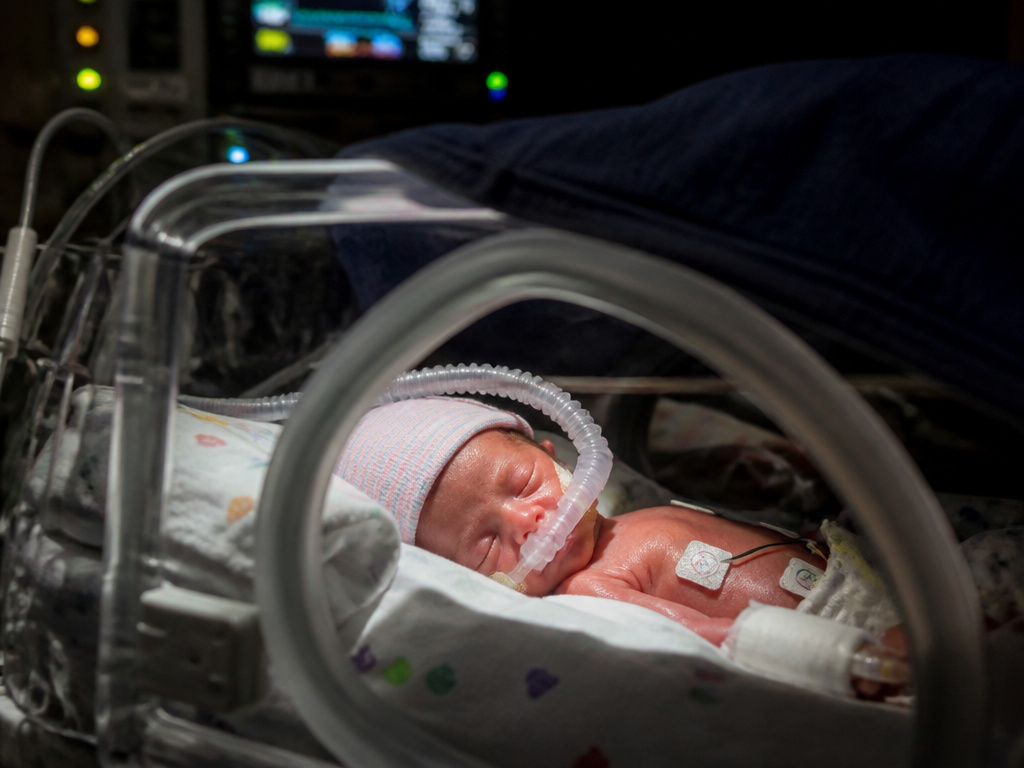
Your preemie’s brain is wired for sleep, but the NICU is wired for medical survival. This creates a fundamental conflict. The very environment designed to save your baby’s life is inherently hostile to the sleep their brain needs to develop.
The core problem is the lack of rhythmic, predictable cues. In the womb, the environment is dark, muffled, and gently rocked by your movements. The NICU is the opposite: constant bright light, unpredictable sharp noises from monitors and alarms, and frequent necessary medical interventions. This sensory chaos directly opposes the development of a circadian rhythm.
A landmark study registered at ClinicalTrials.gov (NCT01513226) found something surprising: very preterm infants exposed to cycled light (12 hours on, 12 hours off) in the NICU showed longer nighttime sleep duration and were the least active compared to those in constant dim light. Their brains latched onto the light-dark cue and used it to organize sleep. This is a powerful, non-pharmacological intervention that has a real impact.
Sound is the other major offender. The NICU developmental care sleep standards are explicit: sound changes as small as 5-10 dB can increase awakenings threefold. An incubator doesn’t block sound; it can even amplify it, like tapping on a fish tank. Conversations, laughter, or closing cabinet doors right next to the isolette create acoustic shocks that fracture fragile sleep cycles.
Where this goes sideways: Assuming “asleep” means “undisturbable.” Handling a preemie during Active Sleep leads to more frequent oxygen desaturations than handling during Quiet Sleep or wakefulness. Timing care for sleep states matters.
The takeaway is that the NICU’s primary mission is physiological stability, not neurodevelopmental optimization. The sleep disruption is a side effect of life-saving care.This is why the meta-analysis of non-pharmacological sleep interventions is so important, it proves that layering in simple, protective practices on top of medical care significantly improves sleep outcomes.
What You Can Do: From NICU Standards to Home
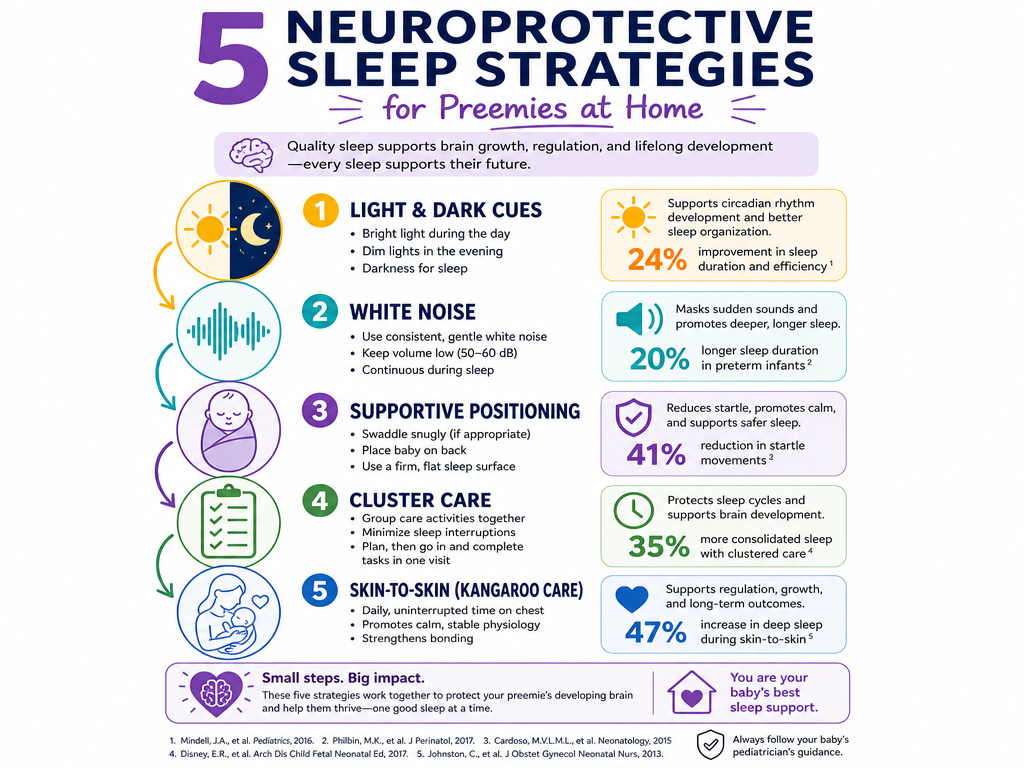
The good news is that the most effective strategies used in progressive NICUs are entirely portable to your home. You don’t need medical equipment; you need to apply the principles of a neuroprotective environment.
1. Master Light and Darkness. This is your single most powerful tool once your baby reaches around 32 weeks corrected age. Your home has a natural day-night cycle, use it. During daytime sleeps, don’t black out the room entirely, but keep it reasonably dim. For nighttime, make it pitch black. Use blackout curtains on the windows and cover any blinking electronic lights. This clear signal helps their pineal gland start producing melatonin, the sleep hormone. This practice is directly supported by the government guide on preterm infant sleep, which notes benefits for sleep organization and weight gain.
2. Control Sound, Don’t Eliminate It. You will drive yourself mad trying to maintain tomb-like silence. The goal is to avoid sudden, sharp noises. Use a continuous, low-volume white noise machine. This doesn’t just mask jarring sounds like a door slamming; it also mimics the constant, whooshing sound of blood flow they heard in the womb. It’s a familiar, soothing backdrop that makes other noises less salient.
3. Use Supported Positioning. Swaddling isn’t just for calming. For a preemie, it’s a boundary-holding tool that recreates the snug containment of the womb, reducing random startles that jerk them out of sleep. When they graduate from swaddling, consider a safe sleep sack on a firm, flat infant mattress. Avoid loose blankets, pillows, or positioners in the crib. The supine (back) sleep position is non-negotiable for reducing SIDS risk, a point emphasized for preemies in all safety guidelines.
4. Cluster Care & Watch for Sleep Cues. You can’t avoid waking them for feeds, but you can be strategic. “Cluster care” means grouping necessary interventions (diaper change, feed, temperature check) together to maximize the undisturbed sleep window in between. Learn their pre-sleep signals: staring into space, drooping eyelids, turning away from stimulation. Intervene before they become overtly fussy. Putting a baby down who is already in a quiet, drowsy state is more successful than waiting for them to cry themselves to exhaustion.
**5. Embrace Skin-to-Skin (Kangaroo Care).This is a profound sleep regulator. Your heartbeat, breathing rhythm, and body temperature are the most biologically perfect soothing system possible.Studies in the PMC review of neonatal sleep-EEG note that skin-to-skin contact can stabilize heart rate, improve oxygen saturation, and facilitate the transition into deeper, more organized sleep. It’s a direct transfer of your own circadian rhythm to your baby.
Your nursery setup is your ally. A firm, well-fitting crib mattress is the foundation. Pair it with snug, fitted crib sheets, no loose fabric. For cozy comfort, select soft, breathable baby blankets for supervised awake time or use muslin swaddle blankets for safe sleep. If you’re room-sharing, a bedside bassinet with a breathable side can make night feeds easier without the risks of bed-sharing.
When to Be Concerned About Preemie Sleep Patterns
Most preemie sleep quirks are just that, quirks of immaturity. But sleep can also be a canary in the coal mine for neurological or medical issues. You’re not looking for a single bad night. You’re looking for persistent patterns that deviate from your baby’s own baseline.
Be alert if you observe: – Extreme difficulty consolidating sleep well past their due date. While preemies are noisy, active sleepers, they should gradually develop longer stretches (3-4 hours) of sustained sleep. – Breathing irregularities during sleep that worry you, long pauses (apnea), persistent grunting, or a blue tinge around the lips. (Note: Periodic breathing, short pauses followed by a burst of faster breaths, is normal in preemies). – An inability to be consoled or to achieve any calm, drowsy state, leading to chronic sleep refusal and extreme fussiness. – A dramatic regression or change in their sleep patterns that coincides with illness or a new medication.
The PubMed study on preterm sleep-wake rhythms and other research connect disorganized sleep with later developmental challenges. Your pediatrician or a neonatal follow-up clinic should take your sleep observations seriously. They are a valid, functional measure of your child’s well-being. Don’t let anyone dismiss your concerns with “all babies are different.” You know your baby’s pattern best.
Frequently Asked Questions
Do preemie babies sleep more than full-term babies?
Yes, significantly more. Preterm infants can spend up to 90% of their day asleep in the early weeks. However, this sleep is qualitatively different, lighter, more fragmented, and dominated by Active Sleep, which is essential for brain development but not as restorative as the deep Quiet Sleep term babies achieve more easily.
When do preemies start sleeping through the night?
“Through the night” for a preemie means a 5-6 hour stretch, and it’s based on their corrected age (their age from their due date), not their birth age. Most preemies begin to consolidate sleep into longer nighttime stretches around 3-6 months corrected age. Reaching a full 10-12 hour night often takes until 6-9 months corrected age or longer.
Why is my preemie such a noisy, active sleeper?
The grunts, squeaks, and jerky movements are hallmarks of Active Sleep (AS). Since preemies spend so much of their sleep cycle in AS, they are naturally noisier. Their immature nervous system also means they have less muscle tone inhibition during sleep, so movements are more pronounced. This is usually normal, but it can be startling.
How can I help my preemie develop a better sleep schedule?
Focus on environmental cues before sleep training. Implement a strict, dark/light cycle. Use white noise consistently. Swaddle if they still have a startle reflex. Feed upon waking, not right before sleep, to avoid a feed-to-sleep association. Be patient and use their corrected age as your guide for expectations. The sleep strategies that work for a term newborn often don’t apply until your preemie reaches that same developmental point.
The Bottom Line
Preemie babies do sleep more, but the “more” is a symptom of their brain’s intense developmental workload and its vulnerability to disruption. Your role is to protect the sleep they are biologically driven to get.
The science is clear: their sleep architecture is different, the NICU environment disrupts it, and specific, evidence-based interventions can help. Start with darkness and rhythmic white noise. Use swaddling and supported positioning. Value skin-to-skin contact as a therapeutic tool, not just a cuddle. And watch their sleep patterns as a meaningful report on their neurological health.
Your goal is to create a bridge between the high-stimulus world they were born into and the rhythmic, contained world their developing brain expects. By doing so, you’re not just helping them sleep. You’re supporting the very architecture of their growing mind.
