
Do Newborns Need to Be Swaddled? Sleep Safety and Evidence
This post contains affiliate links. As an Amazon Associate we earn from qualifying purchases.
No, newborns do not need to be swaddled to sleep. The American Academy of Pediatrics (AAP) states there is no evidence that swaddling reduces the risk of SIDS. Swaddling is a parental choice for soothing, not a safety requirement. If used, it must follow strict rules: always place the baby on their back, ensure the swaddle is snug at the chest but loose at the hips, and stop completely at the first sign of attempted rolling, which can occur as early as 2-3 months.
That statement from the AAP reframes the entire conversation. Swaddling isn’t a protective layer against sleep-related death; it’s a comfort technique with a very specific set of safety guardrails that, if ignored, can increase danger.
What follows is a breakdown of the official guidelines, the peer-reviewed finding about “swaddle-naive” infants that most parents never hear, and the mechanical reasons why a safe swaddle looks nothing like a tight cocoon. By the end, you’ll know exactly when to swaddle, when to stop, and what to use instead.
Key Takeaways
- Swaddling is not a SIDS-prevention strategy. The AAP and other public health bodies are clear: there is no evidence it reduces risk.
- The biggest documented danger is placing a swaddled infant on their side or stomach. This doubles the risk of SIDS.
- Infants who are not accustomed to swaddling, termed “swaddle-naive”, may face an increased risk of SIDS because the practice can depress their natural arousal mechanisms during sleep.
- Weighted swaddles or sleep sacks are not recommended by any safety authority due to a lack of safety studies and potential breathing impediment.
- The absolute stop sign is any sign of rolling. Swaddling must cease immediately, which often happens between 2 and 4 months of age.
The Short Answer (And What the Guidelines Actually Say)
The question isn’t really about need. It’s about risk versus a perceived benefit. Major health authorities have converged on a consistent, evidence-based position.
The American Academy of Pediatrics’ 2022 update on safe sleep states there is no evidence to recommend swaddling as a strategy to reduce the risk of SIDS. If parents choose to swaddle, infants must always be placed on their back, and swaddling should stop when the baby shows any signs of attempting to roll.
This is the technical core. The guideline doesn’t ban swaddling, but it strips away the myth that it’s a safety measure. The benefit is purely behavioral: it may soothe the startle reflex and help some babies sleep longer stretches. The AAP safe sleep 2022 update is firm on the conditions because the risks are physical and measurable.
Other bodies echo this. The Canadian Public Health agency notes swaddled infants have an increased risk of death if they roll. The Michigan Department of Health states flatly that weighted swaddles are not recommended. The consensus isn’t against swaddling; it’s for extremely careful, rule-bound use.
The Swaddle-Naive Risk: A Critical Detail Most Guides Miss
Here’s the piece of research that changes the calculation. A 2022 systematic review in Frontiers in Pediatrics dug into how swaddling affects infant sleep and arousal. Its conclusion isn’t about all babies, it’s about a specific group.
Where this goes sideways: Introducing swaddling to an infant who has never been swaddled before. The Frontiers in Pediatrics swaddling review found that for infants “naive to the intervention,” swaddling creates conditions unfavorable to arousability and may increase the risk of Sudden Unexpected Infant Death (SUDI).
The mechanism is physiological. Swaddling promotes longer periods of quiet sleep and reduces spontaneous arousals. For a baby whose system is used to this, the change might be minimal. For a baby experiencing it for the first time, that dampened arousal response could be problematic if they encounter a breathing difficulty. The review explicitly calls for more research on this population.
This means the common advice to “try swaddling” at 2 months to combat a sleep regression carries an unknown variable. The swaddling effect on infant sleep isn’t neutral; it’s a significant modulator of sleep architecture. Starting it later isn’t inherently wrong, but it should be a conscious decision, not a default troubleshooting step.
How to Swaddle Safely (If You Choose To)
If you decide to swaddle from birth or early on, the rules are non-negotiable. They exist to mitigate the known risks of hip dysplasia, overheating, and restricted breathing.
The Five Rules of Safe Swaddling:
- Back is Best, Always. This is the single most important rule. A swaddled baby placed on their side or stomach cannot reposition themselves if they struggle to breathe. The risk of SIDS doubles in this scenario.
- Snug Chest, Loose Hips. The swaddle should be secure around the arms and chest to prevent the blanket from loosening and covering the face. However, the legs must have ample room to bend up and out at the hips. A tight, straight-legged swaddle can stress the hip joints and is a risk factor for developmental dysplasia.
- Use Appropriate Materials. A lightweight, breathable cotton or muslin swaddle blanket is ideal. Avoid heavy fabrics like fleece, which can lead to overheating, a known SIDS risk factor. For the right fabric choices, our guide on the best swaddle fabrics details breathability and weave.
- Stop at the First Sign of Rolling. This is not a suggestion. The moment your baby shows signs of trying to roll over (often seen as rocking onto their side during tummy time), the swaddle must be retired immediately. This can happen as early as 8-10 weeks. A swaddled baby who rolls onto their stomach is in extreme danger.
- Never Use Weighted Products. Weighted sleep sacks or swaddles are explicitly not recommended by the AAP and state health departments. There are no safety studies proving their safety, and the added weight could make it harder for an infant to breathe or move their chest.
| Safe Practice | Why It Matters | Consequence of Skipping It |
|---|---|---|
| Place on back only | Allows airway to remain clear; baby can turn head if needed. | Doubles SIDS risk if placed on side/stomach; restricts movement if face-down. |
| Loose hip & knee room | Permits healthy hip joint development in the “frog-leg” position. | Can contribute to or exacerbate hip dysplasia, potentially requiring bracing or surgery. |
| Lightweight, breathable fabric | Prevents overheating, a known SIDS risk factor. | Baby overheats, becomes fussy, and faces elevated SIDS risk. |
| Stop at rolling signs | Ensures baby can use arms to push up and reposition if they roll. | Traps baby face-down with arms immobilized; risk of suffocation is severe and immediate. |
| Avoid hats & weighted products | Prevents overheating and unrestricted chest movement for breathing. | Hats indoors raise core temperature; weighted items may impede chest wall expansion. |
What to Use Instead of a Traditional Swaddle

When you stop swaddling, whether by choice or because your baby is rolling, you need a next step. The goal is to maintain sleep cues while ensuring safety.
The Transition Toolkit:
- Sleep Sacks (Wearable Blankets): This is the default safest option. A sleep sack keeps a baby warm without any loose fabric. Their arms are free, allowing them to move, self-soothe, and push up if they roll. Look for a TOG rating appropriate for your room temperature.
- Swaddle Transition Products: These are swaddle products designed to phase out the swaddle. They typically allow one arm out, then both arms out, while maintaining the snug torso feel. Products like the Zipadee-Zip or Merlin’s Magic Sleepsuit are popular, but always ensure any suit is not too bulky and the baby cannot overheat.
- A Safe Sleep Environment: Ultimately, the best tool is a bare, firm mattress with a fitted sheet in a crib or bassinet that meets current essential baby bedding safety standards. Room-sharing without bed-sharing for at least the first 6 months is proven to reduce SIDS risk by up to 50%.
Easy to miss: The arms-out transition can cause a 3-4 night sleep disruption as the baby adjusts to the Moro (startle) reflex. That’s normal. Stick with it for a full week before trying another method.
Swaddling vs. Not Swaddling: A Decision Matrix
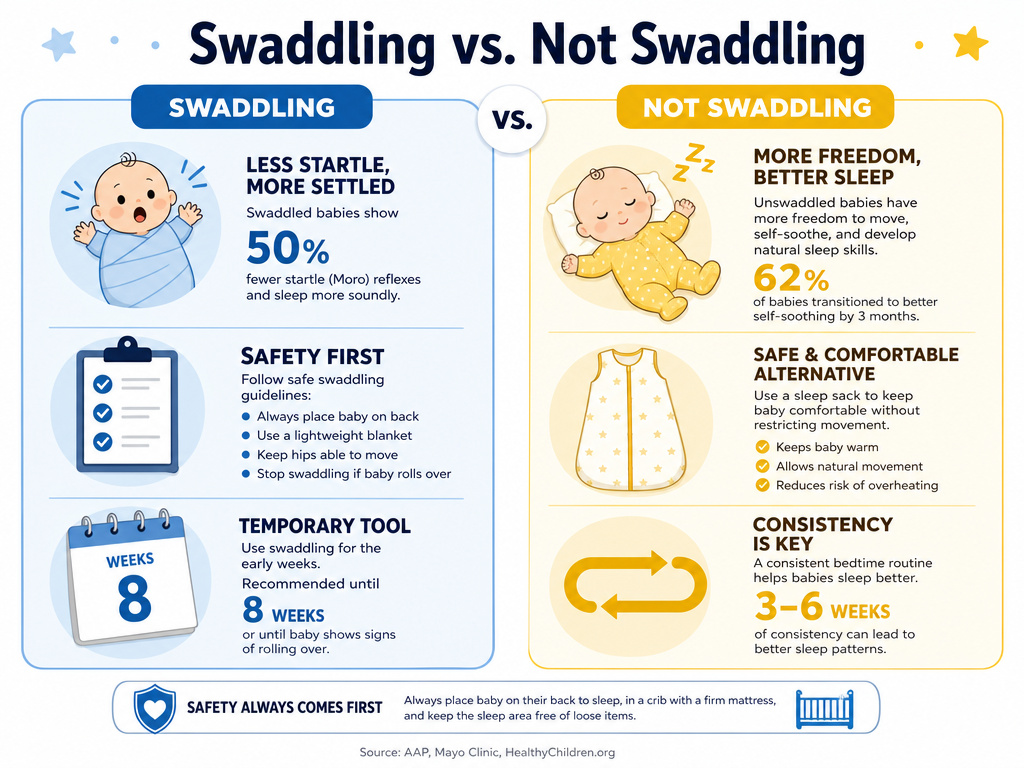
This isn’t a one-size-fits-all answer. Your baby’s temperament, your family’s routine, and your comfort level with the rules all play a role.
| Consider Swaddling If… | Consider Skipping Swaddling If… |
|---|---|
| Your newborn has a very strong startle reflex that consistently wakes them. | Your baby settles easily to sleep without being wrapped. |
| You are confident you can follow all safety rules (back-only, loose hips, stop at rolling). | The idea of the “swaddle-naive” risk gives you pause. |
| You plan to stop swaddling cold-turkey at 8 weeks, before rolling begins. | You want to avoid a sleep transition later. |
| You have access to good-quality, breathable stretchy swaddles that make a safe hip position easy. | You prefer using a sleep sack from day one for consistency. |
The Harvard Medical School swaddling guide puts it plainly: “Babies don’t have to be swaddled. If your baby is happy without swaddling, don’t bother.” The effort and risk mitigation are only worth it if the soothing benefit is clear and substantial for your child.
Frequently Asked Questions
Is swaddling necessary for all newborns?
No, it is not necessary. Swaddling is a soothing technique, not a biological or safety need. Many newborns sleep soundly without ever being swaddled.
When should I stop swaddling my baby?
You must stop the very first time you see your baby attempt to roll from back to side or stomach. Do not wait for a full roll. This sign typically appears between 2 and 4 months of age. Continuing to swaddle a rolling baby creates an immediate and severe suffocation hazard.
Are weighted swaddles or sleep sacks safe?
No. The AAP and state health authorities like Michigan MDHHS explicitly state that weighted swaddles, weighted sleep sacks, and other weighted items are not recommended. There are no safety studies proving their safety, and the weight could impede a baby’s ability to breathe properly.
Can swaddling cause hip problems?
Yes, if done incorrectly. A swaddle that holds the legs straight and tight together can stress the hip joints and contribute to developmental dysplasia of the hips (DDH). A safe swaddle always allows the hips and knees to bend freely with room for the legs to fall into a natural “frog-leg” position.
What if my baby only sleeps when swaddled?
This is common, but the safety rules are absolute. When it’s time to stop swaddling due to rolling, you must transition. Try a one-arm-out method for a few nights, then move to a sleeveless sleep sack. There will likely be a few rough nights of adjustment, but your baby will learn to sleep without the swaddle. Their safety is worth the temporary disruption.
The Bottom Line
Swaddling is a tool, not a mandate. The official guidelines remove it from the safety column and place it firmly in the parental-choice column, surrounded by specific warnings.
If you use it, the rules are strict: back only, loose hips, lightweight fabric, and an immediate halt at the first hint of rolling. Be particularly mindful of the evidence suggesting a unique risk for babies trying it for the first time after the newborn period.
For many families, starting with and sticking to a safe baby blanket or sleep sack is the simplest, safest path. It avoids the transition later and aligns with the fundamental safe sleep principle of an unencumbered sleep space. Your goal isn’t a perfectly wrapped baby; it’s a safe, rested one.
