
Can a Newborn Sleep in a Bouncer? The 7-Degree Rule & Risks
This post contains affiliate links. As an Amazon Associate we earn from qualifying purchases.
No. A newborn cannot and should not sleep in a bouncer, rocker, or swing. These inclined products are not safe for sleep, supervised or unsupervised. The only safe sleep environment for an infant is a firm, flat surface in a certified crib, bassinet, or play yard. An inclined surface exceeding 7 degrees—which includes every bouncer—creates a risk of positional asphyxia, where a baby’s chin can drop to their chest and block their airway.
That answer comes straight from the mandatory safety standard ASTM F2167-22 and global health authorities. The distinction isn’t minor. Between 2006 and 2015, the U.S. Consumer Product Safety Commission (CPSC) tracked 277 incidents with bouncers, including 11 fatalities. The risk of injury showed a statistically significant upward trend.
This guide breaks down the three specific hazards, explains the warning labels you must follow, and gives you a clear alternative for when your baby dozes off. You’ll see why the rules exist and what to do instead.
Key Takeaways
- The 7-degree rule is absolute: Any sleep surface with an incline over 7 degrees is unsafe. All bouncers exceed this.
- Restraints are not a sleep solution: The CPSC mandates warnings to use restraints “even if baby falls asleep” to prevent falls, not to endorse sleep.
- Suffocation is a silent, fast risk: A baby’s head can tilt forward in an inclined seat, causing chin-to-chest positioning that blocks airflow within minutes.
- Stop use at the first sign of mobility: The manufacturer’s manual, like the one for the Chicco E-Motion Glider Bouncer, says to stop when a baby tries to sit up, reaches 20 lbs, or at around 9 months.
- The safe transfer is non-negotiable: If a baby falls asleep in a bouncer, move them to a firm, flat sleep surface immediately.
The Simple, Non-Negotiable Answer
The question isn’t about comfort or convenience. It’s about physics and physiology. A newborn’s airway is about the diameter of a drinking straw. Their head is large and heavy relative to their neck muscles.
An inclined surface or product exceeding 7 degrees is not considered safe for infant sleep and does not meet mandatory safety standards for infant sleep products. This statement from Red Nose Australia, a leading safe sleep authority, draws a bright line.
All bouncers, by design, have an incline greater than 7 degrees to facilitate the bouncing motion. This angle, combined with the soft, padded fabric, allows a baby’s head to slump forward. When the chin presses against the chest, the trachea can kink or close. This is positional asphyxia. It can happen without a sound or struggle.
The U.S. Regulatory framework agrees. The mandatory standard for infant bouncer seats, ASTM F2167-22, which took effect in December 2022, requires explicit warnings that the product is not safe for sleep. The language is not a suggestion.
The Three Physical Hazards (And The Data Behind Them)
Safety rules are written after studying what goes wrong. The CPSC’s analysis of incident data from 2006 to 2015 identified three primary hazard patterns: falls, suffocation, and tip-overs. Each has a specific mechanism.
1. The Fall Hazard: Unrestrained and Elevated
The most immediate danger is a fall. This happens in two ways: a baby wiggling out of an unrestrained seat, or a caregiver placing the bouncer on an elevated surface like a table or bed.
Where this goes sideways: Assuming the bouncer is stable on a sofa. The soft cushion creates an uneven base. One shift in weight and the entire unit can topple over, with the baby strapped inside.
The data includes a fatality of a 4-month-old who suffered a skull fracture after a bouncer fell from a table. This is why the standard requires a specific fall hazard warning label placed where a caregiver will see it.
| Hazard Scenario | Common Cause | Likely Injury |
|---|---|---|
| Fall from bouncer | Not using restraints, or placing bouncer on table/sofa | Head injury, skull fracture |
| Tip-over on soft surface | Using bouncer on a bed, pillow, or couch | Suffocation, impact injuries |
| Strangulation | Bouncer placed near window blind cords | Loss of airway |
The fix is simple and dual-purpose. First, always use the safety harness, snapped snugly. Second, only use the bouncer on the floor, away from stairs.
2. The Suffocation Hazard: Chin-to-Chest and Soft Surfaces
This is the silent, less obvious risk. It occurs either from the baby’s position in the seat or from the bouncer tipping onto a soft surface.
In an inclined seat, a sleeping baby’s head can fall forward. Their weak neck muscles can’t lift it back. The airway narrows or closes. On a soft surface like an adult bed, the bouncer’s legs can sink in, causing the seat to tilt sideways and press the baby’s face into the padded fabric or mattress.
The CPSC’s review noted that some manufacturers’ marketing historically implied bouncers were for sleep, creating a dangerous misconception. The updated 2022 standard explicitly requires warnings to counter this.
3. The Tip-Over Hazard: Movement and Design
As a baby grows and becomes more active, their bouncing can shift the center of gravity. Not all bouncers have a wide, stable base. A vigorous kick or rock can cause the entire unit to tip over, especially if it’s on a hard floor. This is why weight and developmental limits exist.
Decoding the Warning Labels & Manuals
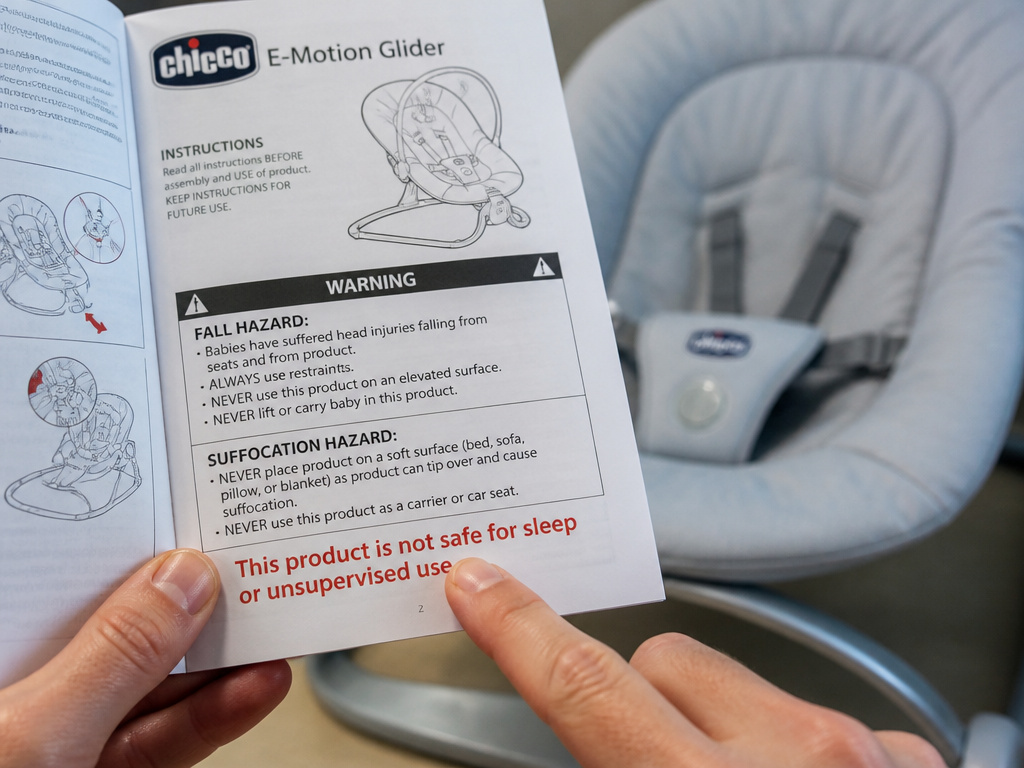
Manufacturer instructions are legal documents built around the ASTM standard. Reading them tells you exactly what the company knows can go wrong. Let’s take the Chicco E-Motion Glider Bouncer manual as a real-world example.
The manual states three clear stop conditions: 1. When baby starts trying to sit up. 2. When baby attempts to climb out (approximately 9 months). 3. When baby reaches 20 lbs.
Whichever comes first.
It also contains these specific, legally-mandated warnings: – “NEVER use on a bed, sofa, cushion, or other soft surface.” – “This product is not safe for sleep or unsupervised use.” – “If baby falls asleep, remove baby as soon as possible and place baby on a firm, flat sleep surface such as a crib or bassinet.“
Notice the phrase “as soon as possible.” It doesn’t say “let them finish their nap.” The instruction is immediate transfer. This language is a direct result of the CPSC’s 2017 rule, which insisted that warnings must address the reality that babies will fall asleep in these products.
The part nobody mentions: The CPSC specifically argued against manufacturer pushback to include “even if baby falls asleep” in restraint warnings. Their reasoning? Infants sleep most of the time, and it’s counterintuitive to caregivers that a soothing product is unsafe for sleep. The warning is there because the hazard is real, not theoretical.
What To Do When Your Baby Falls Asleep in the Bouncer
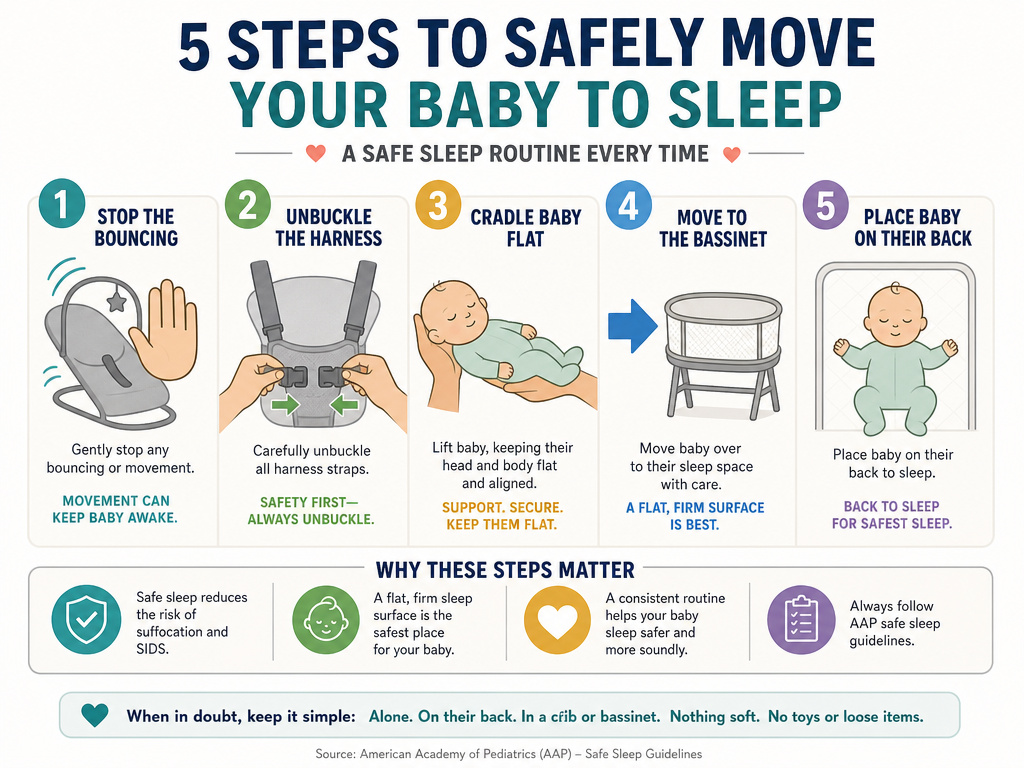
You’re watching them play, and their eyelids get heavy. Dozing happens. Here is the safe, step-by-step response.
- Pause the motion immediately. Stop bouncing or gliding.
- Unbuckle the harness carefully. Support the baby’s head and back with one hand.
- Lift them out. Keep them in a cradled, flat position.
- Transfer directly to a safe sleep space. This means a firm, flat mattress in a bedside bassinet, a certified crib, or a portable play yard. The mattress should be covered only by a fitted sheet.
- Place them on their back. Ensure the sleep space is free of pillows, loose blankets, stuffed animals, or crib bumpers.
This entire process should take less than a minute. The goal is to minimize the time they spend asleep in the inclined position.
Safe Bouncer Use: The Rules for Awake Time
For supervised, awake play, bouncers can be a helpful tool. Follow these rules to mitigate risk.
- Floor only, always. The only safe surface is the floor. Not a table, counter, bed, or sofa.
- Harness every single time. Buckle it snugly. You should only be able to fit one or two fingers between the strap and your baby’s chest.
- Stay within arm’s reach and sight. This is supervised use, not a babysitter. You need to be close enough to touch them.
- Respect the time limit. The World Health Organization advises against young children sitting in the same position for more than one hour. Brands like BabyBjörn echo this. Keep bouncer sessions short.
- Inspect before use. Check for loose screws, frayed fabric, or broken parts. Don’t use it if anything is damaged.
- Stop at the first limit. The moment your baby shows signs of trying to sit up or reaches the weight limit, the bouncer is retired.
The Safe Alternatives for Newborn Sleep
When you need a safe place for your newborn to sleep, the options are clear and regulated. These products are designed to meet strict crib safety standards for a flat, firm sleep surface.
| Product Type | Best For | Key Safety Feature |
|---|---|---|
| Bassinets & Cribs | Primary sleep space | Firm, flat mattress with no gaps at the sides |
| Bedside Sleepers | Room-sharing convenience | Attachable side that lowers for easy access, with a firm, flat mattress |
| Portable Play Yards | Travel or multi-room use | Included mattress that is firm and fits snugly |
Your primary choice should be a crib or a bassinet that meets current CPSC safety standards. For keeping your baby close at night, a bedside sleeper that attaches securely to your adult bed provides a separate, safe surface. For a cozy, contained sleep environment, a wearable blanket (sleep sack) is safer than any loose blanket in a crib.
The common thread is a flat, firm surface. This allows for proper airflow and prevents the airway obstruction that an incline creates.
Frequently Asked Questions
Can a newborn nap in a bouncer if I’m watching them?
No. Supervision does not mitigate the risk of positional asphyxia from the incline. A baby can stop breathing in a seated position without making a sound or appearing to struggle. Safe sleep requires both a safe environment and supervision. The bouncer fails the environment test.
What if my baby only falls asleep in the bouncer?
This is a common pattern, as the motion is soothing. The solution is to use the bouncer for drowsy time, not sleep time. Gently bounce them until they are calm and sleepy, then transfer them to their flat crib or bedside bassinet while they are still awake. This helps them associate the flat surface with falling asleep.
Are some bouncers safer than others?
All bouncers sold in the U.S. After December 19, 2022, must comply with ASTM F2167-22. This standard improves warnings but does not make the product safe for sleep. The inherent hazard is the inclined design, which is present in all bouncers. A “safer” bouncer is one you use strictly by the rules: on the floor, with a harness, for short awake periods.
How is a bouncer different from a car seat? Can’t they sleep there?
Car seats are designed for transportation, not prolonged sleep. They also carry a risk of positional asphyxia. The American Academy of Pediatrics states that when the trip is over, the baby should be moved to a flat sleep surface. The key difference is necessity—a car seat is essential for safe travel. A bouncer is not essential for sleep; a crib is.
What should I look for in a safe sleep product?
Look for certification that it meets CPSC standards for a full-size crib, bassinet, or play yard. The product should have a firm, flat mattress with a snug-fitting sheet. It should have no drop sides, no soft bedding, and no inclined surfaces. Products like a crib mattress designed for newborns will emphasize firmness over plushness.
Before You Go
The bottom line is non-negotiable. A bouncer’s design—an inclined, padded seat—is intrinsically unsafe for infant sleep. The standards, the data, and the tragic incidents all point to the same conclusion.
Use the bouncer for what it is: a short-term activity seat for an awake, supervised baby who is not yet trying to sit up. The moment they drift off, your next move is fixed. Lift them out and place them on their back in a crib, bassinet, or play yard. Their safe sleep space is flat, firm, and free of anything else. That’s the rule, and it’s the one that keeps them breathing.
