
Pack and Plays for Infant Sleep: The Definitive Safety Guide
This post contains affiliate links. As an Amazon Associate we earn from qualifying purchases.
Infants can sleep in a Pack ‘n Play, but only under one specific condition: you must use the original, thin mattress pad that came with it. The official Graco manual forbids adding any other mattress, pillow, comforter, or padding due to a direct suffocation hazard from gaps and soft bedding. This isn’t a recommendation—it’s the design requirement that makes the flexible-sided playard safe for sleep.
That single rule is the entire safety system. A Pack ‘n Play is not a crib. Its sides are fabric, not rigid wood or metal. The original mattress pad is less than one inch thick—27 by 39 inches—for a reason. It leaves no space for a baby’s head to get trapped between the pad and the flexible side wall. Swap it for a thicker, softer aftermarket mattress, and you’ve built a trap. The Consumer Product Safety Commission (CPSC) has issued multiple recalls and warnings for these products because they violate federal crib mattress standards and have been linked to deaths.
What follows is the breakdown of that rule: the physical why, the federal standards that back it, and the specific aftermarket brands you must avoid. By the end, you’ll know exactly how to set up a Pack ‘n Play for safe sleep and why cutting corners here isn’t an option.
Key Takeaways
- Use ONLY the original Graco mattress pad (27″x39″, <1″ thick). Adding any other mattress creates a gap that can trap an infant’s head, leading to suffocation.
- Aftermarket “Pack and Play” mattresses from brands like DODO Baby House, Modera, and Beianpp have been recalled or warned against by the CPSC for violating safety standards.
- A Pack ‘n Play is federally regulated as a play yard under 16 CFR part 1221, which references ASTM standards for safety; its flexible-side design demands the specific original mattress.
- The CPSC’s Infant Sleep Product Rule, effective June 2022, mandates that all products marketed for infant sleep meet strict safety standards, further governing how playards are used.
- For overnight sleep in a fixed location, a certified crib with a firm, flat crib mattress is the gold standard; a playard is best for supervised naps or travel.
The One Mattress Rule and Why It’s Non-Negotiable
The Graco owner’s manual is unambiguous. It uses the words “NEVER add a mattress” and “Use ONLY mattress pad provided by Graco.This is the operational instruction for a device with a critical design difference from a crib, not corporate liability speak.
Unlike cribs that have rigid sides, the playard has flexible sides. As a result, the playard mattress pad is specially designed to prevent suffocation. The playard mattress pad has a solid base, a certain length and width, and is less than one inch thick in order to meet safety standards. Using a thicker or a different sized mattress pad may allow a child’s head to get between mattress pad and the side of the playard causing suffocation.
The mechanism is simple physics. A baby who rolls or presses against the flexible mesh side can deform it. If there’s a gap between the mattress and the side, their head can slide into that space. A rigid crib side prevents this deformation entirely. The original less-than-one-inch-thick pad is sized to eliminate the gap. A thicker, plusher aftermarket mattress reintroduces it. The risk isn’t theoretical—it’s a documented cause of infant suffocation.
This is why searching for a best pack and play mattress is a dangerous path. There is no “best” third-party option. The only suitable mattress is the one it was sold with. If that pad is lost or damaged, you contact Graco for a direct replacement, not Amazon.
Where this goes sideways: Using a “more comfortable” aftermarket mattress. The gap it creates might be only an inch. That’s enough. An infant can suffocate in that space in under a minute, unable to lift or turn their head.
A Pack ‘n Play vs. A Crib: What’s Actually Different?
Understanding the difference is the key to using each product correctly. They are governed by different federal safety standards for a reason.
A full-size crib is regulated under 16 CFR part 1219. It has rigid, fixed sides and slats spaced precisely to prevent head entrapment. It is designed for long-term, unsupervised sleep. Its mattress is firm and flat, but the crib’s safety does not depend on the mattress’s thickness matching the interior perfectly, because the sides don’t move.
A playard, like a Pack ‘n Play, is regulated under 16 CFR part 1221. Its defining feature is its portable, folding frame with soft, flexible side walls. This flexibility is the convenience—and the hazard. The entire safety system is engineered around the specific interaction between that flexible side and the one approved mattress pad.
| Feature | Crib | Pack ‘n Play (Playard) |
|---|---|---|
| Side Material | Rigid wood/metal | Flexible fabric/mesh |
| Governing Standard | 16 CFR part 1219 | 16 CFR part 1221 |
| Mattress Dependency | Low. Mattress must be firm and fit with <1″ gap. | Critical. Must use OEM pad to prevent gap. |
| Primary Use Case | Permanent, unsupervised overnight sleep. | Portable, temporary sleep; travel; supervised naps. |
| Safety Mechanism | Rigid containment, slat spacing. | Integrated pad-and-wall system. |
This distinction matters when choosing a primary sleep space. For a nursery, a crib with a high-quality, firm infant mattress is the benchmark. A playard is fantastic for weekends at grandma’s or as a secure nap spot in the living room. It is not a like-for-like substitute in terms of long-term durability or the margin of safety for unattended sleep.
The Federal Backstop: Recalls, Warnings, and the Sleep Product Rule
Federal regulators enforce the “use only the original mattress” rule, tracking the injuries and deaths that occur when it’s broken. The CPSC has taken direct action against aftermarket companies selling non-compliant mattresses.
- DODO Baby House (Model YX-04): Recalled in November 2023. These mattresses violated the federal safety regulation for crib mattresses, including thickness requirements and missing warning labels.
- Modera “Pack N Play” Mattresses: Recalled in October 2025. Approximately 15,000 units were recalled because they could create an entrapment hazard by not fitting properly in certain play yards.
- Beianpp “Pack and Play” Mattresses: In July 2025, the CPSC warned consumers to immediately stop using these mattresses. They failed to meet mandatory thickness requirements and did not identify which play yards they were compatible with.
These are not isolated incidents. They represent a category of product that fundamentally cannot meet the mandatory crib mattress standards referenced in the playard rules because they are designed for a different structure.
Furthermore, the CPSC’s Infant Sleep Product Rule (effective June 23, 2022) casts a wider net. It defines an infant sleep product as anything “marketed or intended to provide a sleeping accommodation for an infant up to 5 months of age.” This rule mandates that all such products, if not covered by another standard like cribs or play yards, must meet rigorous safety requirements for side height, stability, and sleep surface angle. It underscores that any product sold for infant sleep is taken seriously by regulators. You can read the details in the CPSC infant sleep product rule document.
The takeaway is blunt. The government, the manufacturer, and the physics all agree. Deviating from the one-mattress rule introduces a known, lethal hazard.
Setting Up a Pack ‘n Play for Safe Infant Sleep
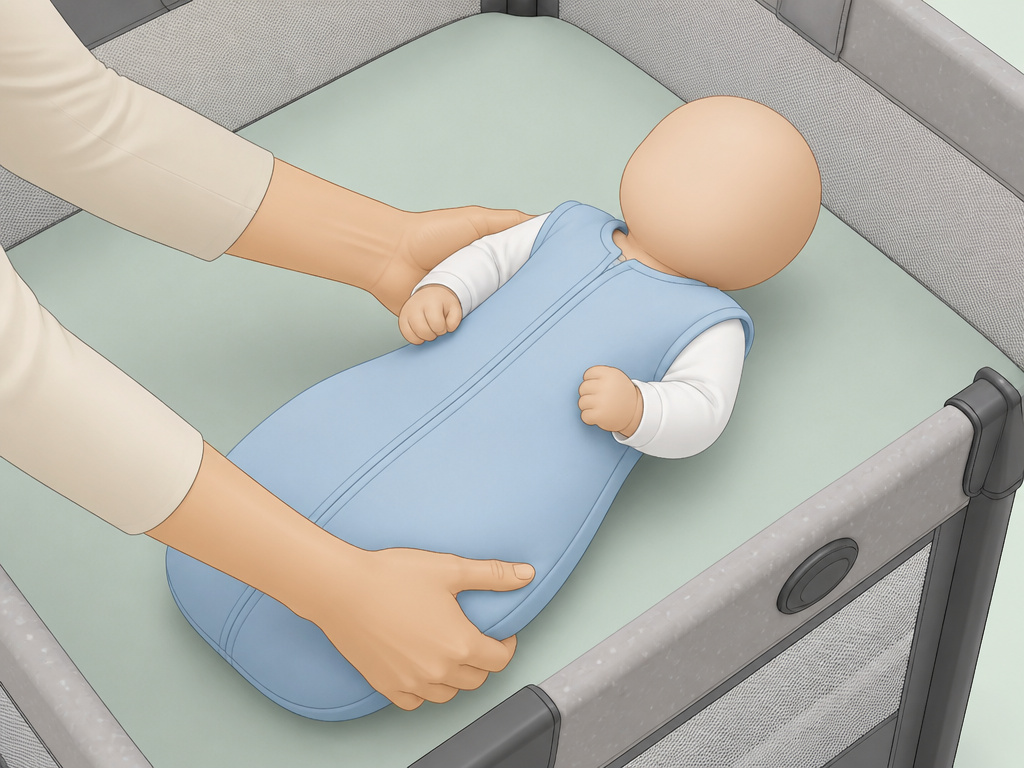
If you’re using the correct mattress pad, the rest of the setup is about eliminating all other risks. Follow this sequence every time.
- Assemble the playard completely on a flat, stable floor. Ensure all latches are fully engaged and the frame is locked. Never place it on a table, bed, or couch where it can tip or fall.
- Insert ONLY the original Graco mattress pad. Ensure it is flat and smooth, with no wrinkles in the fabric cover. The pad’s solid base should be facing down.
- Use a fitted sheet ONLY if it is designed specifically for your Graco model. The manual states to use only the sheet provided by Graco. Aftermarket sheets that are too loose can bunch up and become a suffocation hazard. If you don’t have the official sheet, it’s safer to use no sheet at all on the firm, wipeable pad.
- Dress the infant in a sleep sack or wearable blanket. Never add loose blankets, quilts, pillows, stuffed animals, or crib bumpers to the sleep space. These are soft bedding hazards.
- Always place the baby on their back to sleep. This is the single most effective step to reduce the risk of SIDS, as recommended by the CPSC Safe Sleep guidelines.
Before you start: The flexible sides are a strangulation hazard if cords are nearby. Assemble the playard away from windows with blind cords, and never hang strings, mobiles, or toys with loops over the rails.
What does a safe sleep environment look like? A firm, flat surface with a tightly fitted sheet (or no sheet), and a baby in a onesie and sleep sack. Nothing else in the space. This is true for a nursery mattress in a crib, a bassinet, and a Pack ‘n Play.
When a Pack ‘n Play Is the Right Choice (And When It Isn’t)
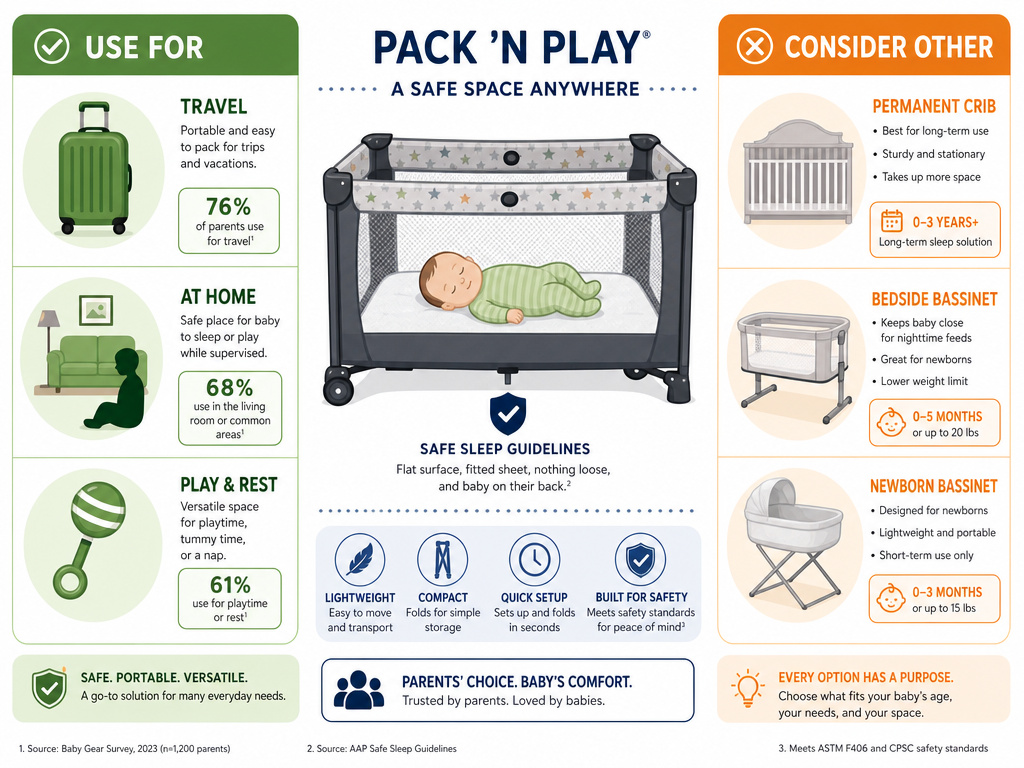
A Pack ‘n Play excels in specific scenarios. It’s a tool, not a universal solution.
Use it for:
- Travel and visits. It’s the standard for safe sleep away from home when a crib isn’t available.
- Supervised daytime naps in a common living area. You can keep the baby contained and safe while you’re in the same room.
- A secure play space for a non-mobile infant once they are awake.
Consider a different product for:
- Primary, long-term overnight sleep. A certified crib is designed for this. It’s more durable, often more comfortable, and offers the highest proven safety margin for thousands of nights of use.
- Bedside sleeping for easy night feeds. A dedicated bedside bassinet is lower, often has a drop-side, and is specifically tested for safe co-sleeping proximity.
- A newborn’s first sleeps. Many parents prefer a smaller, cozier bassinet bedside sleeper for the first few months before transitioning to a crib or playard.
For families on the move, a Pack ‘n Play might be the only realistic sleep surface. In that case, pairing it with a truly portable infant travel bed as a backup isn’t a bad idea. But in a stationary home, the hierarchy is clear: crib first, then other purpose-built sleepers.
Frequently Asked Questions
Can a newborn sleep in a Pack ‘n Play overnight?
Yes, a newborn can sleep in a Pack ‘n Play overnight if you use the original, firm mattress pad and follow all other safe sleep guidelines (back to sleep, no loose bedding, etc.). However, many parents find dedicated beds for newborns like bassinets more convenient for the first few months due to their smaller size and portability within the home.
Why are aftermarket Pack ‘n Play mattresses so dangerous?
These items are dangerous as they are often thicker and softer, creating a gap where an infant’s head can become trapped and leading to suffocation, because they are not part of the playard’s tested safety system. Brands like DODO Baby House and Modera have been recalled for violating the federal mandatory crib mattress standards.
Is it safe to use a Pack ‘n Play without the mattress?
No. The playard floor is too hard, may have seams or hinges that create an uneven surface, and using it without the pad voids any safety certification, as it is not designed or tested as a sleep surface. Always use the original pad.
Can I add a waterproof cover or pad?
Only if it is specifically designed by Graco to fit your model without altering the firmness, flatness, or fit of the original mattress pad. Never add a separate padded cover or quilted pad on top of the mattress, as this creates a soft, compressible surface.
How long can a baby sleep in a Pack ‘n Play?
Baby can sleep in a Pack ‘n Play as long as they fit within the manufacturer’s weight and height limits (typically 35 inches tall or 30 lbs). For long-term primary sleep, most families transition to a crib between 6-8 months, if not sooner, as the baby becomes more active and the crib offers more space and durability.
The Bottom Line
Infants can sleep safely in a Pack ‘n Play. The condition is absolute: you must use the original mattress pad it came with. That pad is not an accessory; it is a integral safety component engineered to work with the flexible walls. Swapping it for an aftermarket mattress, no matter how well-reviewed or comfortable it seems, introduces a documented, lethal suffocation risk that has triggered federal recalls.
For travel and temporary sleep, a properly set-up Pack ‘n Play is a lifesaver. For every night in the nursery, invest in a quality crib and a firm, flat baby mattress that meets all safety standards. Safe sleep is about following the engineered specifications tested to keep a vulnerable infant alive, not about finding hacks or upgrades. The rule is simple.Use the pad that came in the box. Nothing else.
