
Safety Guide: Are Weighted Sleep Sacks Safe for Your Baby?
This post contains affiliate links. As an Amazon Associate we earn from qualifying purchases.
Weighted sleep sacks are not safe for babies. The American Academy of Pediatrics, the Consumer Product Safety Commission, the National Institutes of Health, and the Centers for Disease Control and Prevention all explicitly advise against using any weighted sleep product, including swaddles, sacks, and blankets, for infants. There are no established safety standards for how much weight is safe, and emerging evidence suggests even small amounts can compress a baby’s chest and hinder breathing.
That consensus from every major public health body is a directive based on a fundamental mismatch: a baby’s developing respiratory system and a product that applies constant pressure. The stakes are a compressed ribcage, a suppressed arousal reflex, and a harder time moving out of an unsafe position.
What follows is the breakdown of that official stance, the specific studies and incidents behind it, and the clear line between what’s marketed for infants and what’s considered safe for older children. By the end, you’ll know exactly why the answer from regulators is “no,” and which proven, safe alternatives actually work.
Key Takeaways
- Every major U.S. Health and safety agency (AAP, CPSC, NIH, CDC) states weighted infant sleep products are unsafe and should not be used.
- There is no peer-reviewed research proving weighted sleep sacks are safe for overnight, unsupervised infant sleep, the very way they are marketed.
- The CPSC has reports of infant fatalities involving weighted sleep products and, in November 2023, voted against creating a safety standard due to a lack of data on safe weight limits.
- Major retailers like Amazon and Target have stopped selling weighted infant sleep sacks and swaddles based on this guidance.
- Safe alternatives are non-weighted wearable blankets (sleep sacks) and properly fitted swaddle blankets, used only until an infant shows signs of rolling.
The Official Stance: A Unanimous “No” From Regulators
If you take only one thing from this article, let it be this: the disagreement is between the entire established medical and regulatory infrastructure of the United States and the manufacturers selling these products.
The American Academy of Pediatrics updated its sleep guidelines in 2022 to state: “Weighted swaddle clothing or weighted objects within swaddles are not safe and therefore not recommended.” The AAP’s task force on SIDS is chaired by Dr. Rachel Moon, a pediatrician who has studied infant sleep safety for over a decade. Her position is unambiguous.
The Consumer Product Safety Commission, the federal agency that can recall dangerous products, has updated its safe sleep guidance to advise caregivers not to use weighted blankets or weighted swaddles. The agency has also stated it is aware of at least one report of a fatality involving a weighted infant product.
This stance is echoed by the NIH and the CDC. In April 2024, Senator Richard Blumenthal’s office compiled these positions in a government letter citing NIH and CDC to the FTC, noting the unified advisory against weighted sleep products. This is the consensus.
Why Regulators Are Saying No
The reasoning is mechanical. A baby’s rib cage is pliable, more cartilage than bone.Constant pressure, even from a distributed weight of one or two pounds, can compress the chest wall. This makes the work of breathing harder.
Second, infants need to be able to arouse from sleep easily, it’s a protective mechanism against SIDS. A weight on their body may suppress that natural arousal reflex. If they roll onto their stomach, the added weight makes it dramatically harder to lift their head or shift back to their back.
Finally, the weighted beads or pellets pose a separate hazard if the product tears or the seams fail. The CPSC has long banned loose beads in pillows for this exact choking and aspiration risk.
The 10-Degree Rule and the Lack of a Standard
Here’s where the regulatory landscape gets specific, and where the argument for weighted sleep sacks falls apart. In June 2021, the CPSC issued a final rule for all infant sleep products. The official CPSC rule publication states that any product marketed for infant sleep (for babies up to 5 months) must have a sleep surface angle of 10 degrees or less. This rule was designed to eliminate dangerous inclined sleepers.
But this rule says nothing about weight. That’s the critical gap.
There is no mandatory federal safety standard for how much weight can be sewn into a wearable blanket. The ASTM committee that writes voluntary standards for juvenile products has been grappling with this. The process itself is under scrutiny, as the co-chair of the wearable blankets committee is the CEO of Dreamland Baby, a leading seller of weighted sleep sacks.
Where this goes sideways: The CPSC voted against establishing a voluntary safety standard for weighted sleep products in November 2023. The reason? Commissioners stated there was a lack of information about what a safe maximum weight limit could even be.
You cannot standardize the safety of something when the foundational research on what makes it safe doesn’t exist. That’s the regulator’s point. Companies are selling into a void.
What the Actual Research Shows (and Doesn’t Show)

Manufacturers will point to their own studies. It’s vital to read the fine print.
Nested Bean commissioned a study by a private engineering firm. The NPR weighted infant sleepwear report details it: researchers placed 1-ounce, 3-ounce, and 9.5-ounce weights on the chests of five awake infants under 6 months for two minutes each. The study concluded that the 3- and 9.5-ounce weights “may increase potential hazard” due to decreased oxygen levels and higher pulse rates. The 1-ounce weight showed no clear indication for or against hazard.
Let’s be explicit about what this means. The study that a company uses to support its product found that weights above 1 ounce on the chest may be hazardous after just two minutes. Infants sleep for hours.
The AAP addressed this directly: “There is no evidence in the peer-reviewed scientific literature evaluating the safety of weighted sleep products on typical, healthy infants, and there is also nothing published regarding their use in an unmonitored setting.”
The “unmonitored setting” is the entire point. A parent uses a sleep sack overnight, in a dark room, while they are also asleep. No study offered by these companies replicates that real-world condition with evidence of safety.
| Claim by Manufacturers | What the Evidence Actually Says |
|---|---|
| “Products are safe for overnight sleep.” | No peer-reviewed studies exist on safety for unsupervised, overnight use. |
| “Weight is less than 10% of baby’s body weight.” | This is a self-created guideline, not a safety standard. A pound on an 8-pound newborn is 12.5% of body weight. |
| “No reported adverse events.” | The CPSC is aware of fatality reports involving weighted products. Lack of a formal report to the company is not proof of safety. |
| “Soothes like a parent’s hand.” | The constant pressure of a sewn-in weight is not analogous to the dynamic, responsive touch of a hand. |
The Retailer Response: Amazon, Target, and Babylist Step Away
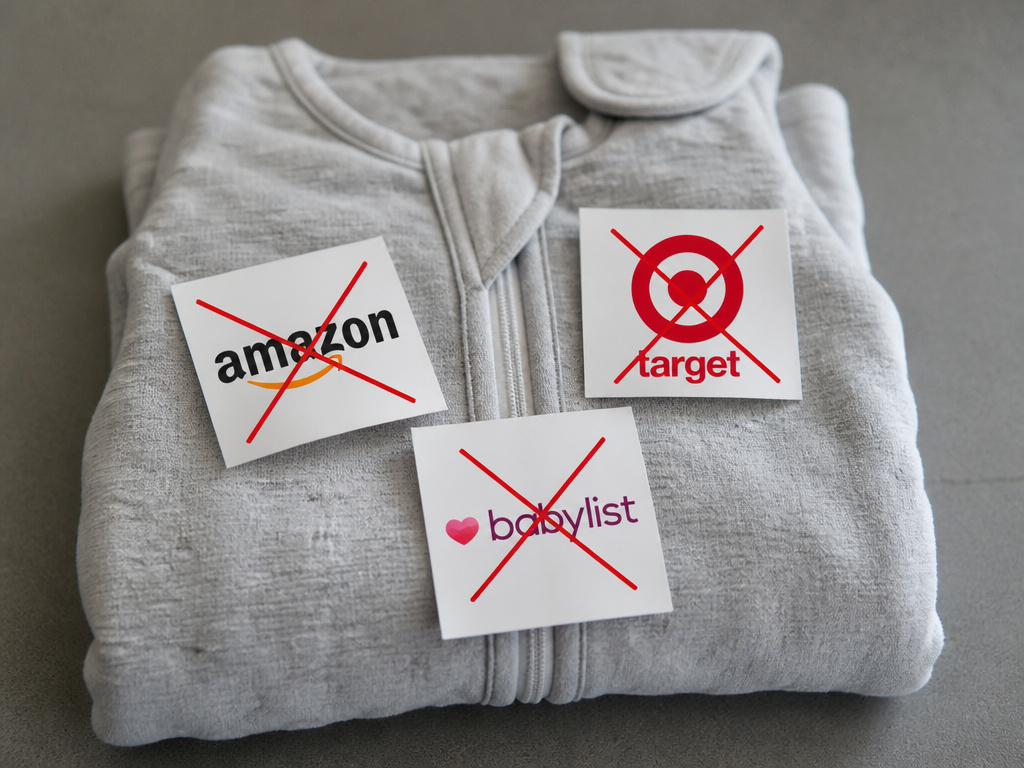
When regulators speak, major retailers listen, especially when child safety is involved. In 2024, Amazon, Target, and the registry site Babylist all announced they would no longer sell weighted infant sleep products.
Amazon’s policy change was particularly stark. The company emailed customers who had previously purchased these items, stating the products were unsafe and should not be used with children under 3. This move was cited in the Consumer Reports weighted sleep sack warning as a significant market shift.
This retailer pullback is a powerful signal. These companies have massive legal and liability teams. Their decision to remove an entire product category from shelves is a data-driven risk assessment. It tells you what their experts concluded after reviewing the same AAP, CPSC, and CDC guidance.
What About Weighted Blankets for Older Kids?
This is a crucial distinction. The warnings above apply specifically to infants under 12 months. The landscape changes for older children.
Weighted blankets are commonly used as a sensory tool for older kids, teens, and adults. They are generally considered safe for children who are old enough to remove the blanket themselves, typically around age 3 or 4, and always under supervision for younger children. Our resource on weighted blankets for kids covers the appropriate use, weight guidelines (usually 10% of body weight plus a pound), and safety checks for older children.
The danger for infants is their physical vulnerability and inability to reposition. A toddler who can toss a blanket aside is in a different risk category than a 2-month-old who cannot roll over. Never use an infant-weighted sleep sack for a toddler, and never use a child’s weighted blanket for an infant.
Safe and Effective Alternatives for Infant Sleep
You don’t need weight for safe, sound sleep. The proven toolkit is simpler.
1. Non-Weighted Wearable Blankets (Sleep Sacks): This is the gold standard. A well-fitting wearable blanket keeps a baby warm without any loose fabric. They come in various fabrics and TOG (thermal overall grade) ratings for different seasons. The Halo SleepSack Wearable Blanket is a consistently top-rated example for its safety and design.
2. Proper Swaddling (For Newborns Only): A snug swaddle blanket can soothe the startle reflex. The key is to stop swaddling as soon as your baby shows any signs of attempting to roll over, usually around 2-3 months. Stretchy cotton or muslin wraps like the Aden + Anais Classic Swaddle are excellent choices.
3. The Bare Crib Environment: The foundation of safe sleep is a firm, flat mattress in a safety-approved crib, bassinet, or play yard with only a fitted sheet. This is the core of any safe newborn bedding setup. All other items, pillows, loose baby blankets, stuffed animals, and bumpers, should be kept out.
4. Other Soothing Strategies: A pacifier at sleep time is associated with a reduced SIDS risk. A white noise machine can mask disruptive sounds. A consistent, calming bedtime routine signals that sleep is coming.
Common mistake: Reaching for a gadget to solve normal infant sleep patterns. Newborns are supposed to wake frequently to feed. Their sleep cycles are short. A product that promises to override this biology is often promising something that is either ineffective or unsafe.
Frequently Asked Questions
Has a baby died from a weighted sleep sack?
The CPSC has stated it is aware of at least one report of a fatality involving a weighted infant sleep product. Public incident reports also contain accounts of sleep-related deaths where a weighted sleep sack or swaddle was present, though other risky products were also involved. The CPSC does not always publicly confirm direct causation in ongoing cases.
Why are weighted blankets safe for adults but not babies?
Adults and older children have fully developed respiratory systems, stronger muscles, and the cognitive ability to remove a blanket if they feel restricted. Infants have pliable rib cages, immature nervous systems, and cannot reliably reposition themselves. The same physical pressure that feels calming to an adult can dangerously compress an infant’s chest.
What does the 10% body weight rule mean?
This is a guideline often cited by weighted blanket manufacturers for older children and adults (e.g., a 40-pound child might use a 4-5 pound blanket). It is not an approved safety standard for infants. The AAP and CPSC reject this as a valid metric for infant sleep products because it does not address the unique physiological risks to babies under 12 months.
Are there any weighted products approved by the AAP?
No. The American Academy of Pediatrics does not approve or endorse any commercial baby products. Its 2022 sleep guidelines explicitly recommend against the use of weighted swaddles, weighted clothing, or weighted objects in or near the sleep environment for infants.
What should I do if I already own a weighted sleep sack?
Discontinue use immediately. You can contact the retailer where you purchased it; some may offer a return or discount on a safer alternative. Replace it with a standard, non-weighted wearable sleep sack appropriate for your baby’s size and the room temperature.
Before You Go
The question “are weighted sleep sacks safe for babies” has been answered, definitively, by the organizations tasked with protecting children. The AAP, CPSC, NIH, and CDC all say no. The lack of safety standards and peer-reviewed research is a red flag.
The safer path is the simpler one. Choose a certified, non-weighted wearable blanket. Use a proper swaddle only until rolling begins. Focus on a firm, flat, bare sleep surface. These aren’t just recommendations; they’re the proven foundations that have contributed to a decades-long decline in sleep-related infant deaths.
Your instinct to help your baby sleep is natural. Channel it into creating a safe sleep environment, not into experimenting with unregulated products. The peace of mind that comes from following the evidence is worth far more than a few extra minutes of sleep.
