
Can a Baby Sleep in a Carrier? Vital Safety Rules & Limits
This post contains affiliate links. As an Amazon Associate we earn from qualifying purchases.
Yes, a baby can sleep in a carrier, but the safety window is narrow and defined by four non-negotiable rules: the baby must be over four months old with full neck control, positioned facing inward with a visible airway, monitored by a fully awake caregiver, and moved to a flat sleep surface after one to two hours. Breaking any one of these rules shifts the risk from minimal to documented, especially for infants under four months where the suffocation hazard is highest.
That “over four months” clause isn’t a suggestion. It’s the line drawn by manufacturer warnings and incident data. The Chicco SnugSupport manual labels infants under four months, premature babies, and those with respiratory issues as the group at “greatest risk of suffocation” in a carrier. This is because a sleeping newborn’s head is disproportionately heavy. Without the muscle strength to pull it back from your chest, their chin can drop, their airway can kink, and their oxygen levels can drop without a sound. The safe sleep you imagine hinges entirely on cervical stability they simply don’t have yet.
What follows is the breakdown of those four rules, the physical mechanics behind them, and the specific scenarios, like outward-facing naps or a drowsy caregiver, that turn a convenient nap into a recorded hazard. By the end, you’ll know exactly when a carrier nap is a safe tool and when it’s a risk you can’t afford to take.
Key Takeaways
- The highest suffocation risk is for babies under four months, premature infants, or those with respiratory issues due to poor neck control.
- A caregiver must never sleep while babywearing; you cannot monitor airway position or carrier tightness if you are asleep.
- Only the inward-facing carry position is safe for sleep; outward-facing and back-carry positions are explicitly warned against by manufacturers for sleeping babies.
- Limit continuous carrier sleep to 1–2 hours to prevent overheating, positional issues, and to allow for movement and stretching.
The 4 Non-Negotiable Rules for Safe Carrier Sleep
Safety isn’t a list of good ideas. It’s a short list of physical thresholds you cannot cross. For a baby sleeping in a carrier, those thresholds are age, position, caregiver state, and duration.
Rule of thumb: If you cannot see your baby’s face and easily kiss the top of their head, their airway is not clear. Reposition them immediately.
Rule 1: Age and Neck Control Are Everything. This is the first and most critical filter. The consensus from manuals like the Chicco UltraSoft and SnugSupport is unambiguous: the risk of suffocation is greatest for infants under four months. This isn’t about milestones; it’s about biomechanics. A newborn’s neck muscles and ligaments aren’t developed enough to reliably support their heavy head if they slump forward in sleep. The positional asphyxiation risk is silent and fast. Before four months, a crib, bassinet, or approved bedside sleeper is the only safe sleep surface.
Rule 2: Position is Inward-Facing, Always. The only carry position approved for a sleeping baby is facing inward, on your chest. This allows you to see their face, monitor their breathing, and support their head and back. Both Ergobaby and Chicco manuals explicitly warn against letting a baby sleep in an outward-facing position. The back-carry position is also not safe for sleep, as you cannot monitor the baby’s airway or position. The baby’s back should be supported in a natural “C” curve, with their hips in an “M” position (knees higher than bottom) to keep their airway open.
Rule 3: The Caregiver Must Be Awake and Alert. This is the rule that catches exhausted parents. You cannot sleep while babywearing. As your body relaxes in sleep, your posture changes, the carrier can loosen, and the baby can slump into an unsafe position. You will not be alert to the subtle signs of breathing trouble. The carrier is a tool for an active, supervising adult. If you are too tired to stay awake, the baby must be moved to a safe, flat sleep space like a co-sleeping bassinet.
Rule 4: Respect the Clock (1-2 Hour Limit). Even with perfect positioning, a baby should not be in a carrier for extended, uninterrupted sleep. Most pediatric experts recommend a break every 1-2 hours. This allows the baby to stretch, move their hips, cool down, and reduces the risk of pressure points or overheating. It’s a rhythm: nap in the carrier, then a break for a diaper change and some movement, then back in if needed.
| Rule | Safe Practice | Risk If Broken |
|---|---|---|
| Age/Neck Control | Wait until baby can hold head upright steadily (usually 4+ months). | Silent positional asphyxiation; highest risk for under-4-month infants. |
| Position | Inward-facing carry on caregiver’s chest. | Airway obstruction in outward-facing; unmonitored slump in back carry. |
| Caregiver State | Awake, alert, and able to monitor baby continuously. | Carrier loosens, baby slumps; caregiver cannot respond to breathing changes. |
| Duration | Limit continuous sleep to 1-2 hours before a break. | Overheating, restricted movement, pressure on hips/spine. |
Why the “Under 4 Months” Warning Exists (The Physiology)
This isn’t scare talk. It’s the predictable outcome of anatomy meeting physics. A young infant’s airway is about the diameter of a drinking straw. It is soft and easily compressed.
When a baby’s chin drops to their chest, that airway kinks. Oxygen saturation can drop in minutes, a phenomenon documented in studies of babies asleep in car seats. In the optimal upright, supported position against a caregiver’s chest, chin up, head supported, studies show this desaturation does not occur. The difference is a matter of millimeters in head position, controlled by neck muscles a newborn hasn’t built yet.
This is why the ASTM F2236 safety standard for soft infant carriers exists and is enforced by the CPSC. It’s also why the CPSC soft carrier business guidance mandates strict design and warning label requirements. The standard aims to mitigate risks that are inherent to the product’s use. Your vigilance is the final, most critical layer of that protection.
When Carrier Sleep is a Hard No
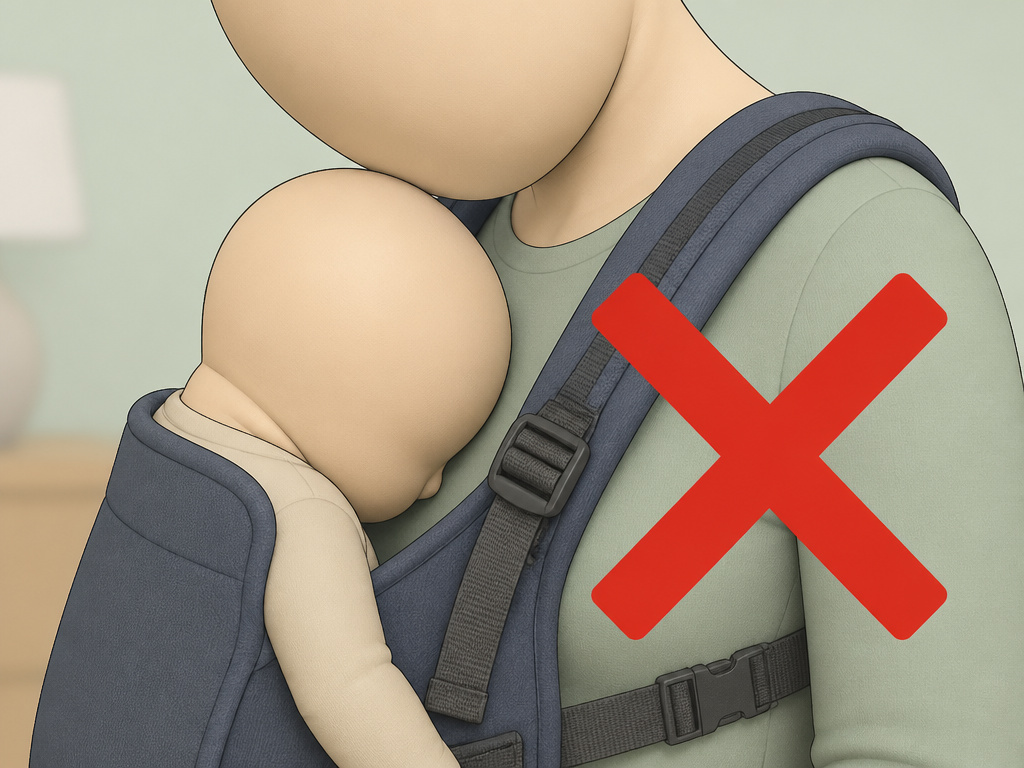
Some scenarios aren’t gray areas. They are bright red lines where the risk is so well-defined that manufacturers and health agencies state them outright.
The Caregiver is Sleepy. This is non-negotiable. If you are feeling drowsy, you are not safe to wear a sleeping baby. Move the baby to a crib or bedside crib immediately. The consequence of nodding off is that you will not feel the baby slump, and you cannot check their airway.
The Baby is in an Unsafe Position. This includes outward-facing (expressly warned against by Ergobaby for sleep) and back carries. It also includes any position where the baby’s face is pressed into fabric or your body, or where their chin is on their chest.
You are Engaged in a Hazardous Activity. Carriers are for standing and walking. They are not for cooking over a hot stove, drinking hot liquids, running, cycling, or driving. Your balance is different with a baby on your chest, and a moment of instability can be catastrophic.
Where this goes sideways: Using a carrier as a substitute for a car seat. Even on a quick trip, a crash would project the baby from the carrier with immense force. The carrier has no crash protection structure. A car seat is non-negotiable for vehicle travel.
How to Safely Transfer a Sleeping Baby Out of the Carrier
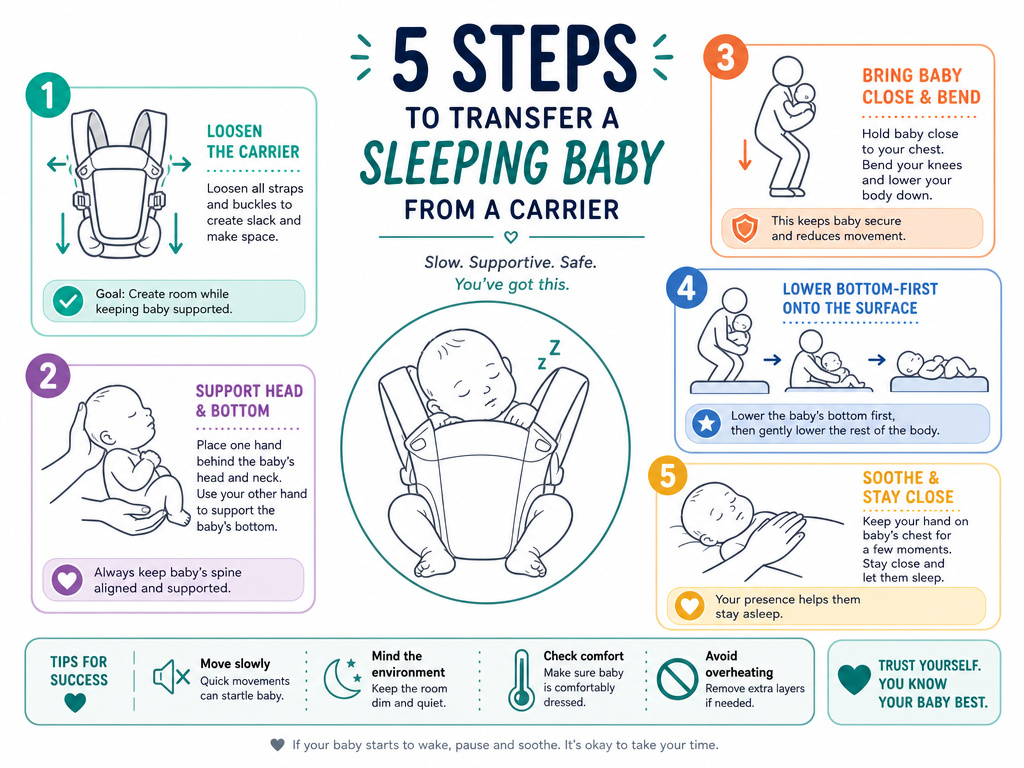
“Unwearing” a sleeping baby without waking them is a skill. Rushing it usually ends in tears. Have your safe sleep space, a firm, flat bassinet for bedside, ready and cleared of loose bedding before you start.
- Loosen Straps Gradually: Start with the waist belt, then one shoulder strap, then the other. Move slowly to minimize jostling.
- Support the Head and Bottom: As you open the carrier, slide one hand firmly under the baby’s bottom and the other behind their head and neck before lifting them out.
- Hold Close and Move Slowly: Keep the baby snug against your chest as you turn and bend at the knees (not the waist) toward the sleep surface.
- Place Bottom First, Then Head: Lower the baby onto the mattress, placing their bottom down first, then gently rolling their back down, and finally supporting the head until it rests on the mattress.
- Wait Before Leaving: Keep a hand on their chest for a minute. If they stir, gentle pressure can help them settle into the new surface. Then back away slowly.
Skip the temptation to rock them in your arms after taking them out. You’re trying to transfer the sleep association from your body to the flat surface, not restart the rocking process.
Carrier Sleep vs. Dedicated Sleep Space: The Real Trade-Off
This isn’t about good versus bad. It’s about choosing the right tool for the need, knowing the limits of each.
A baby carrier is for supervised, upright naps on the go. Its benefits are closeness, convenience, and can help regulate a baby’s breathing and temperature. Its limits are duration, positional safety dependence on your vigilance, and it is not for unsupervised sleep.
A flat, firm sleep surface like a crib, infant bedside sleeper, or bassinet is for longer, unsupervised sleep. It is the only environment that meets the AAP’s “back to sleep” guidelines without qualification. It allows for full-body stretching and movement. The trade-off is that the baby is not in contact with you.
The choice isn’t permanent. Use the carrier for the morning walk or when you need your hands free. Use the crib for the long afternoon nap or nighttime sleep. The problem starts when you use the carrier for the latter because it’s easier in the moment. The hand-held infant carrier safety standard (ASTM F2050-19) regulates products meant for carrying while standing and walking, not for extended, stationary sleep.
Frequently Asked Questions
Is it safe for a newborn to sleep in a carrier?
No, it is not considered safe for a newborn to sleep in a carrier. Infants under four months are at the greatest risk of positional asphyxiation because they lack the neck strength to keep their airway open if their chin slumps to their chest. The safest place for a newborn to sleep is alone, on their back, on a firm, flat surface like a bassinet for a newborn.
Can I sleep while my baby sleeps in the carrier?
Absolutely not. You must never sleep while babywearing. If you are asleep, you cannot monitor the baby’s airway, position, or temperature. Your own body will relax, potentially allowing the carrier to loosen and the baby to slump into a dangerous position. If you are tired, transfer the baby to a safe sleep space.
How long can a baby safely sleep in a carrier?
Most experts recommend limiting continuous time in a carrier to 1-2 hours for sleep. After this, you should take the baby out for a break to stretch, move their hips, cool down, and have a diaper change. This supports healthy physical development and prevents overheating.
What is the T.I.C.K.S. Rule for safe babywearing?
T.I.C.K.S. Is an acronym for safe carrier positioning: Tight (the carrier should be snug), In view at all times (you should always see the baby’s face), Close enough to kiss (the baby’s head should be near your chin), Keep chin off chest (ensure the baby’s chin is up), and Supported back (the baby’s back should be in a natural position with the carrier supporting it). This rule is a excellent quick-check guide for any babywearing session.
Before You Go
A carrier nap can be a beautiful thing, a moment of peace with your baby close. But that peace is built on a foundation of specific, non-negotiable rules. Remember the four filters: a baby old enough to hold their head up, positioned facing you, supervised by an awake adult, and for a limited time. If your situation meets all four, you can proceed with confidence. If it misses even one, the safe choice is always the flat, firm crib or bedside cot. The convenience of a carrier is never worth gambling on an airway you can’t see or a chin you can’t lift. Your vigilance is what makes the closeness safe.
