
What Age to Move From Toddler Bed to Single Bed: Key Signs
This post contains affiliate links. As an Amazon Associate we earn from qualifying purchases.
Move from a toddler bed to a single bed when your child approaches the bed’s 50-pound weight limit, stands taller than the side rails, or needs more sleeping space, typically between ages 3 and 6. The federal ASTM F1821 standard defines a toddler bed for children up to 50 lbs, making that a hard safety ceiling. Waiting until at least age 3, when impulse control improves, leads to a smoother transition.
That 50-pound limit is a printed requirement in the ASTM F1821 safety specification that every toddler bed sold in the US must meet. Once your child’s weight gets within a few pounds of that number, the bed’s structural safety margins are gone.The frame isn’t rated for more.
This guide walks through the three physical signs that force the move, the behavioral readiness most articles miss, and the direct comparison between buying a toddler bed now or going straight to a twin. You’ll have the manufacturer specs, the sleep study data, and a clear decision path by the end.
Key Takeaways
- The ASTM F1821 standard sets a 50-pound weight limit for toddler beds, this is a non-negotiable safety stop sign.
- Transitioning after age 3, when children have better impulse control, cuts down on nighttime wanderings by a measurable margin.
- Skipping the toddler bed and going straight to a twin with guardrails is often more cost-effective and avoids a second transition.
- Childproofing the entire room is mandatory before the move, as a single bed grants access to the whole space overnight.
- A 2019 Sleep Medicine study found sleep quality drops after moving from a crib to a bed, especially for kids under 2, the same principle applies to the toddler-to-single-bed shift.
The 3 Real Signs It’s Time to Move Up
Forget the birthday. The move from a toddler bed to a single bed is driven by physics and safety regulations, not a calendar. Look for these three signs.
Your child is approaching 50 pounds. The ASTM F1821 safety specification defines a toddler bed as a product for a child weighing no more than 50 lbs (27.7 kg). This isn’t a rough guideline; it’s the standard referenced in the mandatory toddler bed safety rules. The frame, guardrails, and mattress support are tested to that limit. Exceed it, and you’re using the product outside its certified safety scope.
Their height makes the bed unsafe. If your child’s head is above the side rails when standing, or if they can easily swing a leg over, the containment function is gone. The fall from a toddler bed is lower than from a crib, but a determined climber can still get hurt. The bed has become a stepping stool, not a safe sleep space.
They simply need more room. Toddler beds use a crib-sized mattress (about 52″ x 28″). A growing child who rolls constantly, sleeps diagonally, or ends up with limbs dangling over the edge needs a larger sleep surface. Discomfort leads to restless nights and more frequent wake-ups.
A toddler bed is intended for a child not less than 15 months of age and who weighs no more than 50 lb. This consumer safety specification is intended to minimize incidents resulting from normal use and reasonably foreseeable misuse. , ASTM F1821-26 Standard Consumer Safety Specification for Toddler Beds
Where does age fit in? Most children hit these physical signs between ages 3 and 6. A tall, solid 4-year-old will outgrow a toddler bed faster than a petite 5-year-old. Let their body lead the decision.
Why Behavioral Readiness Beats a Birthday
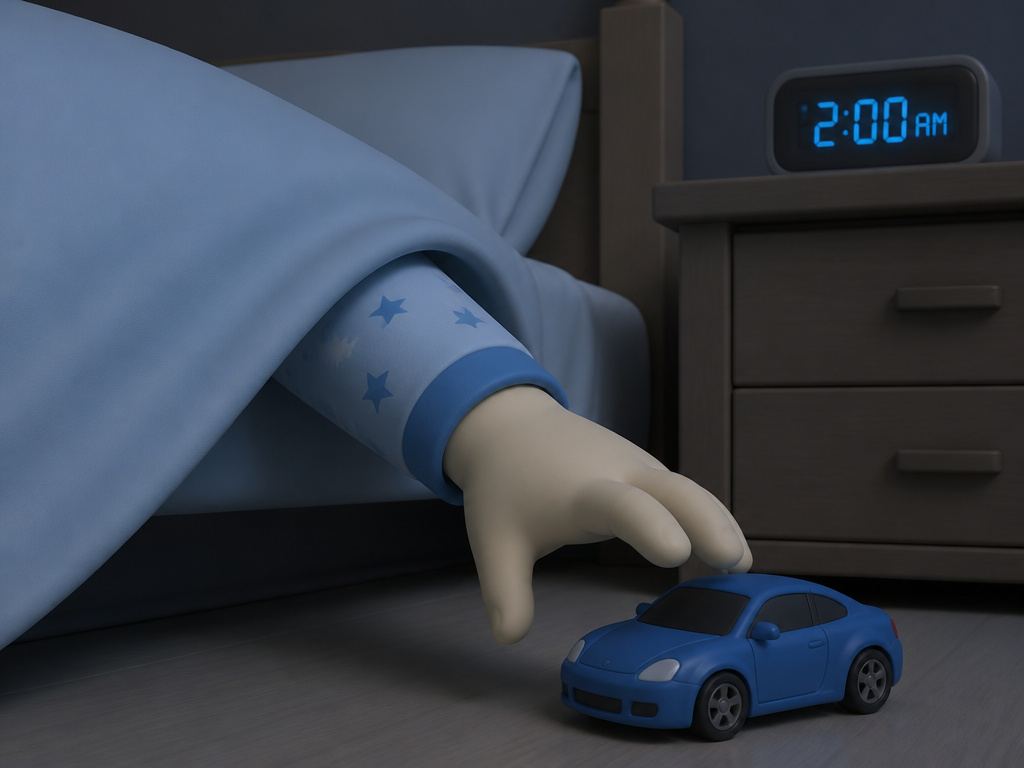 A child can be physically ready at 3 but behaviorally nowhere near prepared. The switch from a toddler bed to a single bed involves granting unsupervised access to an entire room for 10-12 hours.
The part nobody mentions: The bed isn’t the problem. The freedom is. A child who sleeps soundly in a toddler bed might start playing with toys, opening drawers, or appearing at your door at 2 a.m. Simply because they finally can.
Behavioral readiness means your child can understand and follow the basic rule: stay in bed after lights out. Look for these signs elsewhere in their life: * They follow simple household rules most of the time (e.g., not jumping on the couch). * They can play in their room independently for short periods without immediate destruction. * They respond to consistent boundaries around other routines, like bath time or meals.
If your 3-year-old is a boundary-testing, impulsive explorer, moving them to a single bed will turn bedtime into a negotiation. Wait. Another six months of maturation can make the difference between a smooth transition and a months-long sleep battle.
Toddler Bed vs. Single Bed: The Cost & Convenience Breakdown
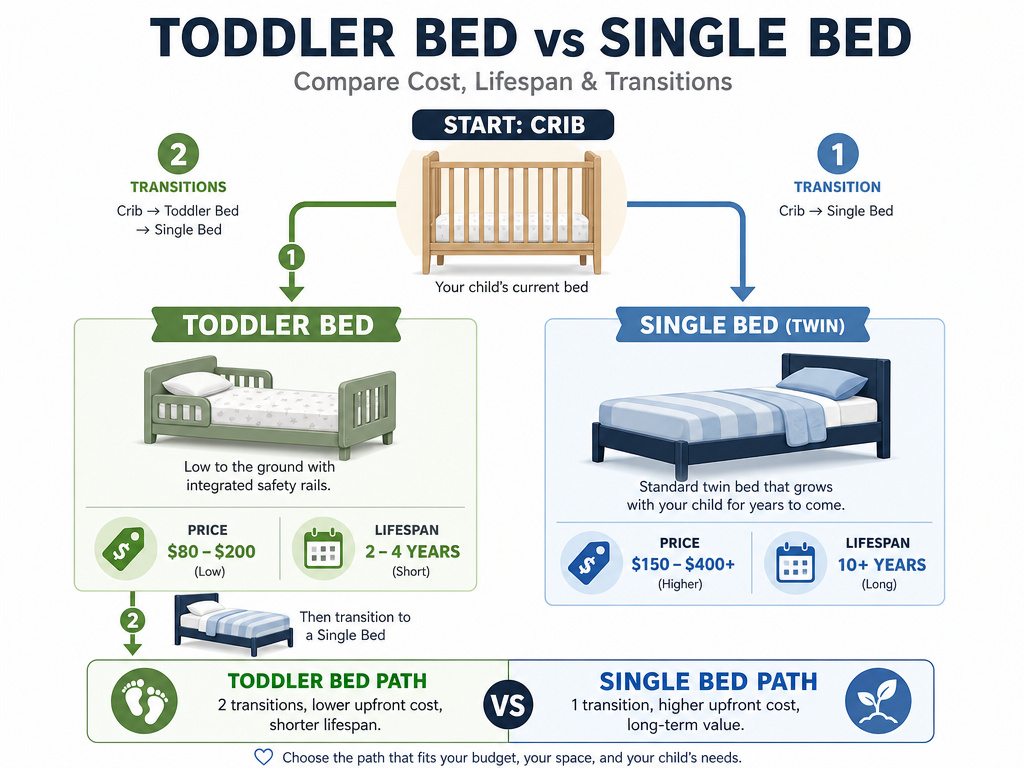 You have two paths: use a toddler bed as an intermediate step, or skip it and go straight to a single bed. This isn’t a minor choice. It involves real money, furniture logistics, and your sanity.
| Consideration | Toddler Bed | Single (Twin) Bed |
|---|---|---|
| Lifespan | 2–4 years (until ~50 lbs or age 4-6) | 10+ years (through childhood) |
| Upfront Cost | Lower | Higher |
| Long-Term Value | Poor – requires a second bed purchase soon | Excellent – one purchase for years |
| Transition Count | Two (crib → toddler bed → single bed) | One (crib → single bed) |
| Safety Setup | Built-in or attached rails usually included | Requires separate bed rails for toddlers |
| Space Required | Compact, fits in small rooms | Standard twin footprint; needs more floor space |
The math is straightforward. A toddler bed costs money now, and you’ll buy a twin bed in a few years anyway. A twin bed costs more today, but you’re done. You will need to add a twin mattress for toddler and safety rails, but those are one-time purchases that stay with the bed.
Common mistake: Choosing a toddler bed for its cute theme. Your child’s love for the “race car bed” will last about 18 months. Then you’re stuck trying to sell a themed bed they’ve outgrown, or worse, dealing with a distraught child who doesn’t want to leave it.
For most families, the single bed is the smarter play. It demands more initial childproofing and a good set of kids bed rails, but it pays off in spades by eliminating the next transition drama.
How to Make the Switch in 5 Steps
When the signs align, follow this sequence. Rushing leads to pushback. Skipping steps leads to escape artists.
1. Childproof the Room – First.
Assume your child will explore every inch of the room the first night. Get on your knees and look around. Anchor all dressers and bookshelves to the wall. Install outlet covers. Secure blind cords. Remove toys that are too tempting. This step is non-negotiable and must happen before the bed arrives.
2. Involve Your Child in the Setup.
Let them pick out new sheets for their “big kid bed.” Have them help place the bed rails. This builds ownership and excitement, turning the change into a privilege, not a punishment.
3. Start With Naps.
Introduce the new bed at nap time for a week. The stakes are lower, and you’re awake to enforce the “stay in bed” rule. It’s a practice run that builds confidence for both of you.
4. Hold the Bedtime Routine Rock-Solid.
Keep every other part of the night exactly the same, bath, book, song, lights out. The consistency is an anchor amid the change. If the routine shifts too, the whole night feels unstable to a toddler.
5. Enforce the Boundary with Boring Consistency.
If they get out, lead them back with minimal interaction. No lectures, no cuddles, no snacks. A calm, repetitive “It’s time to stay in your bed” is all that’s needed. The first three nights set the pattern.
What if they keep getting up? Check that physical needs are met (not thirsty, not needing the bathroom), then return them. Every time. Inconsistency teaches them that persistence pays off.
The Case for Skipping the Toddler Bed Entirely
You don’t have to buy a toddler bed. Going straight from a crib to a single bed is a valid, often superior, strategy. It’s the one I recommend to friends.
The primary advantage is avoiding transition fatigue. Every change is a potential sleep disruption. The data from a 2019 Sleep Medicine study on crib-to-bed transitions shows sleep gets worse after the move, with more night wakings. Why voluntarily sign up for two of those disruptions (crib→toddler, toddler→single) when you can have one?
I won’t recommend a toddler bed for a child over 2.5 unless space is extremely tight. You buy the bed, the specific sheets, the rails. Eighteen months later, you’re shopping for a twin bed, another mattress, another set of sheets, and explaining why the race car bed has to go. It’s double the cost and double the goodbye drama.
A low-profile twin bed frame with sturdy safety bed rails is just as safe as a toddler bed. The mattress is bigger, which means they won’t outgrow it physically. You’re investing in a piece of furniture that will last into their teen years, not a temporary placeholder.
The only real reason to choose a toddler bed is severe space constraints. If the room truly can’t fit a twin, the compact size wins. For everyone else, the single bed is the long-game answer.
Frequently Asked Questions
Can I use a toddler bed after age 4?
You can, but you shouldn’t if your child exceeds the weight or height limits. The ASTM F1821 safety specification sets a 50-pound maximum. Many 4-year-olds weigh 40+ pounds. If they’re near the limit, or if their torso is above the rails, it’s time to move up for safety.
What size is a single bed for a child?
Single bed” typically refers to a twin-size bed, which is 38 inches wide by 75 inches long. This is the standard first adult-sized bed for a child. Some companies offer “junior” beds that are slightly shorter, but a standard twin is the most versatile and compatible with widely available bedding.
Do I need guardrails on a single bed for a toddler?
Absolutely. A standard twin bed is much higher off the ground than a toddler bed. A full-length bed rails for kids on both sides is essential to prevent falls for at least the first year, if not longer. Look for rails that secure firmly between the mattress and box spring.
Is a twin bed too big for a 3-year-old?
It can feel vast initially, which is why routine and rails are critical. Use a twin mattress for toddler that’s firm and fits the frame snugly. Add guardrails, and use a rolled blanket or a body pillow under the fitted sheet to create a cozy, defined sleep space. They’ll grow into the extra room within months.
What if my child is scared of the new bed?
Move the old toddler mattress to the floor next to the new bed for a few nights. Let them start the night in their familiar spot, then encourage them to try the “big bed.” Keep their favorite lovey and blanket with them. The fear usually stems from the unknown, familiar smells and textures ease the jump.
Before You Go
The right age to move from a toddler bed to a single bed is determined by the intersection of three factors: the 50-pound safety limit, your child’s need for more space, and their hard-won ability to follow the ‘stay in bed’ rule. That intersection usually happens around age 4, but your child’s body and behavior are the final guides.
If you’re staring down this decision, lean toward the single bed. Invest in a good twin mattress and sturdy rails, anchor your furniture, and commit to the boundary. It’s one change, one purchase, and then you’re done until they leave for college.
