
What Age to Sleep Train Your Infant? Expert Advice & Safety
This post contains affiliate links. As an Amazon Associate we earn from qualifying purchases.
Sleep train an infant between 4 and 6 months of age, once they show a regular day-night sleep pattern and can self-soothe. The American Academy of Sleep Medicine states behavioral interventions are effective and recommended, with studies showing 94% report clinically significant improvement. Always consult your pediatrician first, especially if your baby was premature or has special health needs.
That 4-6 month window is when a baby’s circadian rhythm, the internal sleep-wake clock, starts to function. Before this, their sleep is chaotic by biological design.Trying to impose order earlier is like asking a newborn to ride a bike; the wiring isn’t there yet.
What follows is the breakdown of that readiness window, the physical signs that matter more than the calendar, and the four methods backed by clinical parameters. We’ll also cover the one safety check you cannot skip.
Key Takeaways
- The earliest safe age is 4 months, but readiness hinges on developmental signs like a emerging day-night rhythm and the end of the newborn feeding frenzy.
- Consult your pediatrician before starting. This is non-negotiable for preemies, babies with special health needs, or those with sensory processing differences.
- Self-soothing is the goal, not sleeping through the night. Sleep training teaches a baby to fall back asleep independently, which may still involve night wakings.
- Room-sharing without bed-sharing is the safest sleep environment for the first 6 months, per AAP guidelines to reduce SIDS risk.
- Bedtime fading and graduated extinction (Ferber) are both clinically validated methods that help babies fall asleep faster and reduce parental stress.
The 4-Month Readiness Window
Infants usually adapt to a day-night sleep schedule between 4 months and 6 months of age. This shift is physiological, not behavioral. Before four months, a baby’s brain is too neurologically immature to consistently self-soothe or maintain long sleep blocks.
Common mistake: Starting at 8 weeks because a book said so. The scoping review of sleep interventions noted that pressuring sleep before four months can misinterpret normal infant behavior as a problem.
Look for these signs, not just a date on the calendar: * A predictable day-night pattern: Longer sleep stretches (4-6 hours) occur at night, not randomly. * Decreased need for nighttime calories: Most babies can meet nutritional needs during the day by 4-6 months, a point the RACGP emphasizes for controlled crying. * Emerging self-soothing: You might notice baby sucking on hands, turning head side-to-side, or settling with a soft murmur before sleep.
The “4 months and 14 pounds” guideline from places like UChicago Medicine exists because weight can indicate metabolic readiness to go longer without feeding. It’s a helpful checkpoint, but developmental signs are primary.
Physical & Safety Prerequisites
Sleep training is a behavioral process inside a physical environment. If the environment isn’t safe, don’t start.
| Prerequisite | Why It Matters | What to Check |
|---|---|---|
| Safe Sleep Space | Reduces SIDS and suffocation risk. | Firm, flat infant mattress in a safety-approved crib or bassinet. No pillows, loose blankets, or stuffed animals. |
| Room-Sharing | AAP recommends it for the first 6-12 months. It facilitates monitoring and feeding while being safer than bed-sharing. | Your baby’s bedside sleeper or crib is in your room, within arm’s reach. |
| Pediatrician Clearance | Rules out underlying issues (reflux, apnea) and confirms growth is on track for night weaning. | Discuss your plan. This is critical for preemies or babies with medical conditions. |
| Consistent Bedtime Routine | Signals to the brain that sleep is coming. Creates a predictable behavioral chain. | A short, calming sequence: feed, bath, book, bed. The same order every night. |
Before you start: Ensure your baby is placed on their back for every sleep. Double-check that the crib sheet is a tight-fitting fitted sheet and that the sleep space is clear. A safe newborn swaddle is appropriate before rolling begins, but transition to a sleep sack after.
Step-by-Step Sleep Training Methods
The AASM pediatric sleep practice parameters classify several behavioral interventions as effective. These are standardized clinical approaches.
Graduated Extinction (The Ferber Method)
This is the classic “check-and-console” approach. You put baby down drowsy but awake and leave the room. If they cry, you return after progressively longer intervals (e.g., 3, 5, 10 minutes) to offer brief, minimal reassurance without picking them up.
- Why it works: It balances learning self-soothing with the reassurance of your presence. The ZERO TO THREE sleep resource notes it helps babies fall asleep faster and reduces maternal stress.
- The step most skip: The check-in should be boring, a quiet “I love you, it’s sleep time,” a pat, and out in under 30 seconds. Lingering or picking up resets the clock.
- Timeline: Many babies show significant improvement in 3-5 nights.
Bedtime Fading
If your baby fights bedtime for an hour, their natural sleep onset is likely later. Bedtime fading works with their rhythm. You temporarily set bedtime to when they actually fall asleep quickly, then move it 15 minutes earlier every few nights.
- Why it works: It uses the body’s own sleep drive. You’re not fighting a circadian rhythm that isn’t ready.
- Pair it with: A solid, positive bedtime routine. This method is often combined with others once the bedtime is shifted to an ideal time.
The Chair Method (Camping Out)
You sit in a chair next to the crib until baby falls asleep, offering quiet verbal reassurance. Each night, you move the chair farther away until you’re outside the room.
- Best for: Parents who cannot tolerate crying or babies with high separation anxiety. It’s slow but gentle.
- The catch: It can take weeks. Some babies find a parent’s silent presence more stimulating than comforting.
Unmodified Extinction (Cry-It-Out)
After the bedtime routine, you put baby down and do not re-enter until a scheduled morning feeding or wake-up time. The UChicago Medicine sleep training guide notes it often works the quickest but is hardest on parents.
- The critical rule: All caregivers must be 100% committed. Going in after 45 minutes of crying teaches baby that persistence pays off, making the next night longer.
- Not abandonment: You monitor via audio/video. This method is about removing the interaction as a reinforcement for crying, not ignoring needs.
When to Wait or Adjust Your Plan
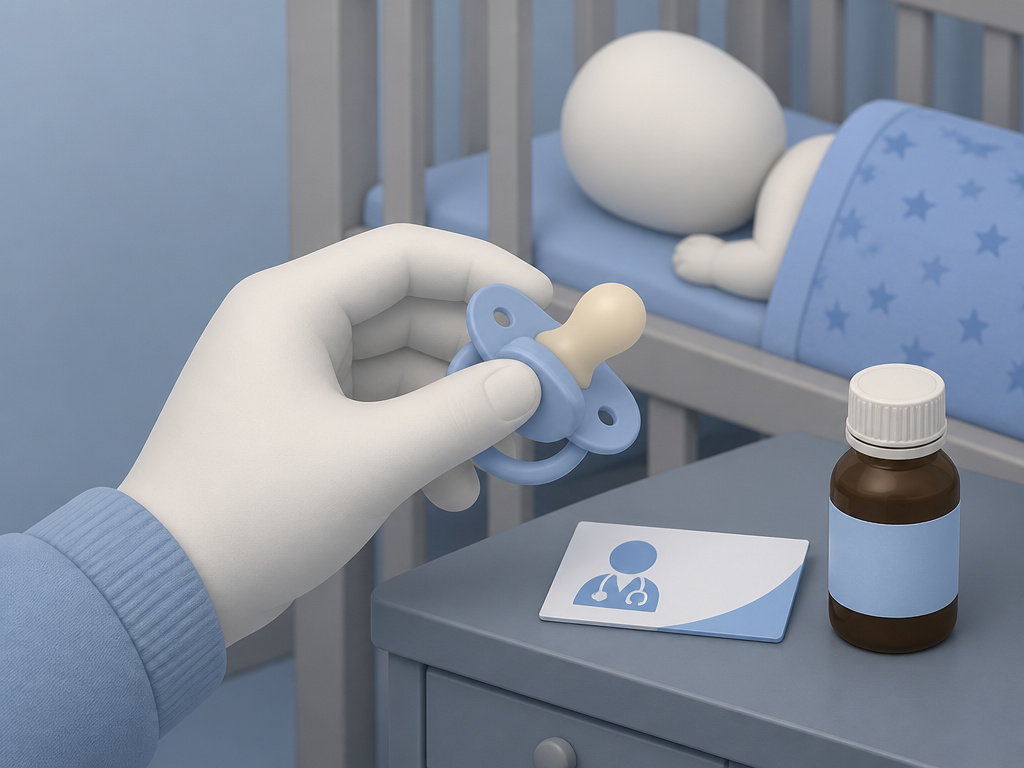 Some conditions mean you should pause or heavily adapt a standard plan. A one-size-fits-all approach fails here.
Where this goes sideways: Pushing sleep training on a baby with untreated acid reflux. The crying is from pain, not a lack of skill, and ignoring it delays needed medical care.
Consult your pediatrician and consider a gentler path if:
- Premature birth: Use adjusted age, not birth age. A 4-month-old born 8 weeks early is developmentally a 2-month-old.
- Special healthcare or sensory needs: These babies may need more tailored support. The Norland review notes infants with sensory processing difficulties might find rocking stimulating, not calming.
- Family stress or parental mental health: If you’re severely sleep-deprived or dealing with PPD/PPA, your capacity for consistency is low. Getting support for yourself is step one.
- It’s not working after 2 consistent weeks: If there’s zero progress with unwavering consistency, stop. Re-evaluate schedule, sleep environment, or potential hidden issues like teething or an ear infection.
What Sleep Training Actually Changes
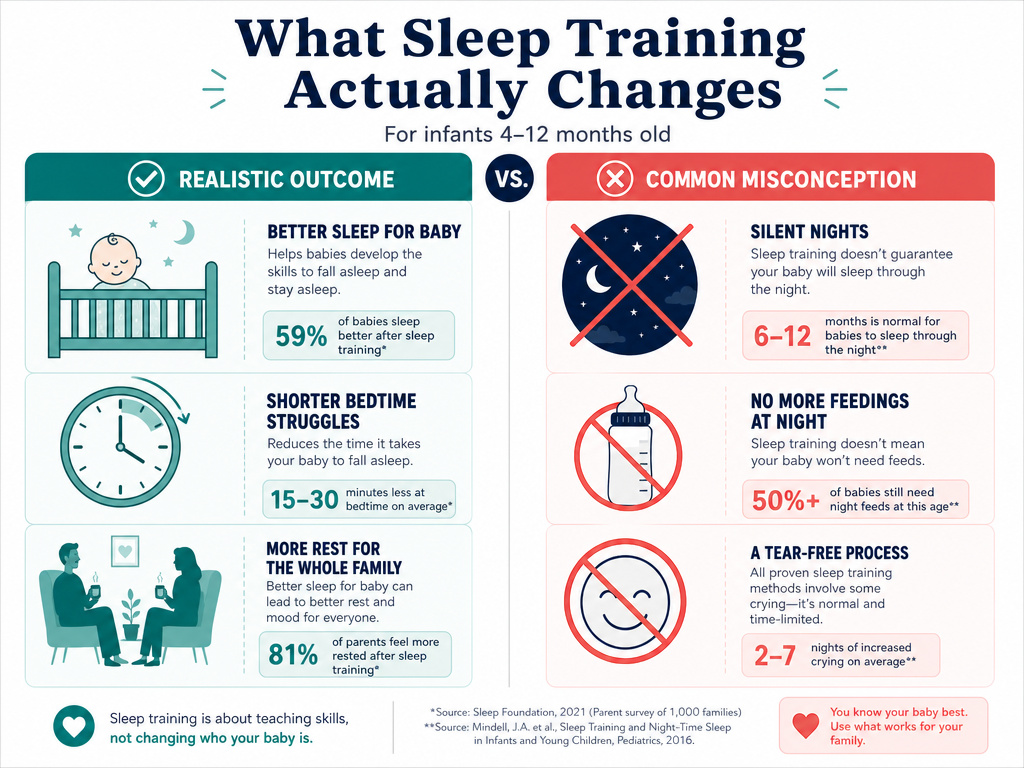 A major misconception is that sleep training equals 12 hours of silent slumber. That’s not the promise.
| Realistic Outcome | Common Misconception |
|---|---|
| Baby learns to fall asleep independently at bedtime. | Baby will never wake at night. |
| Night wakings may shorten as baby self-soothes back down. | All night feedings will instantly stop. |
| Parents gain predictable evenings and reduced stress. | The process will be tear-free for everyone. |
| The skill of self-soothing is learned. | The baby’s fundamental sleep needs change. |
The Infant sleep training review article found significant reductions in severe sleep problems and multiple night wakings. The benefit is fewer problematic wakings, not zero wakings. A baby might still wake, fuss softly, and put themselves back to sleep, that’s success.
Your sleep environment supports this learning. A comfortable, safe space with a good crib mattress and appropriate baby blankets (for older infants) sets the stage.
Frequently Asked Questions
Can I sleep train a 3-month-old?
It’s too early. At 3 months, the circadian rhythm is still organizing, and most babies genuinely need night feeds. Focus on establishing a bedtime routine and putting baby down drowsy but awake to practice. Formal training should wait until at least 4 months, confirmed by your pediatrician.
Does sleep training harm the parent-child bond?
No. Long-term studies, including a five-year follow-up cited in the RACGP guidelines, have found no negative effects on attachment, child behavior, or stress hormone levels. Consistent, responsive care during waking hours is what builds secure attachment.
What if my baby stands up in the crib and cries?
This is a common phase. During your check-ins (if using Ferber), calmly lay them back down without engaging in conversation or eye contact, then leave. They will learn to lie back down on their own. Ensure the crib mattress is at the lowest setting for safety.
How long does sleep training take?
With consistent application, most methods show clear improvement within 3-7 nights. The “cry-it-out” method can work in 3-4 nights, while gentler methods like the chair method may take 2-3 weeks. The first two nights are typically the hardest.
Is it okay to use a lovey or pacifier?
After 12 months, a small lovey is safe. For younger babies, a pacifier is recommended for sleep as it is associated with reduced SIDS risk. If it falls out and baby cries, you can replace it during check-ins until they learn to do it themselves.
Before You Go
The right age to sleep train is less about a perfect date and more about a convergence: a baby showing developmental readiness, a safe sleep environment, and a parental plan you can stick to. The goal is a child who has the skill to settle themselves, within the safety of a predictable routine and a secure safe sleep space.
Pick one method, clear it with your doctor, and commit to a week of unwavering consistency. The data is on your side, these interventions work. What you’re teaching is a foundational life skill, wrapped in safety and care.
