
How to Survive Newborn Sleep Deprivation: The Real Timeline
This post contains affiliate links. As an Amazon Associate we earn from qualifying purchases.
To survive newborn sleep deprivation, you accept the reality of broken sleep for the first 3–6 months and build a system around safety and shared shifts. The goal isn’t more infant sleep—it’s safer infant sleep and protected parental rest. A 2019 study of German parents found good sleep didn’t return for up to six years, but the steepest climb ends between six weeks and seven months postpartum.
That timeline is the median from research on thousands of new parents. Your job in the first six weeks is pure survival, anchored to one non-negotiable rule: safe sleep prevents tragedy, and exhaustion makes mistakes more likely.Every strategy that follows exists to uphold that rule.
What follows is the framework that works: the science behind the exhaustion, the absolute safety specs you cannot bend, and the tactical kit for dividing nights, managing feeds, and knowing when to call for help.
Key Takeaways
- Newborns sleep 16–17 hours daily but in 1–2 hour chunks; most don’t sleep 6–8 hours straight until about 3 months old. Your sleep will mirror this pattern.
- Room sharing on separate surfaces cuts SIDS risk by up to 50%. A firm, flat crib or bedside bassinet with a tight-fitting sheet is the only safe sleep space.
- Split nighttime shifts with a partner using a 4–6 hour block schedule. If solo, secure help for at least one overnight block per week.
- Never use products marketed to help babies sleep longer or deeper (wedges, positioners, monitors). They lack evidence and can create a false sense of security.
- Sleep deprivation is a risk factor for postpartum mood disorders. Tell your doctor if you’re exhausted but can’t sleep, or if sadness persists.
Why Is Newborn Sleep So Disrupted?
Newborn sleep works exactly as designed for a human with a stomach the size of a cherry. They sleep about 16 to 17 hours per day in segments of 1 to 2 hours at a time.This pattern is driven by hunger and brain development, not a flaw in your routine.
The first three months are about survival, not schedules. Your baby’s sleep cycles are shorter and spend less time in deep REM sleep than an adult’s. This lighter sleep pattern is a protective evolutionary trait. It allows them to wake easily if they’re hungry, cold, or in an unsafe position.
Stanford Medicine infant sleep overview confirms that regular sleep cycles don’t typically develop until about 6 months of age. Expecting a newborn to “sleep through the night” is biologically unrealistic.
Your sleep will be fragmented because theirs is. A Lullaby Trust survey found 59% of parents with babies under one year report their baby sleeps for less than four hours at a stretch. You are not failing. You are in the majority.
TL;DR: Newborn sleep is light and brief by biological necessity. Your exhaustion is the expected outcome, not a sign you’re doing it wrong.
The One Rule That Overrides Everything
Exhaustion compromises judgment. In the fog of 3 a.m., the sofa looks like a safe place to rest while feeding. It is not.
Safe sleep is a physical specification. The American Academy of Pediatrics recommendations are built on decades of data to prevent Sudden Infant Death Syndrome (SIDS) and accidental suffocation.Your number one job is to follow them, especially when you’re tired.
The ABCs of safe sleep are your checklist: * Alone: Baby sleeps alone in their own space. No toys, pillows, blankets, or crib bumpers. * Back: Always placed on their back for every sleep. * Crib: A firm, flat sleep surface in a safety-standard crib, bassinet, or play yard.
Where this goes sideways: Falling asleep with a baby on a sofa or armchair. This increases the risk of SIDS by up to 50 times. If you’re feeding on a sofa, set an alarm on your phone for 15 minutes. If you feel drowsy, stop and place the baby in their safe sleep product immediately.
This rule also bans inclined sleepers, nests, and any product claiming to reduce SIDS risk without proof. After the June 2021 CPSC rule, any infant sleep product must meet the same strict federal standards as a crib or bassinet. If your hand indents the sleep surface, it’s too soft. A tilt greater than 10 degrees is unsafe for sleep.
Your safe sleep setup is non-negotiable. It’s the foundation that lets you implement every other survival tactic without fear.
Your Practical Survival Kit
This is about creating a system that defends your sleep within the ironclad rules of safety. The kit has three components: the environment, the division of labor, and the backup plan.
The Environment: Set Up for Safety and Speed
Your baby’s sleep area should be boring and efficient. A crib mattress needs only a tight-fitting fitted sheet. Next to your bed, place a bedside sleeper or bassinet. Room sharing halves the risk of SIDS and minimizes how far you have to walk for night feeds.
| Gear | Safety Purpose | Common Mistake |
|---|---|---|
| Firm, Flat Sleep Surface | Prevents re-breathing and airway obstruction. | Using a padded mattress topper or inclined sleeper. |
| Wearable Blanket / Sleep Sack | Keeps baby warm without loose blankets. | Swaddling after baby shows signs of rolling (often by 2 months). |
| Fitted Sheets Only | Eliminates suffocation risk from loose fabric. | Adding a quilt, bumper, or plush toy for comfort. |
For warmth, use a wearable blanket instead of a loose blanket. If you swaddle, use a swaddle blanket designed for the purpose and stop the moment your baby shows any sign of trying to roll over.
The Division of Labor: The Shift System
If you have a partner, you are a team, not two individuals taking turns being exhausted. The goal is to guarantee each adult one uninterrupted block of sleep (4-6 hours) per 24-hour period.
How the shifts work:
- Split the night into two clear blocks (e.g., 8 p.m.–2 a.m. And 2 a.m.–8 a.m.).
- The “on-duty” parent sleeps in the room with the baby and handles all wake-ups.
- The “off-duty” parent sleeps in a separate, quiet room with earplugs and a white noise machine.
- If the baby is breastfed, the off-duty parent can bring the baby to the feeding parent and then handle the diaper change and resettling.
This system requires a bottle of pumped milk or formula for one feed during the off-duty shift. Introduce one bottle after breastfeeding is well-established (around 3-4 weeks) to make this possible. That single block of deep sleep is a lifeline.
The part nobody mentions: The parent sleeping alone might feel guilt. Ignore it. Protected sleep makes you a safer, more patient caregiver. It is a critical safety strategy, not a luxury.
The Backup Plan: Line Up Your Reserves
You will hit a wall. Plan for it before the baby arrives. * Identify helpers: Who can take a 4-hour shift on a Tuesday night? A parent, a sibling, a trusted friend, or a postpartum doula. * Communicate needs: Be specific. “Could you come over Saturday from 10 p.m. To 2 a.m. So we can both sleep?” is better than “We need help.” * Use the village: Let someone else handle laundry or make a meal. Your job is baby and sleep, not a clean house.
What Not to Do: The Sleep Deprivation Traps
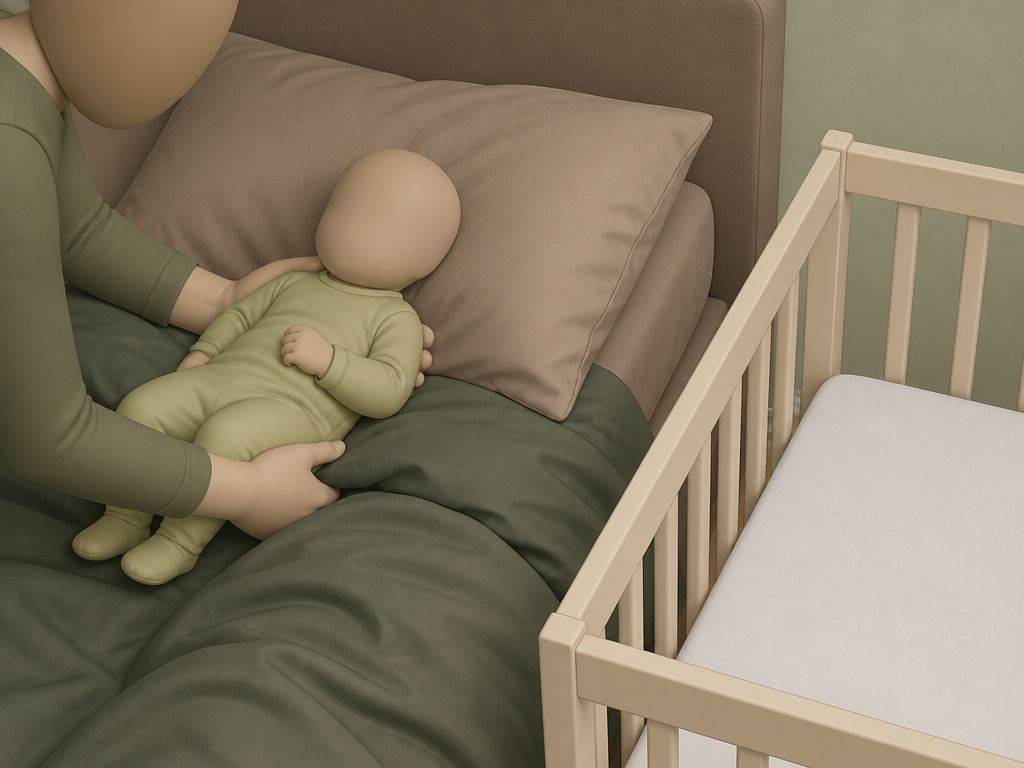
Desperation leads to bad shortcuts. These are the traps that compromise safety for the illusion of rest.
Trap 1: Trying to make baby sleep longer. The Lullaby Trust warns against encouraging longer, deeper sleep. A baby’s ability to wake easily if their airway is blocked is a protective reflex. Products or methods that promote deeper sleep can suppress that reflex.
Trap 2: Bed-sharing without a plan. The CDC safe sleep guidelines are clear: the safest place for a baby is alone in their own crib or bassinet. If you are so exhausted that bed-sharing feels inevitable, you must prepare the adult bed: remove all pillows and heavy blankets, ensure the mattress is firm, and never do it if you’ve taken sleep aids, alcohol, or are on a sofa.
Trap 3: Ignoring your mental health. Sleep deprivation is a direct risk factor for postpartum depression and anxiety. Warning signs include lying awake with a racing mind when the baby is finally asleep, or feeling persistent sadness and hopelessness.
If you are exhausted but can’t sleep, tell your doctor. This is a medical symptom, not a personal failing. Support exists.
When Does It Get Better?
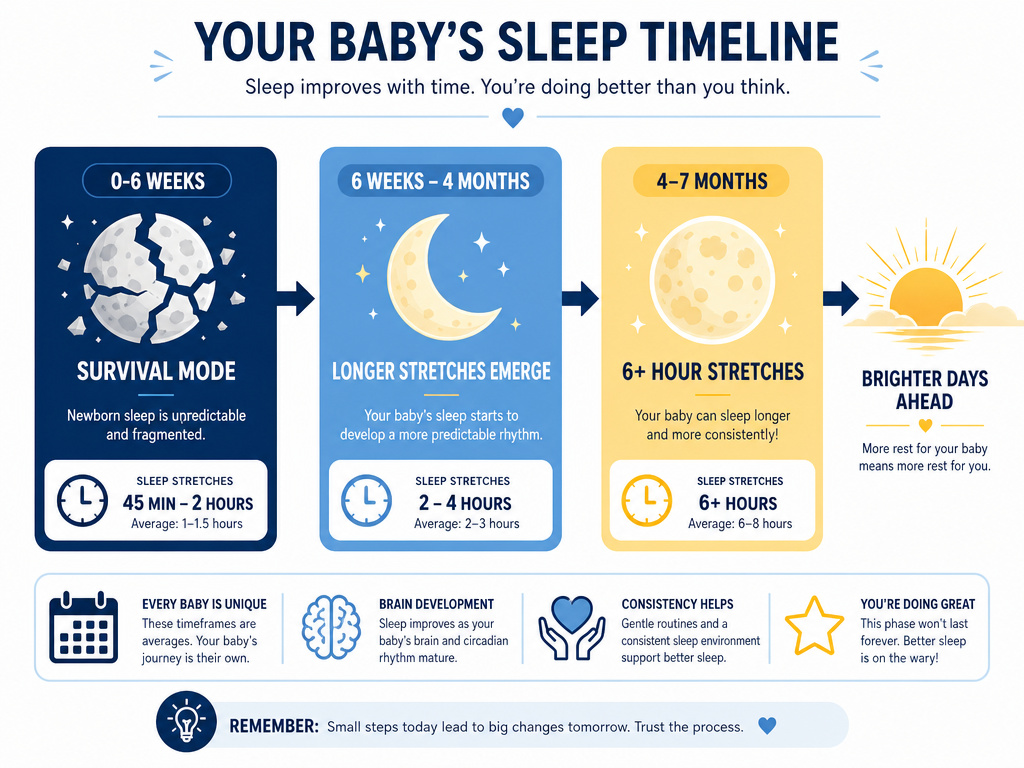
You need a light at the end of the tunnel. The data provides one.
Research indicates parental sleep usually improves significantly between six weeks and seven months postpartum. The first six weeks are the steepest climb. After that, night feeds may space out, and baby’s sleep cycles begin to consolidate.
| Postpartum Period | Typical Sleep Reality | Parental Goal |
|---|---|---|
| 0–6 Weeks | Survival mode. 1–2 hour sleep fragments. | Protect safe sleep above all. Implement shifts. |
| 6 Weeks – 4 Months | Longer 3–4 hour stretches may emerge. | Establish a simple bedtime routine. |
| 4–7 Months | Many babies can sleep 6+ hour stretches. | Work toward independent sleep onset in the crib. |
A 2019 German study of over 2,000 parents found sleep duration and satisfaction plummeted in the first three months. While the study noted good sleep might not return to pre-pregnancy levels for up to six years, the most intense, dangerous deprivation phase has a much shorter horizon.
Your baby will change. The newborn bedding you chose for safety will still be relevant, but your capacity to think clearly will return. Hold on for the first six weeks. Then look for the gradual shift.
Frequently Asked Questions
How little sleep is dangerous for a parent?
Chronic sleep deprivation (less than 4-5 hours per 24 hours across multiple days) impairs cognitive function equivalent to being legally drunk. It increases risk of accidents, lowers frustration tolerance, and is linked to postpartum mood disorders. If you’re hallucinating, experiencing extreme confusion, or having thoughts of harming yourself or your baby, seek emergency medical help.
Can I sleep when the baby sleeps?
Yes, but it’s often impractical. The phrase is well-intentioned but ignores other needs (eating, showering, other children). Aim for one daytime nap that aligns with your baby’s longest sleep block. Even 20 minutes of shut-eye can improve alertness. Don’t stress about cleaning the house instead of napping.
Is it safe to use a sound machine?
Yes, a continuous white noise or pink noise machine is safe and can help mask household sounds that might startle a baby (and you) awake. Keep it at a moderate volume (around 50 decibels, or the sound of a quiet shower) and place it across the room from the sleep space, not inside the crib.
What if I’m a single parent with no help?
This is the hardest scenario. Your priority is to engineer one 4-hour block of uninterrupted sleep as often as possible. This may mean hiring a night doula for one night a week, trading childcare with another single parent, or asking a relative to stay over on weekends. Even one full sleep cycle per week can reset your system. Also, ensure your baby’s infant sleep product is right next to your bed to minimize awake time during feeds.
Are weighted sleep sacks or swaddles safe?
No. The AAP explicitly advises against weighted swaddles, sleep sacks, or blankets. The added weight can make it harder for a baby to arouse from sleep, which may interfere with their natural protective reflexes and increase risk. Use a standard, well-fitted wearable blanket for warmth.
The Bottom Line
Surviving newborn sleep deprivation is a defensive operation. You are guarding two things: your baby’s physical safety and your own mental health. The tactics—shifts, a bare crib, asking for help—are just armor for that mission.
The fog does lift. The first six weeks are the trench. By seven months, you’ll have more nights than not where sleep feels possible again. Until then, measure success in safe nights survived, not hours slept. Your job isn’t to get the baby to sleep. Your job is to get everyone through this season intact. That’s enough.
