
Can Newborns Sleep in Socks? The Sizing & Safety Truth
This post contains affiliate links. As an Amazon Associate we earn from qualifying purchases.
Newborns can sleep in socks if the socks fit snugly, do not restrict circulation, and are worn under a properly sized sleep sack or wearable blanket as part of their sleepwear ensemble. The primary risk isn’t the sock itself; it’s overheating from too many layers or a loose sock that slips off and becomes a suffocation hazard. A fitted, cotton sock under a 1.0 TOG sleep sack is safe at a room temperature of 68–72°F (20–22°C).
That temperature range is the whole game. Overheating is a documented risk factor for SIDS, and adding a sock is adding a layer. You must account for it in the total thermal load. The question shifts from “can they” to “should they, given what else they’re wearing and how warm the room is.”
What follows: the specific fit rules that prevent circulation cuts, the TOG math that stops overheating, the government flammability specs most parents never see, and the three scenarios where a sock is genuinely the right call. By the end, you’ll be able to look at any sleep setup and know if a sock belongs in it.
Key Takeaways
- Socks are safe only if they stay on without leaving elastic marks and are part of a total layer count that prevents overheating.
- Loose socks that slip off are a suffocation risk; a bare foot is safer than a lost sock in the crib.
- The ASTM F3735 standard covers wearable sleep products for infants up to 2 years, setting safety benchmarks socks should indirectly meet.
- Health Canada’s flammability regulations demand an average char length under 178mm for loose-fitting sleepwear—most baby socks aren’t tested to this standard.
- For consistent warmth, a TOG-rated sleep sack or footie pajamas are safer, more reliable choices than socks.
The Core Rule: Fit Over Fashion
A safe sock fits like skin. It should not leave a deep imprint, a red ring, or any mark that lasts more than a few seconds after you remove it. That imprint signals restricted blood flow. Newborn circulation is still developing, and constant pressure from a tight cuff can cause damage over a single night’s sleep.
A wearable sleep product must not impair circulation or breathing. The ASTM infant sleepwear standard (F3735-26) explicitly covers products worn over daywear or sleepwear for infants up to 2 years old, setting performance requirements to reduce injury risk from foreseeable use and misuse.
The second fit rule is about loss. A sock that is too loose will come off. Inside a sleep sack or crib, a detached sock becomes a loose object. An infant can maneuver it over their face. It’s a soft, pliable suffocation hazard that most parents don’t consider when they put a cute, slightly-big sock on at bedtime.
Where this goes sideways: Putting a newborn in socks that are a size up “to grow into.” The cuff is loose, the heel pouch is empty. The sock twists, slides down, and is kicked off within an hour. You now have a hazard in the sleep space and a cold foot.
| Fit Problem | Immediate Sign | Long-Term Risk |
|---|---|---|
| Too tight | Red ring or deep imprint on ankle/calf | Restricted circulation, tissue damage |
| Too loose | Sock twists, heel not seated, easy to pull off | Sock becomes loose bedding, suffocation hazard |
| Too long | Excess fabric bunches at toes | Can curl toes, restrict movement, cause discomfort |
The fix is simple. If you use socks, use ones labeled for the newborn’s current weight range, not their future size. Check the cuff after 30 minutes of wear. If there’s a mark, go up a size or choose a different style. If the sock comes off once, retire that pair for sleep.
The Overheating Equation
Overheating is a confirmed risk factor for Sudden Infant Death Syndrome (SIDS). A sock is a layer. You must count it. The goal is to dress the baby in enough clothing to keep them comfortably warm without causing them to sweat or overheat.
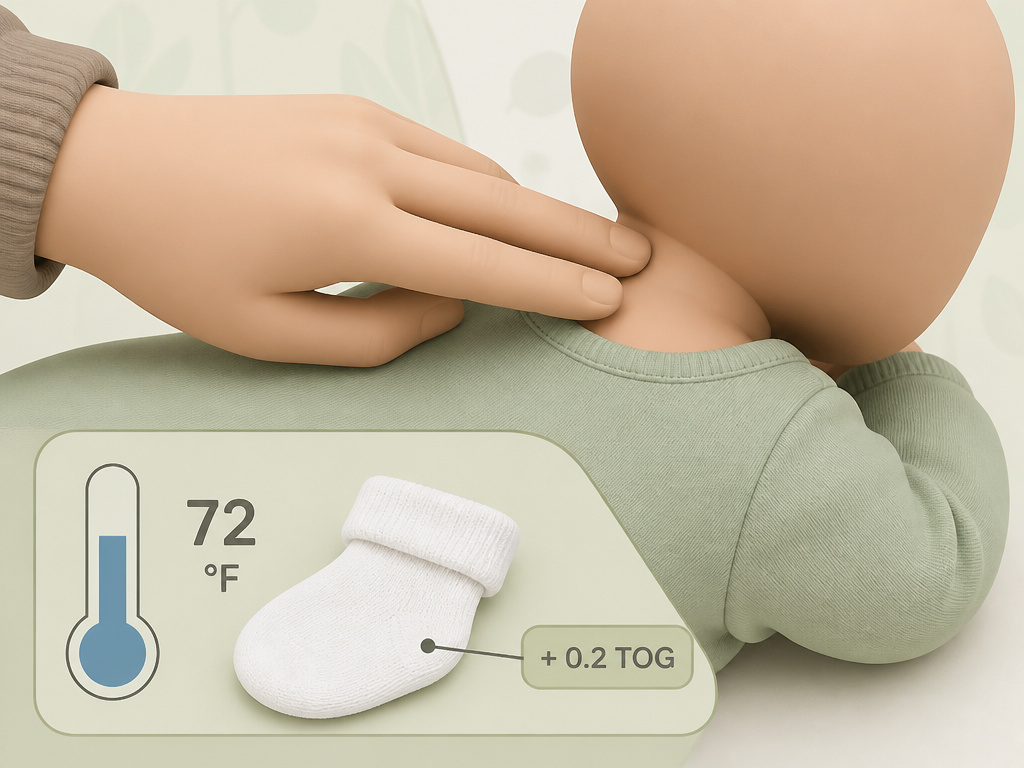
The standard measure for infant sleepwear warmth is the TOG (Thermal Overall Grade) rating. A 1.0 TOG sleep sack is suitable for a room at 68–72°F (20–22°C). If you add a sock underneath, you are effectively adding roughly 0.2 TOG. In a room already at 72°F, that could push the baby into the overheating zone.
Common mistake: Feeling a baby’s cool hands or feet and adding a sock. Hands and feet are naturally cooler. The right check is the back of the neck or the chest. If the skin there is warm and dry, the baby is fine. If it’s sweaty or clammy, they’re too hot.
Here is the layer math that works for most homes: – Room 68–72°F (20–22°C): A cotton onesie + a 1.0 TOG sleep sack. – Same room, with a sock: A cotton onesie + a 0.5 TOG sleep sack + a cotton sock. – Room below 68°F (20°C): A cotton onesie + a 2.5 TOG sleep sack. Socks are typically unnecessary as the sack provides full-foot coverage.
The CDC safe sleep guidance emphasises a bare sleep environment to prevent overheating. While a sock isn’t “loose bedding,” it contributes to the thermal load. The official recommendation is to use sleep clothing, such as a wearable blanket, as an alternative to blankets to keep the infant warm without the risk of covering the head.
When Socks Are the Right Answer (And When They Aren’t)
Socks solve specific problems. Outside of these scenarios, a footed sleeper or sleep sack is almost always the simpler, safer choice.
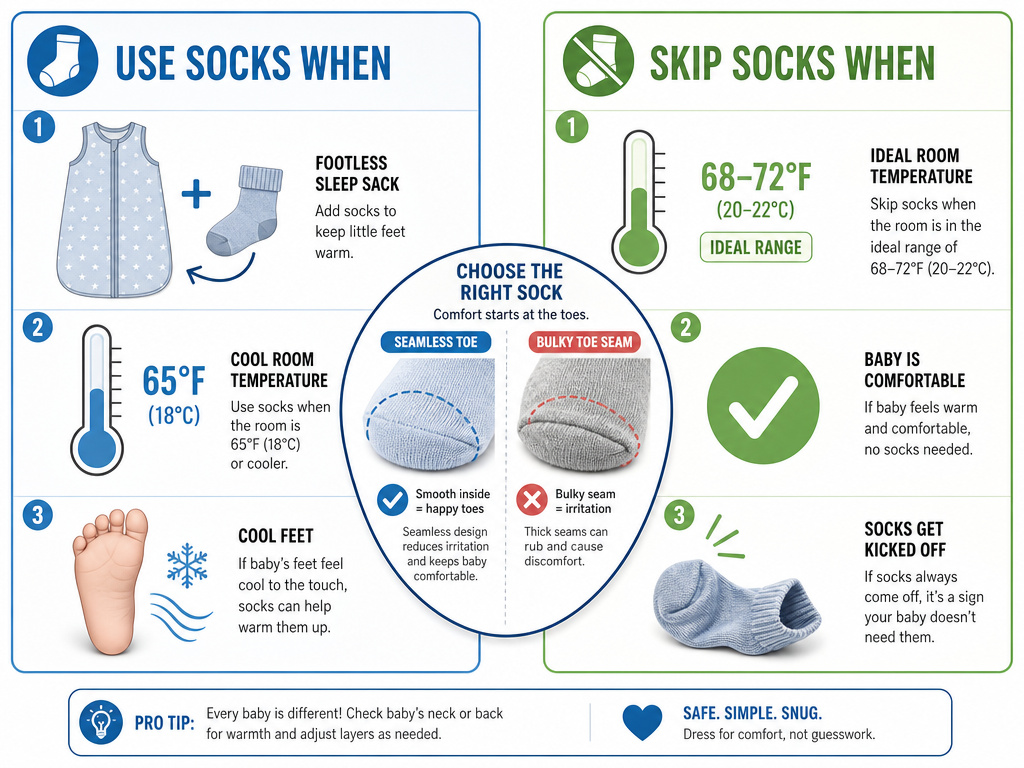
Use socks when:
- The sleep sack is footless. This is the most legitimate reason. If your preferred sleep sack model (like many Halo or Woolino designs) is footless, a well-fitted sock completes the ensemble.
- You’re in a drafty, older home and the room temperature fluctuates below 68°F at night, even with a 2.5 TOG sack. The sock adds a targeted bit of warmth.
- The baby has cool extremities due to circulation (confirmed by your pediatrician) and needs the extra layer on the feet specifically.
Skip socks and choose footie pajamas or a footed sack when:
- The room temperature is consistently within the ideal range.
- You are troubleshooting overnight wake-ups and want to eliminate variables.
- The baby is a frequent kicker who routinely removes socks.
The part nobody mentions: The seam at the toe of a sock. Cheap socks have bulky, irritating seams that press against a newborn’s sensitive toes all night. If you use socks, inspect the inside and choose seamless varieties. That seam is why many babies fuss until the sock is pulled off.
For everyday, reliable warmth, a one-piece solution is best. A footed pajama like those from Burt’s Bees or a Kyte Baby sleep sack integrates the foot covering, removing the fit variable and the loss risk entirely. It’s one less thing to check at 2 a.m.
The Hidden Standards: Flammability and Product Safety
Baby clothing, including sleepwear, is regulated for safety. In Canada, the Health Canada Children’s Sleepwear Regulations (SOR/2016-169) set strict flammability requirements. Loose-fitting sleepwear (which includes certain sleep sacks) must have an average char length not exceeding 178 mm when tested, with no single specimen burning the full 254 mm length.
While socks are often exempt as “accessories,” the principle is vital: sleepwear should resist ignition and not accelerate flame. This is why snug-fitting cotton or cotton-blend pajamas are the baseline. A loose, fuzzy sock made from synthetic material doesn’t meet this safety ethos, even if it isn’t legally classified as sleepwear.
Furthermore, the Consumer Product Safety Commission (CPSC) rule from June 2021 mandates that any product marketed for infant sleep for babies 5 months and younger must meet the federal safety standards for cribs, bassinets, or play yards. This targeted inclined sleepers and “baby nests,” but it underscores the regulatory scrutiny on the infant sleep environment. Every component matters.
| Safety Aspect | Regulation / Standard | What It Means for Socks |
|---|---|---|
| Flammability | Health Canada SOR/2016-169 | Socks aren’t tested as sleepwear, but materials should be flame-resistant (e.g., tight-fitting cotton). |
| Wearable Product Safety | ASTM F3735 | Sets benchmarks for garments worn during sleep; socks should not impair circulation or breathing. |
| Sleep Product Definition | CPSC Rule (June 2021) | Reinforces that the entire sleep environment is regulated for hazards. |
These aren’t abstract rules. They are the engineering behind the recommendation to avoid loose, synthetic, or poorly fitting items in the crib. Your choice of sock material and fit should respect the intent of these standards.
Better Alternatives to Socks for Nighttime Warmth
If your goal is warm feet, socks are a fiddly solution. These alternatives are safer and more effective.
1. Footed Sleep Sacks (Wearable Blankets)
This is the top recommendation. Brands like Zipadee-Zip, Gunamuna, and Ergobag make sacks with integrated feet. They provide continuous coverage that can’t be kicked off, and their TOG ratings account for the entire garment. You solve the warmth problem and the hazard problem in one product.
2. Footie Pajamas (One-Piece Sleepers)
A classic for a reason. A well-sized footie pajama, like a magnetic me gown or a simple Carter’s sleeper, is a single layer of fitted warmth. There’s no gap at the waist where a top and bottom separate, and the feet are permanently attached. For swaddled newborns, a footie pajama under the swaddle is the standard base layer.
3. Adjustable Wearable Blankets
Some wearable blankets, such as the Dreamland Baby weighted sack, come with optional, attachable foot covers. This gives you flexibility: use the feet on colder nights, remove them when it’s warmer. It’s a modular approach that adapts to changing temperatures without introducing a separate sock.
The AAP safe sleep guidelines consistently recommend wearable blankets as the safest way to keep an infant warm. When you use a dedicated sleep sack, you’re using a product designed for the job, tested for safety, and measured for warmth. A sock is a workaround. In safety-critical environments, you choose the tool designed for the task.
Frequently Asked Questions
Can socks cause overheating in newborns?
Yes, absolutely. A sock is an additional layer of insulation. In a room that is already at the warmer end of the safe range (72°F/22°C), adding socks under a sleep sack can push a newborn into the overheating zone. Always check the nape of the neck for sweat, not the feet for coolness, to gauge true body temperature.
What type of socks are safest for sleep?
The safest socks for sleep are made of 100% cotton or a tight-fitting cotton blend, have no loose threads or embellishments, and feature a seamless toe. They must fit snugly without leaving marks. Avoid loose, slouchy, or overly thick acrylic socks, as they pose a higher suffocation risk and can contribute to overheating.
Is it safe for a newborn to wear socks under a swaddle?
It can be safe, but it requires careful layering. If you are using a swaddle blanket or sack over the baby’s clothing, the sock becomes part of that base layer. The total ensemble must not cause overheating. A common safe setup is a cotton onesie, fitted cotton socks, and a lightweight muslin or cotton swaddle. Always ensure the swaddle is snug around the arms and chest but loose at the hips and feet to allow healthy leg movement.
How can I tell if my baby’s socks are too tight?
Remove the sock after your baby has been wearing it for 30 minutes. Look at the line left by the cuff. If you see a deep, red imprint that doesn’t fade within 10-15 seconds, the sock is too tight. Also, check the toes after removal. If the skin is significantly wrinkled or discolored, the sock is either too small or too restrictive.
Are sleep sacks with feet safer than socks?
Yes, in almost every case. A sleep sack with integrated feet is a single, tested product. It cannot come off to become a loose object, its warmth rating (TOG) is standardized, and its fit is designed to be safe for sleep. It eliminates the two biggest risks of socks: becoming a hazard and being an unaccounted-for layer in your temperature math.
Before You Go
The short answer is yes, but the real answer is “it depends on everything else.” A sock is never just a sock in a newborn’s crib. It’s a thermal layer, a potential hazard, and a test of fit. The government and medical standards exist for a reason—overheating and suffocation are real risks with documented outcomes.
Your default should be a footed sleeper or a TOG-rated sleep sack. Use socks as a targeted tool for specific situations: a footless sack on a cold night. Always buy for current fit, check for marks, and prioritize seamless, breathable cotton. When in doubt, feel the back of the neck, not the feet. Warm and dry means they’re dressed just right.
