
Can Newborns Nap in Another Room? The AAP 6-Month Guideline
This post contains affiliate links. As an Amazon Associate we earn from qualifying purchases.
A newborn should not nap in a different room. The American Academy of Pediatrics and other health authorities recommend room-sharing, placing your baby’s crib, bassinet, or portable play yard in your bedroom, for at least the first six months, and ideally for the first year. This applies to all sleep, including naps, and is shown to reduce the risk of Sudden Infant Death Syndrome (SIDS) by as much as 50%.
That six-month line is drawn from mortality data that shows where the risk curve drops, so it is not a suggestion you can bend for convenience. The recommendation treats naps and nighttime sleep identically because a sleeping baby’s physiology doesn’t know the clock.
What follows is a breakdown of why room-sharing is non-negotiable for naps, how to set up a safe sleep space right next to your bed, and the specific, evidence-backed timeline for when you can safely move naps to another room. We’ll also cover the realistic scenario every parent faces: what to do when you accidentally fall asleep feeding the baby.
Key Takeaways
- Room-sharing for naps is as critical as for nighttime sleep for the first six months, cutting SIDS risk significantly.
- The AAP’s 2022 update recommends room-sharing for a full year, but the first six months carry the highest protective benefit.
- A safe separate sleep space means a firm, flat mattress in a CPSC-approved crib, bassinet, or play yard with only a fitted sheet.
- If you fall asleep with your baby in an adult bed, move them back to their own sleep surface immediately upon waking.
- Transitioning naps to a separate nursery is safest after six months, once the peak SIDS risk period has passed.
What Do the Official Guidelines Say?
The guidance is unanimous and specific. It doesn’t distinguish between a two-hour nap and an eight-hour night.
Room sharing, placing the infant’s crib, portable crib, play yard, or bassinet in the parents’ bedroom, is recommended for at least the first 6 months and ideally for the entire first year. This arrangement reduces the risk of SIDS by as much as 50% and is safer than both bed sharing and sleeping in a separate room.
This 50% risk reduction comes from the American Academy of Pediatrics’ 2022 evidence review. The mechanism isn’t fully understood, but it’s thought that parents’ presence, breathing sounds, and movements help regulate the infant’s own breathing and prevent deep sleep states where arousal is difficult.
The CDC safe sleep guidelines echo this, advising that the baby’s sleep area be in the same room where you sleep for at least the first six months. State health departments have built their own materials on this federal core. The Texas DSHS room-sharing recommendations, finalized in February 2024, state the terms clearly: “Share your room with your baby for at least the first six months or up to the first year.”
The “six months or up to one year” phrasing is the key. The first six months cover the period of highest vulnerability. After that, the risk declines, but the protective benefit of room-sharing continues. That’s why the ideal is a full year.
| Organization | Minimum Room-Sharing Period | Ideal Period | Applies To |
|---|---|---|---|
| American Academy of Pediatrics (AAP) | 6 months | 1 year | All sleep (naps & night) |
| Centers for Disease Control (CDC) | 6 months | Not specified | All sleep |
| Texas Department of State Health Services | 6 months | 1 year | All sleep |
The bottom line: If your baby is under six months old, their nap spot needs to be in your room. A nursery down the hall, no matter how beautifully prepared, does not satisfy the safety standard during this critical window.
Why Naps Are No Different Than Nighttime Sleep
A baby’s risk of SIDS doesn’t check the time of day. The same physiological vulnerabilities that make room-sharing protective at 2 a.m. Are present at 2 p.m.
The deep-sleep argument is central here. Young infants have immature respiratory and arousal systems. During deep sleep, they may have longer pauses in breathing or fail to rouse themselves if their airway becomes obstructed. The sensory stimuli from a parent in the same room, the sound of breathing, rustling sheets, even ambient light, may help keep the baby in a lighter, safer sleep stage or prompt gentle arousals. This regulatory effect is needed for every sleep cycle, not just the overnight ones.
Where this goes sideways: Assuming a short nap is a lower-risk event. The data on sleep-related deaths doesn’t show a dip for daytime sleep. A baby left to nap alone in a swing, on an adult bed, or in a separate room before six months faces the same statistical hazards.
Furthermore, consistency matters for habit formation. Using a safe crib mattress in a bedside crib for every sleep reinforces that this is the only place for sleeping. It reduces the temptation to put a baby down for a “quick nap” on an unsafe surface like a couch or armchair because the proper sleep space is right there.
How to Set Up a Safe Separate Sleep Space
Room-sharing means a separate, approved sleep surface within arm’s reach of your bed, not in your bed. This is the non-negotiable setup.
Your options are a safety-approved crib, bassinet, or portable play yard. The Consumer Product Safety Commission (CPSC) sets the standards these products must meet. Look for a label or certification stating it meets CPSC safety standards. For a bedside bassinet, this is especially critical, as it will be adjacent to your adult bed.
The sleep surface itself must be firm and flat. Press on the mattress in the center and at the edges. It should not indent or conform to the shape of your hand. A soft, plush, or memory foam mattress is dangerous, it can create a pocket where an infant’s face can press, leading to rebreathing or suffocation. The only thing on the mattress should be a tight-fitting sheet designed for that specific model.
The 4-item safety checklist for the sleep space:
- CPSC-approved product: Crib, bassinet, or play yard with visible certification.
- Firm, flat mattress: No pillows, toppers, padded bumpers, or positioners.
- Empty crib: No toys, loose blankets, pillows, or stuffed animals.
- Correct placement: Next to your bed, away from windows, cords, and drapes.
This setup gives you the monitoring benefit of room-sharing while maintaining the safety of a separate, controlled environment. It makes those night feedings easier, too, you can soothe or feed without fully leaving your bed.
The Critical Difference Between Room-Sharing and Bed-Sharing
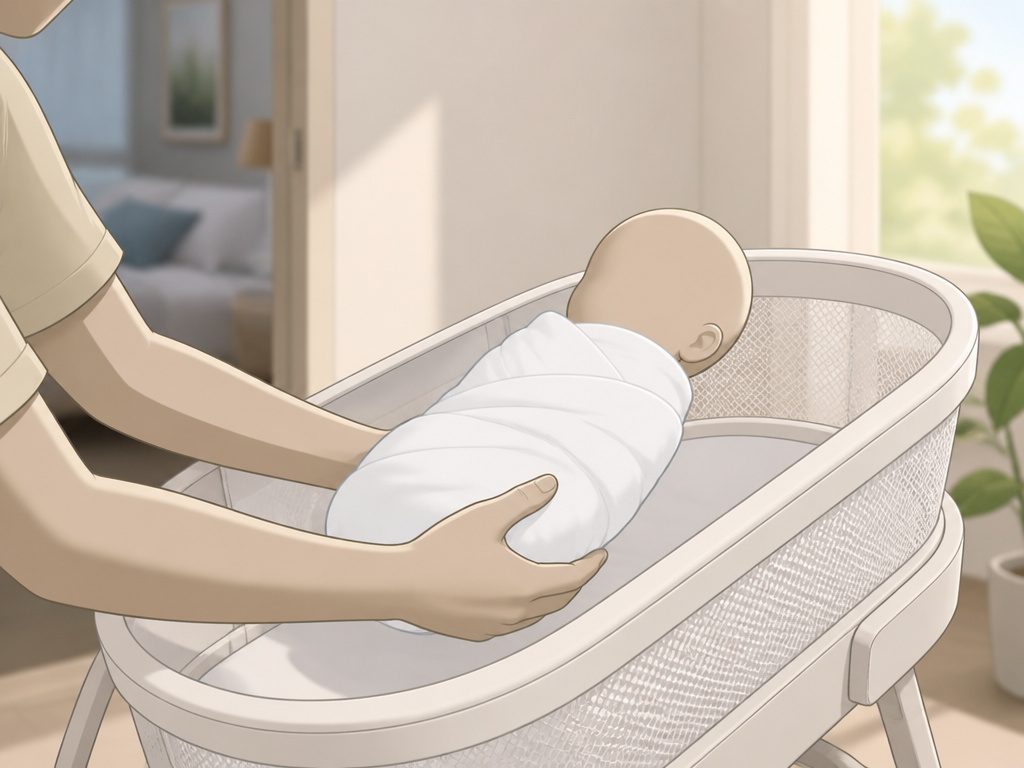
This is the line that saves lives. Room-sharing is safe. Bed-sharing, especially for infants under four months, drastically increases the risk of SIDS and accidental suffocation.
The AAP safe sleep recommendations are unambiguous: they cannot recommend bed-sharing under any circumstances. Adult beds are not designed for infant safety. They have soft mattresses, heavy bedding, pillows, and gaps where a baby can become trapped.
Common mistake: Bringing the baby into bed to feed or comfort and accidentally falling asleep. If you do fall asleep, place the baby back on their separate sleep surface as soon as you wake up.
The Texas DSHS document provides a practical tip for this universal scenario: before bringing the baby into your bed, remove all soft bedding, toys, and pillows from the area. Set a timer to go off every few minutes to keep you awake. Have someone stay with you. This approach focuses on harm reduction when the ideal plan fails, rather than perfect compliance.
If your goal is closeness, a co-sleeping bassinet that attaches securely to the side of your bed provides a barrier-free view and easy access while keeping the baby on their own firm surface. It’s the middle ground that satisfies the safety rules.
When Can You Safely Move Naps to a Different Room?
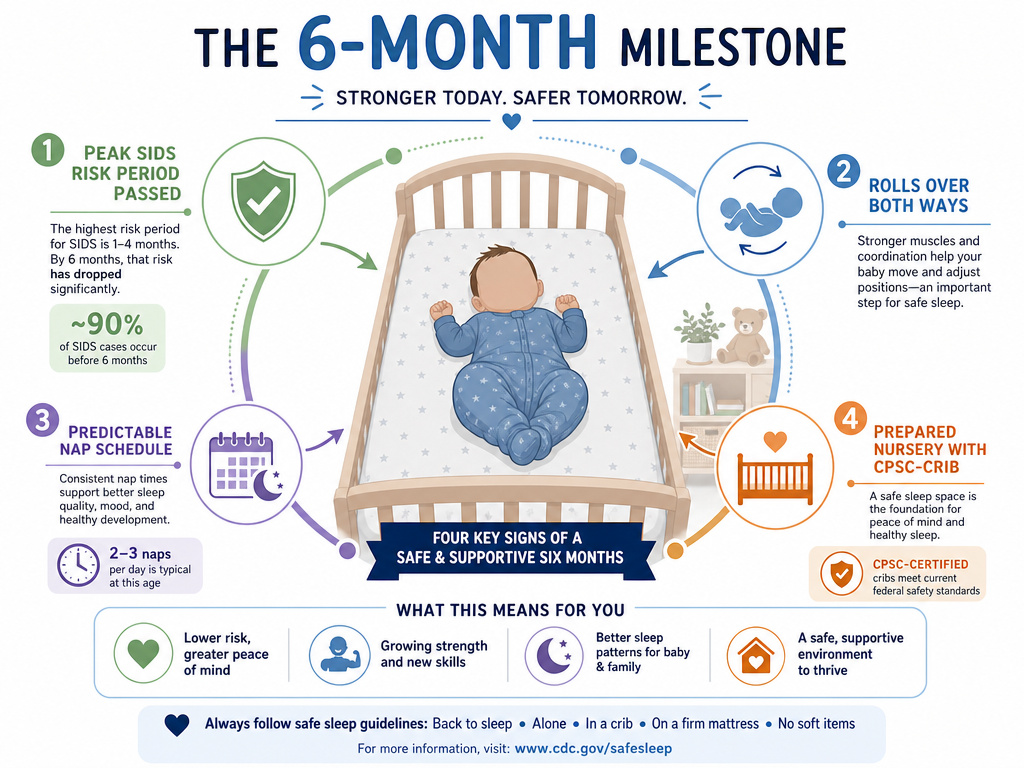
The timeline is driven by risk reduction, not developmental milestones like rolling over.
The safest transition point is after the baby reaches six months of age. This aligns with the end of the highest-risk period for SIDS. Many parents choose to move naps to the nursery at this six-month mark while continuing nighttime room-sharing until closer to one year. This is a reasonable, graded approach supported by the “ideal for one year, essential for six months” framework.
Signs your baby is ready for nap transitions (after 6 months):
- They are past the peak SIDS risk period (2-4 months).
- They can roll over both ways independently.
- They are on a somewhat predictable nap schedule.
- Their nursery is fully prepared with a safe infant mattress in a CPSC-approved crib.
Start with the first nap of the day in the nursery. Babies are often most alert and content in the morning. Use a consistent pre-nap routine (e.g., book, sleep sack, white noise) to signal the change. A reliable video monitor becomes essential now, choose one without unnecessary features that can cause anxiety.
What About Unsafe Surfaces for Naps?
The rule is simple: if it’s not a designed sleep product, it’s not safe for unsupervised sleep. This is true regardless of the room.
The list of unsafe surfaces is long because the ways an infant can suffocate are numerous. Couches and armchairs are exceptionally dangerous due to cushions, gaps, and backrests. Adult beds, waterbeds, air mattresses, and bean bags are too soft. Swings, bouncers, and car seats are for transportation and containment, not for prolonged sleep.
Never place a baby to sleep on a standard bed, couch, futon, or armchair. A baby can suffocate when sleeping on these unsafe surfaces.
If your baby falls asleep in a swing or car seat, move them to their firm, flat sleep surface as soon as is practical. For naps, “as soon as is practical” means immediately. Don’t let the convenience of a sleeping baby in a carrier override the clear physical hazard.
The Washington State infant sleep guidelines put it bluntly: “Don’t sleep with your baby in a bed, on a chair or couch, put your baby in his or her own bed.” That “own bed” should be a nursery mattress in a approved crib if they are in their own room, or in a bedside bassinet for newborns if they are in yours.
Frequently Asked Questions
Can I let my newborn nap in the living room while I’m awake and watching?
Even under supervision, the sleep surface itself must be safe. A bassinet or play yard placed in the living room is acceptable if it meets all safety standards (firm, flat, empty). Letting a newborn nap unsupervised on a couch or recliner is unsafe, regardless of you being in the same room. The risk of sudden suffocation is too fast for even a watchful parent to prevent.
My baby only naps well in a swing. What should I do?
This is a common but serious problem. Swings are not safe for sleep due to the semi-reclined position and risk of positional asphyxia. You must transition the baby to a flat, firm surface. Start by ensuring the baby is fully awake when placed in the crib or bassinet. Use strong white noise and darken the room. It will take consistency, often 3-5 days of persistent tries, to break the swing habit. The short-term struggle is worth the long-term safety.
Does room-sharing mean I can’t use a white noise machine?
You can and should use a white noise machine. It helps mask household sounds that might disturb the baby (and you). Place the machine between the baby’s sleep space and the door or source of noise, not directly next to the baby’s head. Keep the volume at a reasonable level (around 50 decibels, similar to a quiet shower).
What if my bedroom is too small for a crib?
If a standard crib won’t fit, a bedside sleeper bassinet or a compact, CPSC-approved portable play yard is the solution. These are designed specifically for small spaces and can be placed right next to your bed. The key is verifying the product meets current safety standards before purchase.
Are there any exceptions to the 6-month rule?
The guidelines are based on population-level risk reduction. There are no official exceptions for healthy, term infants. For babies with specific medical conditions, a pediatrician may give tailored advice, but this is rare. The consistent recommendation from the peer-reviewed SIDS prevention study is clear: room-sharing for six months is a universal standard.
Before You Go
The question concerns where your newborn sleeps, period, rather than naps. For the first six months, that answer is a firm, flat, empty crib or bassinet in your bedroom.
The nursery can wait. The cute decor and rocking chair aren’t going anywhere. The statistical window for peak vulnerability, however, is narrow and non-negotiable. Set up a safe bedside sleeper bassinet or crib in your room. Use it for every single sleep.
When you hit that six-month mark, you can start moving daytime naps to the nursery with confidence, knowing you’ve provided the safest possible start. That’s the goal: understanding the evidence behind the rule so you can make informed choices for every sleep.
