
Choosing the Best Night Light Color for Your Baby’s Sleep
This post contains affiliate links. As an Amazon Associate we earn from qualifying purchases.
The best color night light for baby sleep is a dim red or amber light. These warm colors have longer wavelengths that minimally impact melatonin, the sleep hormone. Avoid blue, white, and green lights, which have short wavelengths that suppress melatonin and signal wakefulness to the brain, making it harder for babies to settle and stay asleep.
This answer hinges on a specific measurement called melanopic equivalent daylight illuminance (melanopic EDI). It’s a metric that predicts how light will affect the body’s internal clock, and it explains why a dim red glow is sleep-friendly while a bright white one is not. The common advice to pick warm colors is correct, but the why is more precise, and more useful, than most guides let on.
What follows: the peer-reviewed evidence on how light color and brightness affect sleep architecture, a breakdown of which colors to pick and which to skip, and the practical steps to implement a night light without sabotaging your baby’s rest.
Key Takeaways
- Red and amber lights are best because their long wavelengths have the least impact on melatonin production, protecting your baby’s natural sleep-wake cycle.
- Blue and white lights are the most disruptive; they suppress melatonin strongly and can trick the brain into thinking it’s daytime, leading to longer bedtimes and more night wakings.
- Brightness matters as much as color. A night light should be just bright enough for you to navigate, aim for under 10 lux at the crib, which is about the light from a single candle several feet away.
- Placement is critical. Position the light low and away from the crib to avoid direct exposure to your baby’s eyes.
- Some babies are more light-sensitive than others. If sleep problems persist after switching to a warm, dim light, try a night without it.
The Science of Light and Sleep
Light doesn’t just let us see. It’s the primary signal that tells our brains whether it’s day or night. Specialized cells in our eyes, called intrinsically photosensitive retinal ganglion cells (ipRGCs), detect light and send signals directly to the brain’s master clock, the suprachiasmatic nucleus. This clock regulates the production of melatonin.
The Technical Snippet: Melanopic equivalent daylight illuminance (melanopic EDI) is the preferred metric for predicting non-visual, circadian responses to light. A 2022 systematic review in Lighting Research & Technology concluded that melanopic EDI provides a robust predictor for sleep effects, with levels above 100 lx showing clear dose-response relationships for delaying sleep onset. For healthy evening exposure, recommendations are to keep melanopic EDI under 10 lx in the 3 hours before bedtime.
This is why the old rule of “avoid bright lights before bed” is incomplete. A dim, warm light and a dim, cool light can have the same brightness in lumens but wildly different effects on melatonin. The ipRGCs are most sensitive to light in the blue spectrum, around 450–480 nanometers. This is the color of a clear midday sky, and of many LED bulbs and screens.
The body’s response isn’t just about feeling sleepy. It changes the structure of sleep itself. A 2005 study in the Journal of Physiological Anthropology and Applied Human Science exposed adults to different color temperatures of light before bed. It found that exposure to a 6700K (cool white) light source significantly reduced the amount of deep, stage-4 slow-wave sleep in the early part of the night compared to a 3000K (warm white) light. Slow-wave sleep is crucial for physical restoration and memory consolidation.
For babies and children, the effect can be even more pronounced. Their eyes are still developing, and some research suggests their melatonin may be more easily suppressed. One finding noted that children had greater melatonin suppression than adults when exposed to light, and it was even more suppressed under yellow light than whitish-blue light in one test. This underscores that the common advice isn’t just for adults, it’s often more critical for little ones.
What Color Night Light Is Best for Baby Sleep?
The winner is a very dim red or amber (warm orange) light. Second place is a dim warm white light, used sparingly. The goal is to choose a color with a long wavelength that the circadian system largely ignores.
| Light Color | Wavelength | Effect on Melatonin & Sleep | Best Use |
|---|---|---|---|
| Red / Amber | Long (~620-750 nm) | Minimal to no suppression. Safest for maintaining sleep-wake cycles. | Ideal for all-night nursery use, feeding, and diaper changes. |
| Warm White | Mixed, but low blue content | Low suppression if kept very dim. Better than cool white but not as good as red. | An acceptable alternative if red/amber isn’t available. Keep brightness extremely low. |
| Blue / Cool White | Short (~450-495 nm) | Strong suppression. Signals “daytime” to the brain, delaying sleep onset and reducing sleep quality. | Avoid entirely in the evening and night. |
| Green / Purple | Medium (~495-570 nm) / Short-Medium | Can suppress melatonin. Stimulating and disruptive to settling. | Avoid for night lights. |
Red and amber lights work because their long wavelengths barely register with the ipRGCs that drive circadian responses. Think of a sunset, the sky glows red and orange as the shorter blue wavelengths scatter. Your body reads that as a cue to wind down. A red night light mimics this natural signal without the alerting blue component.
Warm white light, around 2700 Kelvin, is a compromise. It contains some blue light but much less than a daylight bulb (5000K+). If it’s your only option, use the dimmest setting possible and place it far from the crib.
Where this goes sideways: Using a “warm” white light that’s too bright. A bright 2700K bulb can still deliver a high melanopic EDI. The color temperature is only half the equation; intensity is the other.
The colors to categorically avoid are blue, cool white, and green. Blue light is the most potent suppressor of melatonin. It’s why experts recommend no screens before bed. A blue night light is essentially giving your baby a dose of “digital sunset” all night long. Green light, while sometimes perceived as calming, also falls into a shorter wavelength category that can interfere with melatonin.
How to Choose and Use a Night Light
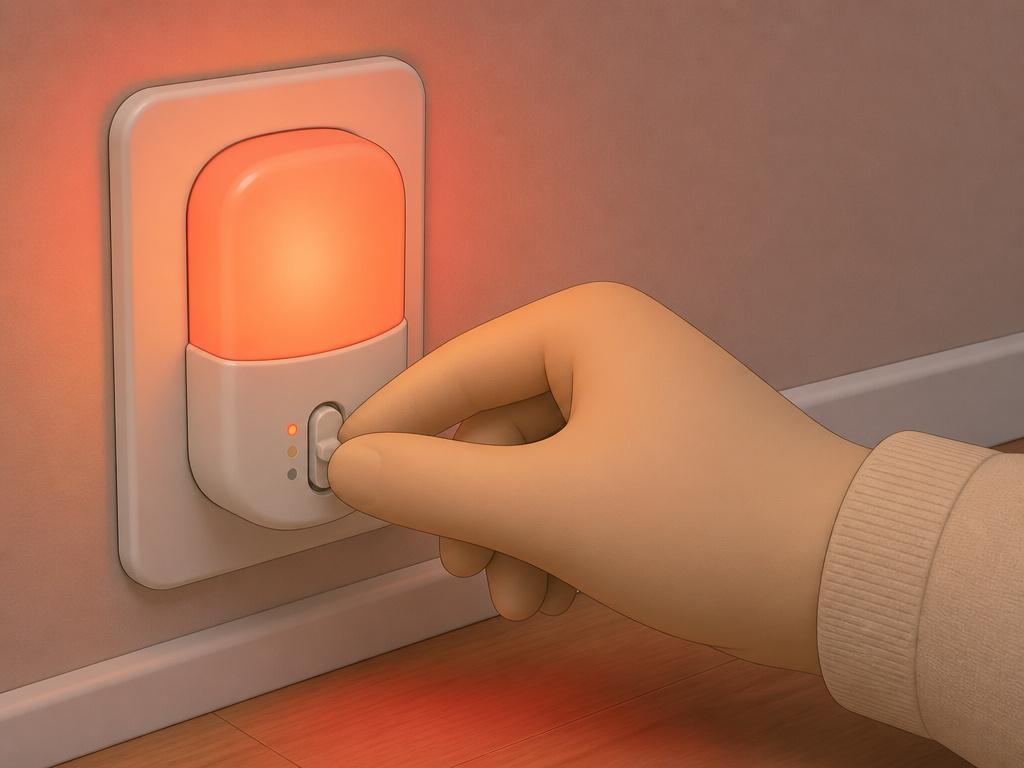
Selecting the right color is the first step. Implementing it correctly is what makes it work. This isn’t about lighting the room; it’s about providing the bare minimum glow for parental convenience without invading your baby’s sleep space.
Start with the right product. Look for a night light that specifically offers a red or amber light mode, not just a colored bulb cover. Many plug-in lights have a color-selector button. A simple, dimmable model like the Hatch Rest or the VAVA VA-CL006 is often more effective than a multi-feature gadget that projects stars and plays lullabies.
Common mistake: Choosing a night light with too many features. Projections on the ceiling are fascinating visual stimuli. Lullabies can become a sleep crutch or simply be distracting. Start with light only. You can add sound later if needed, but introduce one element at a time to see how your baby reacts.
Control the brightness. The wattage guideline from the research is a good start: 4 to 7 watts is usually sufficient for a night light. What you’re really after is a light level at the crib of less than 10 lux. In practice, this means if you can easily read a book by its light, it’s too bright. The glow should just be enough to see the outline of furniture and avoid stubbing your toe.
Placement is non-negotiable. Never put the night light right next to or above the crib. Position it low, near the floor, behind a chair, or by the door, so it illuminates your path, not your baby’s face. The light should be indirect, creating a soft ambient glow, not a beam.
Use it intentionally. The night light is for your benefit during feeds and changes, not for your baby’s entertainment. Consider a motion-activated plug-in light that turns on only when you walk in. For older toddlers with a fear of the dark, a dedicated, dim amber comfort light placed well away from the bed is better than turning on a hallway light.
The Impact of Light on Sleep Cycles and Safety
Creating a sleep-conducive environment extends beyond the night light. It’s about managing all light exposure in the sleep space to support your baby’s developing circadian rhythm and ensure safety.
Daytime light is your ally. Exposure to bright, natural light during the day helps set a strong circadian rhythm, making the contrast with dark nights more powerful. This is especially important in the early weeks to resolve day-night confusion. Don’t make the nursery a cave during the day.
Total darkness for naps is ideal. Once your baby is past the newborn stage, napping in a dark room helps produce longer, more restorative sleep. Darkness removes stimulating visual input. Use blackout curtains or shades to achieve this. This practice reinforces that dark space equals sleep time, whether it’s night or day.
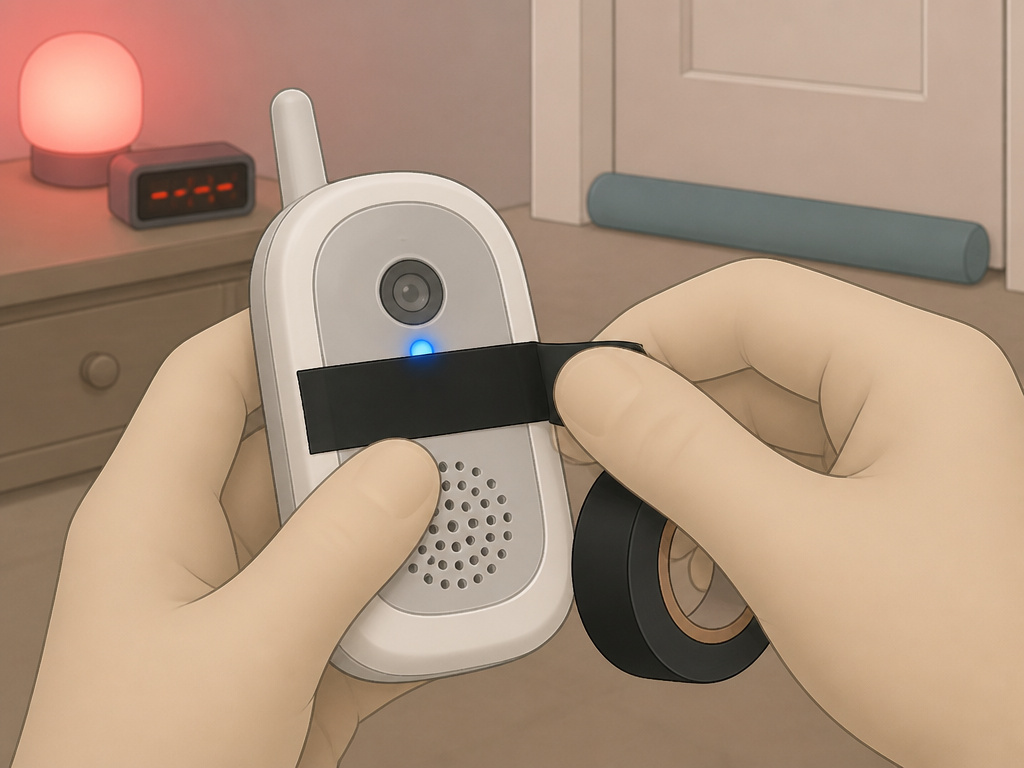
Beware of other light sources. The night light might be perfect, but a glowing baby monitor, a digital clock with bright LEDs, or light seeping under the door can be just as disruptive. Cover monitor lights with electrical tape (ensure vents aren’t blocked). Choose a clock with a red display or one that can be dimmed. Consider a draft stopper for the door.
This holistic approach to light management dovetails with other safe sleep practices. A safe sleep space has a firm baby mattress with a tight-fitting crib sheet and no loose bedding. The night light should never be a source of heat or a cord hazard within reach of the crib.
Frequently Asked Questions
Can a night light cause sleep problems?
Yes, if it’s the wrong color or too bright. A blue, white, or bright light can suppress melatonin and make it harder for your baby to fall asleep and stay asleep. If you’ve introduced a night light and sleep gets worse, try removing it for a few nights or switch to a dim red option.
When should I introduce a night light?
Many parents find a night light helpful from the early weeks for nighttime feeds and diaper changes. There’s no mandatory age. Some parents start around 4-6 months when sleep patterns become more regular. Let your need for visibility and your baby’s sensitivity be your guide. For toddlers, a night light can be introduced to ease fears of the dark.
Is it okay to use a white noise machine with a light?
Many sound machines have a small LED indicator light. These are often blue or green and can be surprisingly bright in a dark room. Cover the indicator light with a piece of opaque tape if it’s disruptive. The goal is to have no point-source lights visible from the crib.
What about “smart” lights that change color?
Smart bulbs that can be set to a dim red or amber for night and a brighter white for day are an excellent, flexible option. Just be sure to automate the schedule or double-check the setting at bedtime. The convenience is great, but a manual switch to a harsh white light defeats the purpose.
My baby seems scared of the dark. What should I do?
For toddlers with nighttime fears, a dim red or amber night light placed low in the room (not in the crib) can provide reassurance. Combine this with a consistent, calming bedtime routine. The light should be a tool for comfort, not a distraction.
Before You Go
The science is clear: a dim red or amber night light is the best choice for supporting baby sleep. It provides the utility you need without the circadian disruption of blue or white light. Remember that brightness and placement are just as important as the color on the box.
Start simple. Pick a single-color, dimmable light. Place it low and out of your baby’s direct line of sight. Observe for a week. If sleep improves or stays the same, you’ve found a keeper. If problems arise, don’t hesitate to go back to total darkness. Every child’s sensitivity is different, and the perfect sleep environment is the one that works for your family.
Your goal isn’t a perfectly lit nursery. It’s a baby who sleeps soundly and parents who can move through the night with confidence. A little warm glow, strategically used, can help with both.
