
How to Tell If Your Baby is Ready to Transition to One Nap
This post contains affiliate links. As an Amazon Associate we earn from qualifying purchases.
Your baby is ready to move to one nap when they are between 14 and 15 months old and consistently show three specific signs: fighting the second nap for at least two weeks, taking very long morning naps, and handling a longer awake window without meltdowns. Pushing this transition before 14 months, even if signs appear, leads to overtiredness and sleep disruption.
The 14-15 month window is where developmental readiness, dropping sleep needs, and circadian rhythm maturity converge. Before this point, what looks like readiness is usually a temporary regression.
What follows: the exact data on when naps actually drop, the three real signs versus the fake ones, the physiological reason an early move backfires, and a step-by-step plan that stretches the process over a month. By the end, you’ll be able to read your child’s cues and the calendar with equal confidence.
Key Takeaways
- The vast majority of babies need two naps until at least 14 months. A 2022 meta-analysis found less than 2.5% stop napping before age two.
- True readiness signs are consistent over 10-14 days, not occasional nap strikes. Look for second nap refusal, morning naps over 1.5 hours, and stable mood until a later bedtime.
- Transitioning too early triggers a cortisol response. The baby’s body fights fatigue with stress hormones, leading to night wakings and early mornings, the opposite of your goal.
- The process is a gradual slide, not a switch. Start by slowly pushing the morning nap later in 15-minute increments over 2-3 weeks.
- A consistent sleep environment, including a firm baby mattress and safe crib sheets, supports better sleep during this unstable period.
The Data on Dropping Naps: What the Research Actually Says
Forget vague advice. The schedule is written by biology, and the numbers are clear.
A 2022 systematic review published in Sleep Medicine Reviews gives us the big picture. After analyzing data from thousands of children, researchers found that less than 2.5% of children cease napping before their second birthday. The massive drop-off happens during the preschool years: 57% stop napping by age 3-4, and 80% by age 4-5.
This 2022 meta-analysis of infant nap patterns provides the clearest epidemiological data we have: napping is the norm for toddlers, not the exception.
This tells you that if your 10 or 12-month-old is fighting sleep, it’s almost certainly not a sign to drop a nap. It’s a sign of something else, a regression, a schedule tweak, or teething. The average nap duration for a 1-2 year old is still 2.3 hours per day, typically split across two sleep periods.
The transition from two naps to one is a process of consolidation. Another clinical reference on child sleep development notes the number of naps decreases at a steady rate of about 0.09 per month from 13 to 24 months. That’s a slow, gradual fade, not a cliff.
Why does this consolidation happen? It’s a sign of a maturing circadian rhythm. The drive to sleep becomes stronger and more consolidated at night, and the need to recharge during the day diminishes. Pushing this biological process is like asking a flower to bloom in February.
The 14-15 Month Window: Why This Age is the Sweet Spot
Fourteen months is the earliest reliable starting line. Some babies will hold on to two naps until 18 months or even longer, and that’s perfectly normal. But starting the transition before 14 months is almost always a mistake.
Sleep consultant Kelly Murray states it bluntly based on her own experience: transitioning her son at 12 months “blew up in my face.” The reason is a mismatch between social scheduling and biological readiness. Your baby’s total sleep need does drop around a year, from 12-16 hours to 11-14 hours in a 24-hour period. But that doesn’t mean their brain is ready to pack all that daytime rest into a single block.
At this age, they are also exploding with developmental milestones. Walking, talking, and understanding sequences are cognitively and physically exhausting. They need those two breaks to process and recharge. Taking one away too soon leaves them overtired long before bedtime.
Where this goes sideways: Moving to one nap before 14 months creates a 5-6 hour awake window before the nap and another long stretch after. The baby’s system interprets this sustained fatigue as a threat and releases cortisol to stay alert. This hormone surge makes falling asleep harder and causes fractured night sleep, often manifesting as sudden 5 a.m. Wake-ups.
The goal is to wait for your child’s system to signal it can handle longer periods of alertness without hormonal intervention. That signal reliably begins to flash around the 14-month mark.
The 3 Real Signs of One-Nap Readiness (Not the Fake Ones)
You will see plenty of sleep disruptions around 12 months. Do not mistake them for readiness. True signs are persistent, lasting 10 to 14 days, and occur together.
1. Consistent Second Nap Refusal. This isn’t a bad day or two. This is your baby happily playing or fussing in their crib for the full duration of the nap time, for at least a week straight, even when the morning nap was short. They have genuinely lost the ability to fall asleep at that second biological dip.
2. Long, Solid Morning Naps. When they do sleep for the first nap, it stretches to 1.5, 2, or even 2.5 hours. This shows their sleep drive is strong enough to consolidate daytime sleep into one major block. If the morning nap is still a crisp 45 minutes, they need that second recharge.
3. They Can Handle a Longer Awake Window. If the morning nap ends at 10 a.m., can they make it to a 2 p.m. Nap (a 4-hour window) without becoming a meltdown monster? What about from nap end to bedtime? Success here shows their circadian rhythm is lengthening.
| Real Readiness Sign | Fake Sign (Usually a Regression) | What to Do |
|---|---|---|
| Second nap refusal for 7-10+ days | Occasional nap strike due to teething or new skill | Stay the course. Keep offering the second nap quietly. |
| Morning nap consistently >1.5 hours | One random long nap after a bad night | Note it, but wait for a pattern. |
| Tolerates 4+ hour awake windows | Seems fine but then crashes hard at 5 p.m. | This is overtiredness. Move bedtime earlier, not nap later. |
The fake signs are what trick most parents: a few days of early morning wakes, a week of fighting the afternoon nap during a growth spurt, or shortened naps because of a change in routine. These are temporary. True readiness is a permanent shift in your child’s sleep architecture.
The Physiology of a Failed Early Transition: Cortisol and Circadian Rhythm
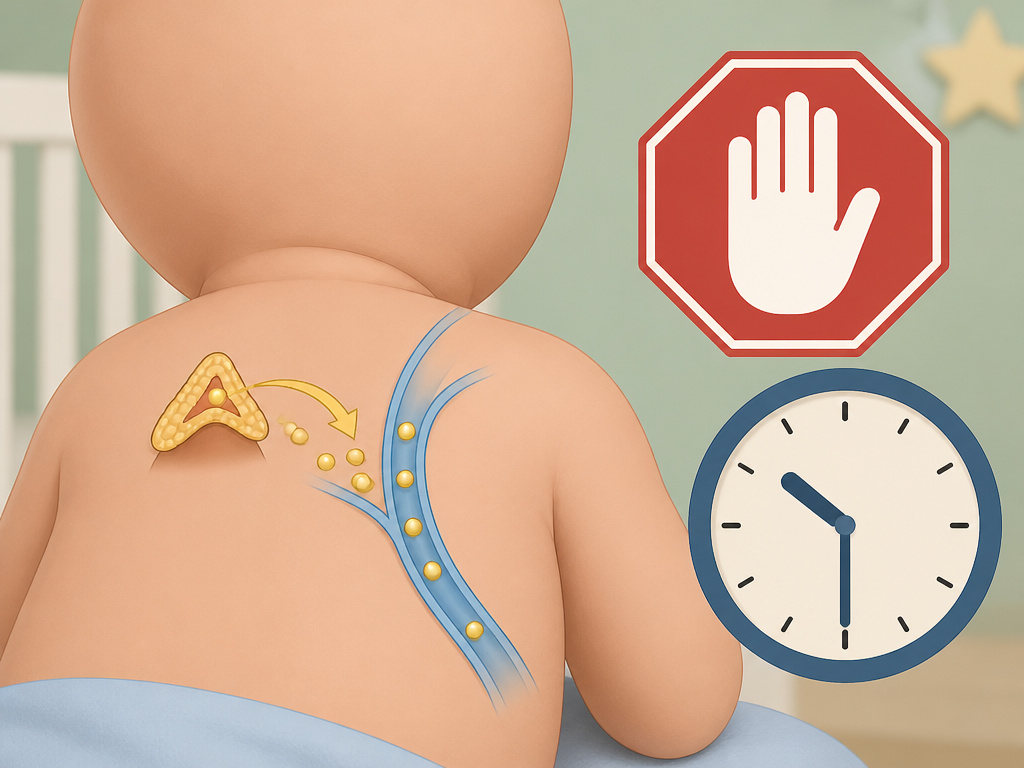
Understanding why early transitions fail helps you stick to the plan when you’re tired and tempted.
When a baby is kept awake past their biological capacity, their body perceives a threat. The adrenal system releases cortisol, a stress hormone designed to promote alertness. This is the opposite of what you want at nap time. The resulting “second wind” makes your baby look wired, jumpy, fussy, but refusing to sleep.
I won’t recommend transitioning before 14 months, full stop. The cortisol spike doesn’t just ruin that day’s nap. It lingers, disrupting the following night’s sleep and setting off a cycle of overtiredness that can take weeks to reset. Found that out the hard way.
This is also a circadian rhythm issue. The body’s internal clock needs to mature to support a longer midday sleep period and a longer evening awake span. Research from the University of Colorado sleep habits guide indicates that the timing of melatonin release (the sleep hormone) shifts later as children consolidate naps. Forcing a one-nap schedule before this shift creates a mismatch where the child is put to bed before their body is ready to sleep, causing bedtime battles.
The mess you’re trying to fix, early wakes, night parties, is often the direct result of trying to fix a problem they didn’t have. Stay patient.
The Step-by-Step Transition Plan (It’s a Slide, Not a Switch)
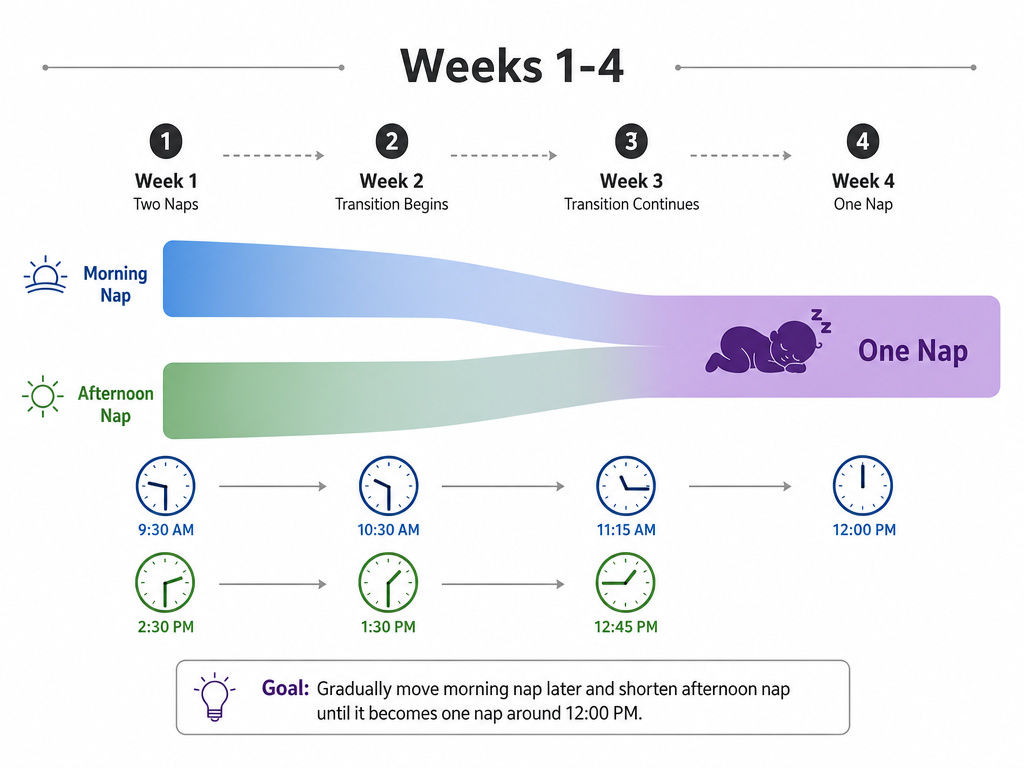
Switching cold turkey from two naps to one is a shock to the system. The gradual method respects biology and saves everyone’s sanity. Plan for this process to take 3-4 weeks.
Week 1-2: The Slow Push. Begin by pushing your baby’s morning nap later by 15 minutes every 2-3 days. If they typically nap at 9:30 a.m., aim for 9:45, then 10:00. Use this time for calm, low-stimulation activity. Simultaneously, offer the second nap 15 minutes later as well. The goal is to slowly merge the two nap windows. During this phase, the second nap might become a short 30-minute catnap. That’s fine, it’s a bridge.
Week 3: The “Nap Hour” Anchor. You’re now aiming for a single nap that begins between 11:30 a.m. And 12:30 p.m. This is the sweet spot. To get there, you may need to temporarily move bedtime earlier by 30-60 minutes to prevent overtiredness. An earlier bedtime is your best tool during a transition.
Week 4: Stabilize. Lock in the new nap time. Expect some variability in nap length as your baby adjusts. One day it might be 1.5 hours, the next 2.5. Stay consistent with the start time.
Throughout this, their sleep environment is a constant. A familiar, safe space signals it’s time to rest. This means a consistent room, a firm organic crib mattress, and familiar baby bedding. Don’t introduce a new toddler bed or nursery bedding set in the middle of this change.
Troubleshooting the Most Common Transition Problems
Even with a perfect plan, you’ll hit bumps. Here’s how to navigate them.
Problem: The nap is too short (less than 1 hour).
This means the schedule is still too ambitious. Your baby isn’t tired enough to sleep deeply. The next day, push the nap start time 15 minutes later, not earlier. Increase pre-nap activity and outdoor time to build sleep pressure. Protect the room with blackout curtains and white noise.
Problem: Extreme fussiness in the late afternoon.
The awake window from nap end to bedtime is too long. Move bedtime earlier immediately, as early as 5:30 or 6 p.m. Is acceptable during the first week of a solid one-nap schedule. This is not a permanent change, but a necessary buffer against overtiredness.
Problem: Early morning waking (5 a.m.).
This is the hallmark of an overtired baby. Their cortisol is spiking too early. The fix is counterintuitive: move bedtime even earlier for a few nights. Also, ensure their nursery mattress is comfortable and the room is pitch black. An early wake often means the last awake window was 30 minutes too long.
The part nobody mentions: The transition isn’t done when they take one nap. It’s done when that nap is reliably over 1.5 hours and night sleep is stable. That can take a full month after the second nap disappears. Measure success in weeks, not days.
If problems persist beyond two weeks of a stable one-nap schedule, reconsider. It’s possible your baby genuinely needs a two-nap schedule for a while longer. There is no prize for an earlier transition.
Frequently Asked Questions
Can a 1-year-old be ready for one nap?
It is rare. While a 12-month-old may show signs like fighting the second nap, this is almost always a temporary regression linked to developmental leaps, not true biological readiness. The PMC systematic review on nap transitions data strongly supports waiting until at least 14 months to avoid sleep disruption.
What is the best one-nap schedule for a 15-month-old?
Aim for a nap that begins between 11:30 a.m. And 12:30 p.m. The nap itself should last 1.5 to 2.5 hours. This creates two manageable awake windows: about 4.5-5.5 hours before the nap, and 4.5-5.5 hours after the nap until bedtime.
How long does the 2-to-1 nap transition take?
Plan for a gradual transition over 3 to 4 weeks. The first two weeks involve slowly pushing the morning nap later. The third week is about landing on a consistent midday start time. The fourth week is for stabilizing nap length and night sleep.
What if my baby won’t nap longer than 30 minutes on one nap?
Short nap means the schedule is off. The most likely culprit is putting them down too early, they aren’t tired enough to dive into deep sleep. Try pushing the nap start time later in 15-minute increments over several days. Also, ensure their sleep space is optimal with a breathable mattress and comfortable fitted crib sheets.
Should I cap the one nap?
Usually, no. Let them sleep as long as they need, up to about 3 hours. Capping the nap is only necessary if the long nap is causing very late bedtimes (past 8:30 p.m.) or night wakings. In that case, wake them gently after 2.5 hours.
Before You Go
Watch the calendar first, then your child. The 14-month mark is your earliest green light. The real signs are a stubborn cluster: a vanished second nap, a lengthened morning nap, and a toddler who doesn’t unravel with longer awake stretches.
When you move, go slow. Slide the morning nap later in tiny increments over weeks, and use an earlier bedtime as your shock absorber against overtiredness. A consistent, cozy sleep environment with safe, comfortable baby sheets and a firm mattress provides the stability their changing biology needs.
The goal is to smoothly consolidate sleep in line with your child’s development. Getting it right means better rest for them, and finally, for you.
