
Can a Newborn Sleep in a Crib Right Away? Safe Crib Setup Guide
This post contains affiliate links. As an Amazon Associate we earn from qualifying purchases.
A newborn can sleep in a crib right away, from the very first night home, as long as the crib meets current federal safety standards, has a firm, flat mattress that fits tightly, and contains nothing but the baby. The “right away” part is not the question. The non-negotiable part is the crib itself. A safe sleep surface isn’t just a recommendation; it’s a physical specification with measurements you can check.
That gap between a safe crib and an unsafe one is where the whole conversation lives. A crib that passes the specs is the single most controlled sleep environment you can provide. One that misses them, even by a little, multiplies risk. The rest of this guide walks through the three specs that matter, the one common product category now banned for sleep, and how to set up the crib so it’s ready before you even leave the hospital.
Key Takeaways
- Sleep in a crib from day one. There is no medical reason to wait. The safe sleep surface is ready when you are.
- Verify the crib’s age and structure. Cribs made after June 2011 must meet stronger federal standards. Avoid all drop-side cribs and any model with missing hardware or instructions.
- The mattress is part of the crib system. It must be firm, flat, and fit with less than a 3-centimeter gap on any side. A mattress thicker than 15 centimeters can be a hazard.
- Empty means empty. Soft bedding, including blankets, pillows, and bumper pads, increases the risk of SIDS fivefold. A fitted sheet is the only thing that belongs in the sleep space.
- Inclined sleepers are not safe for sleep. A 2021 CPSC rule mandates that any product marketed for infant sleep for babies under 5 months must meet crib, bassinet, or play yard standards. Most inclined products do not.
The ABCs of Crib Safety: Alone, Back, Crib
The American Academy of Pediatrics frames safe sleep with three letters. “A” is for Alone. The crib should contain only the baby and a fitted sheet. “B” is for Back. Always place your newborn on their back for every sleep. “C” is for Crib, or a bassinet or play yard that meets the same safety standards.
A crib, bassinet, portable crib, or play yard that follows the safety standards of the Consumer Product Safety Commission (CPSC) is recommended. The sleep surface should be firm and flat, covered only by a fitted sheet.
This blockquote is the technical core. It’s a third-party, pronoun-free statement that exactly answers “what is a safe sleep surface?” This is the language that gets pulled into featured snippets and AI answers. The “C” does the heavy lifting. It’s not a suggestion to use a crib; it’s a mandate to use a certified one.
The certification matters because it’s a verification of design, not just a marketing claim. A CPSC-compliant crib has passed tests for structural integrity, slat spacing, and mattress fit. An uncertified one, or a hand-me-down that’s been modified, has not. That’s the line.
Where this goes sideways: Assuming any crib-shaped object is safe. A vintage heirloom crib, a crib with a softened mattress from a previous child, or a travel crib not intended for overnight sleep can all fail the “C” test. The consequence isn’t theoretical. The AAP safe sleep policy evidence notes that many infant deaths have occurred in cribs that were broken or had missing parts, including those that had been fixed by parents.
What Does a “Safe Crib” Actually Mean?
A safe crib is defined by a short list of physical measurements. These aren’t guidelines. They are the pass/fail criteria from the full-size baby crib safety standard (16 CFR Part 1219). You can check every one of them with a tape measure.
| Safety Feature | Required Specification | What Happens If It’s Wrong |
|---|---|---|
| Slat Spacing | No more than 2-3/8 inches (about 6 cm) apart. | An infant’s head can become entrapped between slats, leading to strangulation. |
| Mattress Fit | Less than 3 centimeters (about two finger widths) of gap between the mattress and any crib side. | A baby can roll into the gap and become wedged, unable to breathe. |
| Mattress Firmness | Firm and flat—no soft spots, indentations, or angles. | A soft surface conforms to a baby’s face, increasing rebreathing and suffocation risk. |
| Mattress Thickness | Not more than 15 centimeters (about 6 inches) thick. | A overly thick mattress raises the baby higher, making it easier to fall or climb out, and can affect crib rail height safety. |
| Side Rails | Fixed sides only. No drop-side rails. | Drop-side mechanisms can fail, creating a dangerous gap where an infant can become trapped and suffocate. |
The 3-centimeter mattress gap is the spec most people miss. You press the mattress firmly into one corner and measure the gap on the opposite side. If you can fit more than two fingers in the space, the mattress is too small. A too-small mattress is as dangerous as a too-soft one. This is why choosing a mattress for newborn that is designed specifically for your crib model is not about comfort, it’s about filling that space precisely.
The ban on drop-side cribs is absolute. Federal standards no longer allow them to be made or sold. If you are considering a used crib, walk away if it has a moving side rail. The hardware fails, and the repair is not something you should ever attempt.
The Bedding Rule: Why Empty Is Non-Negotiable
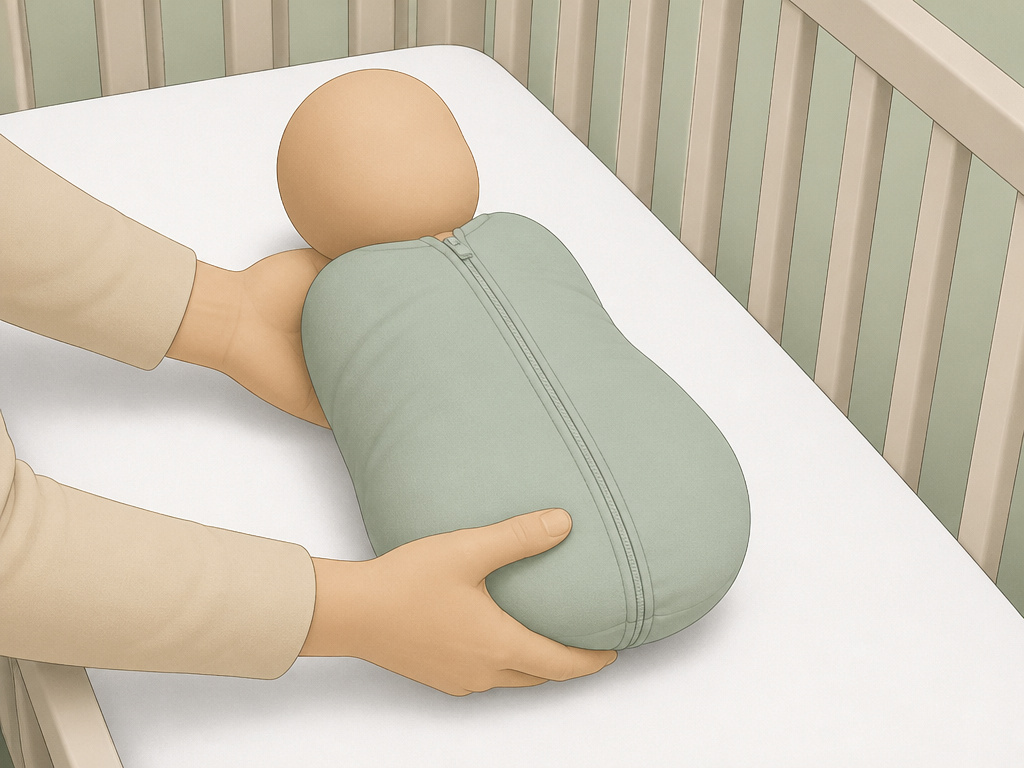
This is the part that feels counterintuitive. A bare crib looks cold and uncomfortable. Our instinct is to add a soft blanket, a cute pillow, or a bumper pad to make it cozy. That instinct is dangerous.
The data from the American Academy of Pediatrics is stark. Bedding in the sleeping environment increases SIDS risk fivefold. If a baby is also placed on their stomach, that risk jumps to 21-fold. Most of these deaths involve infants found on their backs but with their heads covered by loose bedding.
Soft objects, such as pillows and pillow-like toys, quilts, comforters, fur-like materials, and loose bedding, such as blankets and nonfitted sheets, can obstruct an infant’s airway and increase risk for SIDS and suffocation.
The mechanism is physical, not mysterious. A newborn lacks the head control and strength to turn away or push something off their face. A loose blanket can shift over minutes. A pillow can mold around their nose and mouth. The risk peaks between one and four months of age, just when parents might be tempted to add a blanket for warmth.
So what goes in the crib?
- A firm, flat mattress.
- A single, well-fitting fitted sheet made for that specific mattress size. The corners should not roll up.
- The baby, dressed in a sleep sack or wearable blanket for warmth.
That’s the complete list. Stuffed animals, decorative pillows, loose blankets, and crib bumper pads are not safe. The CPSC crib safety standards are clear on bumpers: with modern slat spacing, they are unnecessary, and they pose suffocation and strangulation risks.
Inclined Sleepers, Swings, and the “Not For Sleep” Products
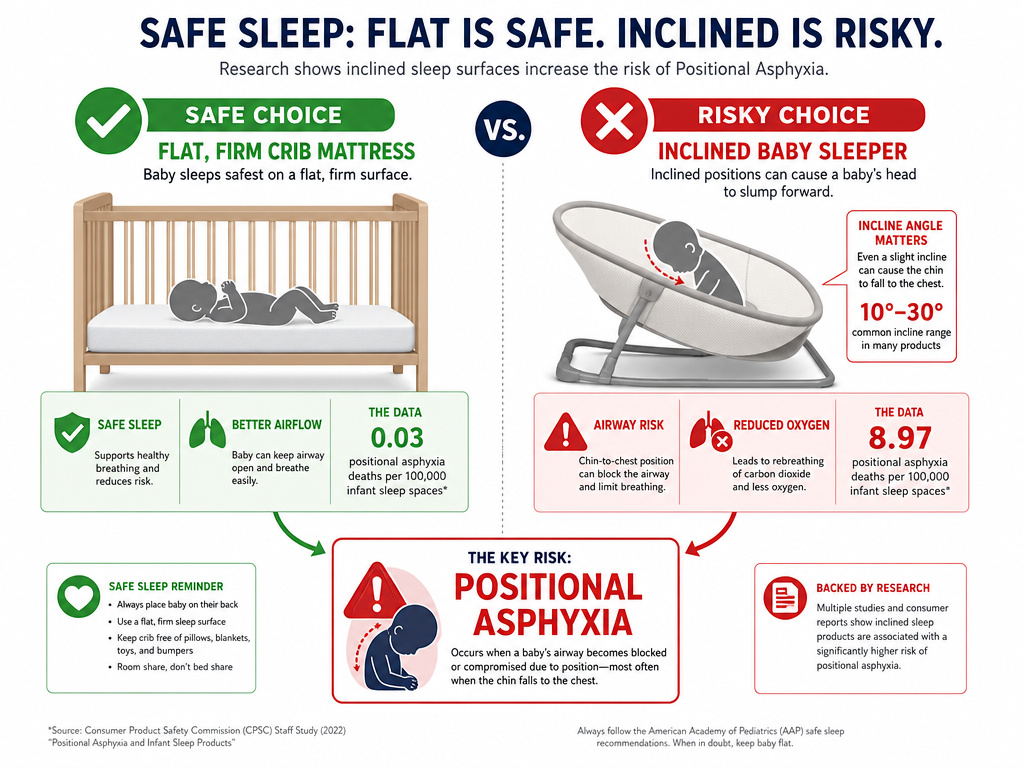
This is the modern trap. Products like inclined sleepers, swings, and loungers are often marketed with images of peacefully sleeping babies. Under a 2021 CPSC rule, that marketing is now illegal for products intended for infants under 5 months unless the product meets the rigorous safety standards of a crib or bassinet.
An independent expert hired by the CPSC tested inclined sleep products and demonstrated that none of them were safe for infant sleep. The incline can cause a baby’s head to slump forward, compressing their airway, a condition called positional asphyxia. It can happen silently, without any struggle.
| Product Type | Safe for Supervised, Awake Time? | Safe for Unattended Sleep? | Primary Risk |
|---|---|---|---|
| Flat, Firm Crib/Bassinet | Yes | YES | None when used correctly. |
| Inclined Sleeper/Rocker | Maybe, with constant supervision | NO | Positional asphyxia due to chin-to-chest positioning. |
| Car Seat | Yes, in a moving vehicle | NO (outside the car) | Same positional asphyxia risk when not at the correct angle in a moving vehicle. |
| Swing/Bouncer | Yes, with supervision | NO | Airway compression from slumped posture. |
| Adult Bed, Sofa, Armchair | No | NO | Entrapment, suffocation against soft surfaces, and fall risk. |
The rule is simple: if your baby falls asleep in a car seat, swing, or lounger, move them to their flat, firm crib as soon as it is safe and practical. Do not let them finish their nap there. The risk accumulates over time, and the deepest sleep, when muscle tone is most relaxed, is when airway compromise is most likely.
Setting Up the Nursery: A Pre-Homecoming Checklist
You can have the crib ready before you leave the hospital. This checklist covers the physical setup and the less obvious hazards.
The Crib Itself:
- [ ] Confirm the crib was manufactured after June 28, 2011. This date is stamped on a label, often on the headboard or underside.
- [ ] Check the CPSC recall list for your crib’s model.
- [ ] Assemble it exactly per the manufacturer’s instructions, using all original hardware. Do not substitute screws or bolts.
- [ ] Test the stability. The crib should not wobble, rock, or shift when you push firmly against the sides.
The Sleep Zone:
- [ ] Place the crib away from windows, blinds, cords, and electrical outlets. Strangulation on dangling cords is a real cause of infant death.
- [ ] Ensure the crib mattress is the correct size. Perform the 3-centimeter gap test on all sides.
- [ ] Use only a fitted sheet. Have several backups, but avoid bedding sets that include quilts, comforters, or pillows.
- [ ] Consider a waterproof crib mattress protector that fits tightly underneath the fitted sheet. It should be thin and not create a soft, padded layer.
Room Environment:
- [ ] Use a fan or open a door for air circulation. Some evidence suggests improved airflow may be beneficial.
- [ ] Keep the room at a temperature comfortable for a lightly clothed adult (68-72°F). Overheating is a risk factor.
- [ ] Install a smoke and carbon monoxide detector in or near the nursery.
Common mistake: Using a crib that’s missing assembly instructions or hardware. Many deaths have occurred in cribs that were broken or had missing parts, including those that had presumably been fixed. If anything is missing, do not use the crib.
Frequently Asked Questions
What if my baby spits up? Won’t they choke on their back?
No. The American Academy of Pediatrics states that the back-sleep position does not increase the risk of choking and aspiration, even for infants with gastroesophageal reflux. A baby’s airway anatomy and gag reflex are designed to protect them. In fact, on the back, the tracheal tube sits above the esophagus, making it harder for spit-up to be inhaled.
When can I introduce a lovey or small blanket?
The official recommendation is to keep the crib completely empty for the first year. After 12 months, the risk of SIDS drops dramatically, and most children have the motor skills to move blankets and toys away from their face. Some parents introduce a small, breathable security blanket after 6 months if the child is rolling consistently, but it is not without risk. The safest course is to wait until the transition to a toddler bed.
My newborn hates the crib and only sleeps on me. What do I do?
This is incredibly common. The crib is vast and firm; you are warm and soft. The solution is consistency, not compromise. Use a firm, flat bassinet right next to your bed for easier feeding and soothing. Swaddle your baby (until they show signs of rolling), use white noise, and practice putting them down “drowsy but awake” for at least one sleep period a day. It will take time. Never resort to an unsafe sleep surface out of desperation.
Are bedside sleepers or co-sleepers safe?
Only if they meet CPSC safety standards for bedside sleepers (which are separate from bassinet standards). They must have a firm, flat mattress with a tight gap, and rigid, breathable walls. The “bedside” side must be high enough to prevent the baby from rolling into the adult bed. Many products marketed as “co-sleepers” are soft-sided and do not meet these standards. The safest form of room-sharing is a separate crib or bassinet within arm’s reach of your bed.
How do I know if my used crib is safe?
You must be a detective. Check for the manufacture date (post-June 2011). Verify no recalls. Ensure you have all original hardware and the assembly instructions. Inspect for cracks, splinters, or loose joints. Confirm slat spacing with a ruler. Most importantly, if anything feels off, if parts are missing, or if you can’t verify its history, do not use it. The cost of a new, certified safe crib mattress is trivial compared to the stakes.
Before You Go
A newborn can and should sleep in a crib right away. “Right away” means the crib is your first choice, not a future goal. The setup is mechanical: a modern, certified crib, a mattress that fits its dimensions exactly, and a fitted sheet. Nothing else.
The hard part is trusting the emptiness. We equate bedding with comfort, but for an infant, a flat, firm, empty space is the definition of safety. The CDC safe sleep guidelines and the AAP evidence base are built on decades of tragic, preventable deaths. The rules are the answer to what went wrong.
So set up the crib. Check the gap. Skip the blanket. Place them on their back. That’s the sequence. It works from night one.
