
Newborn Sleep: Should Babies Sleep in the Dark for Safety?
This post contains affiliate links. As an Amazon Associate we earn from qualifying purchases.
Newborns should sleep in the dark or near-dark. A completely dark room supports the natural production of melatonin, the sleep hormone, and aligns with safe sleep guidelines that advise against loose objects, cords, or bright lights in the crib. The goal is a safe, flat, firm sleep surface in a room dark enough that you can barely see your hand.
That distinction—dark for sleep, not necessarily pitch black—is where most of the confusion lives. You are not trying to achieve a sensory-deprivation chamber. You are removing the light pollution that disrupts a newborn’s immature circadian rhythm and the physical hazards that come with plug-in lights placed too close to the sleep space. The evidence from pediatric bodies is consistent on the environment: a bare crib, in your room, with minimal and controlled lighting if needed for feeds.
What follows is the breakdown of why darkness matters, what the official guidelines actually say about light, and how to set up a sleep space that is both safe and realistically dark. We will cover the physiology, the specific risks of getting it wrong, and the handful of products that solve the problem without creating a new one.
Key Takeaways
- Darkness triggers melatonin production. Even a newborn’s rudimentary circadian rhythm responds to light cues, and a dark room signals that it’s time for sleep.
- The AAP and international safe sleep guidelines prioritize an empty crib. Any light source inside or attached to the crib is a potential entanglement, strangulation, or overheating hazard.
- If you need a light for nighttime feeds or checks, use a dim, red-hue night light placed well away from the sleep surface and secured so the cord is inaccessible.
- True blackout solutions like the SlumberPod or blackout curtain liners are effective, but they must be used with a standalone, approved sleep product like a bedside bassinet—never draped over a crib rail. The risk of light extends beyond poor sleep to include the temptation to add unsafe items to the sleep space when trying to solve the problem.
How Darkness Supports Newborn Sleep & Safety
A dark room isn’t just a preference; it’s a biological cue. Newborns are born without a mature circadian rhythm. That internal clock develops over the first 2-4 months, guided primarily by exposure to light and dark.
Exposure to light suppresses melatonin secretion, and exposure to darkness stimulates it. For an infant, even the low-level blue light from a charging indicator or a hallway night light can delay the onset of sleep and fragment sleep cycles.
The mechanism is straightforward. Light hits the retina, signaling the brain’s suprachiasmatic nucleus to pause melatonin production. In a dark environment, that signal stops, allowing melatonin levels to rise and promote sleepiness. This is why consistent light-dark cycles are one of the foundational tools for helping a newborn differentiate day from night.
The safety correlation is direct. A baby who settles into sleep more easily in a dark room is less likely to need parental interventions like rocking or holding that can lead to accidental sleep on an unsafe surface. Furthermore, the pursuit of darkness should never compromise the safe sleep environment. This is the core tension.
The Risks of Light at Night: More Than Just Sleep Disruption
The immediate problem with a bright night light is sleep disruption. The longer-term risk is the cascade of unsafe choices it can inspire.
The Hazard of In-Crib Lighting: Any product designed to clip onto a crib rail, hang from the slats, or sit inside the sleeping area violates the cardinal rule of a bare sleep surface. These items pose entanglement, strangulation, and fall hazards. The Consumer Product Safety Commission (CPSC) rule from June 2021 is explicit: any product marketed for infant sleep must meet the same stringent safety standards as a crib or bassinet. A glowing stuffed animal or a light projector does not meet that standard.
Overheating and Distraction: Some light-emitting products, especially those with plastic covers, can trap heat if placed too close to the baby. Furthermore, a moving light show can overstimulate a newborn rather than soothe them, keeping them in a state of alertness when the goal is sleep.
The Compromise Cycle: This is the most common failure pattern. A parent uses a bright night light. The baby sleeps poorly. The parent, desperate for a solution, then introduces another non-recommended item—a positioning pillow, a loose blanket—in an attempt to compensate. Now the sleep space has multiple risk factors.
Where this goes sideways: Adding a cute plug-in turtle night light to the crib bumper. The light itself is a hazard, and the bumper is a suffocation risk. You have now doubled the danger while solving zero sleep problems.
Official Guidelines: What Do the Experts Say About Light?
Major pediatric and public health organizations focus their safe sleep guidelines on eliminating risks like soft bedding and prone sleeping. Direct statements on room darkness are less common, but the principles are clear when you read the full context.
The American Academy of Pediatrics (AAP) emphasizes a bare sleep space. Their official infant safe sleep recommendations do not endorse any in-crib devices, including light projectors. The focus is on a firm, flat surface with only a fitted sheet.
The International Society for the Study and Prevention of Perinatal and Infant Death (ISPID) is more direct in its global infant sleep safety report. They list key recommendations for a safe sleep environment, which implicitly argue against light pollution by advocating for a clear, uncluttered space.
Perhaps the most practical guidance comes from health departments. For instance, NSW Health safe sleep practices from Australia discuss reducing environmental stimulation to promote sleep, which includes controlling light and noise.
The consensus holds that any intervention used to manage light must avoid adding physical risk to the sleep zone, rather than requiring total blackness. This is a crucial distinction that most parent advice blogs completely miss.
How to Create a Safe, Dark Sleep Space
Your goal is a dark room with a safe, independent sleep surface like a bassinet for newborns or a crib. The light management happens outside the crib.
Step 1: Assess and Eliminate Ambient Light
Start with the room itself. Where is light coming in? * Windows: Use blackout curtains or shades. A product like the Blackout EZ liner is effective and can be added to existing curtains. Ensure cords are safely secured and out of reach. * Electronics: Cover or remove LEDs from monitors, sound machines, chargers, and air purifiers. Electrical tape works perfectly for this. * Cracks: Use a draft guard or towel under the door to block hallway light.
Step 2: Choose a Safe Sleep Product
The sleep surface itself is non-negotiable. It must be a certified crib, bassinet, or bedside sleeper that meets current safety standards. The mattress must be firm and covered only by a fitted sheet. This is the foundation upon which everything else is built.
Step 3: Select a Safe Night Light (If Needed)
If you need light for nighttime feeds or checks, follow these rules: 1. Placement is everything. The light must be outside the crib/bassinet, on a dresser or shelf across the room. It should illuminate your path, not the baby’s face. 2. Use red or amber light. These wavelengths have been shown to be less disruptive to melatonin than blue or white light. The Hatch Rest+ is popular because it allows you to set a dim, red light from an app. 3. Secure the cord. Any power cord must be tightly wound and secured behind furniture, absolutely out of reach of the crib. 4. Keep it dim. It should be just bright enough for you to see what you’re doing, not to read a book.
Step 4: Consider a Dedicated Sleep Space for Travel
For travel or grandparents’ houses, a portable solution like the SlumberPod can be excellent. It’s a blackout canopy that fits over a pack-n-play or travel bassinet, creating a dark, private space. Crucially, it is used over an approved sleep product, not as a sleep surface itself.
| Solution | How It Helps | Critical Safety Check |
|---|---|---|
| Blackout Curtains | Eliminates street/dawn light. | Ensure cords are wound up and inaccessible. |
| Red-Hue Night Light | Provides minimal light for care without melatonin suppression. | Place on far side of room, secure cord. |
| SlumberPod | Creates a dark, portable sleep cave for travel. | Must only be used over a firm, flat, approved playard or bassinet. |
| Electrical Tape | Covers disruptive LED indicators on electronics. | Non-negotiable for any device in the sleep room. |
The Special Case: Naps and Daytime Sleep
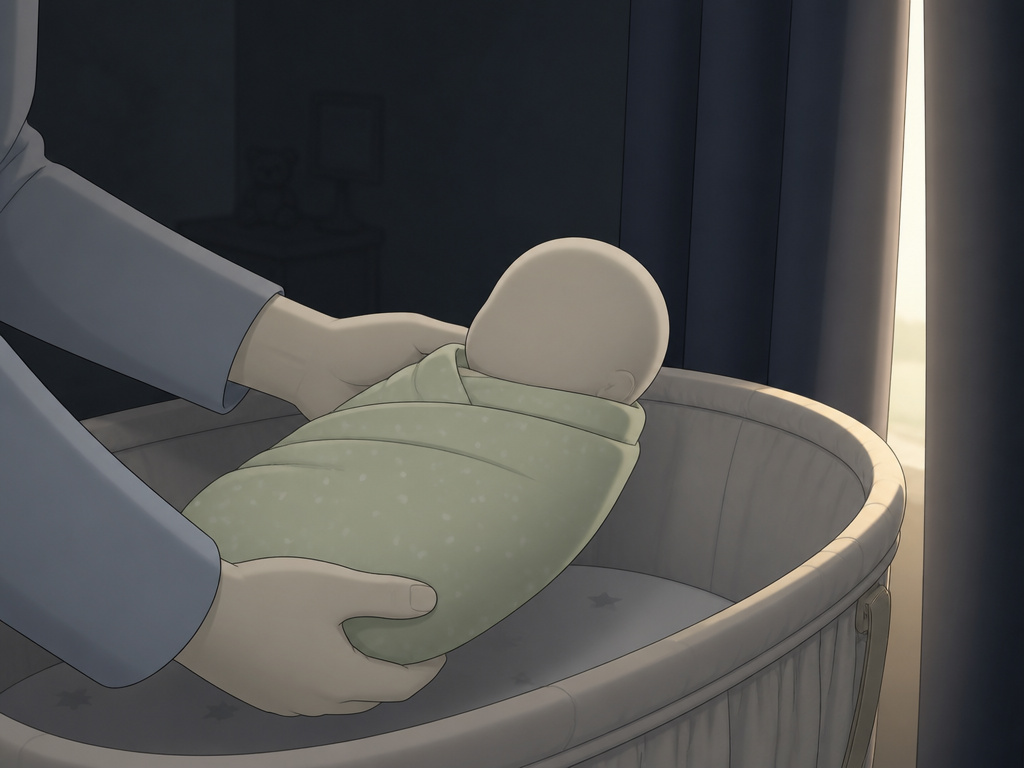 Should a newborn’s room be dark for naps? Yes, but with a strategic difference.
Daytime naps are essential for preventing overtiredness, which makes nighttime sleep harder. A dark room supports longer, more consolidated naps. However, to help set their circadian clock, it’s beneficial to have some exposure to natural light during awake periods.
The routine could look like this: 1. Awake time: Engage in bright, natural light (indirect sunlight near a window is fine). 2. Pre-nap routine: Move to a dimmer space for feeding and calming. 3. Nap: Put down in the same dark room used for nighttime.
This contrast between bright daytime activity and dark sleep periods helps teach the difference between day and night faster than keeping all environments uniformly lit.
Frequently Asked Questions
Should I use a night light in my newborn’s room?
You can, but you likely don’t need one. If you do, choose a dim, red or amber light placed away from the crib and with a secured cord. The primary purpose is for you to navigate safely, not to soothe the baby. Many parents find they adapt to the dark quickly and need no light at all.
Is it okay for my newborn to sleep with a light on?
No. Sleeping with a main light or a bright night light on can suppress melatonin production and disrupt sleep cycles. It also increases the likelihood of the baby becoming distracted or overstimulated. Consistent darkness is a stronger signal for sleep.
What if my newborn seems scared of the dark?
Newborns do not have a developed fear of the dark; this is a cognitive development that comes much later, often around age 2. What can seem like fear is usually startle reflexes, discomfort, or hunger. Addressing those needs directly is more effective than adding light. A consistent bedtime routine in the dark is the best long-term strategy.
How dark does the room really need to be?
Dark enough that you can barely see your hand in front of your face. It does not need to be pitch black, but it should be free of distinct light sources like glowing clocks, charger LEDs, or cracks of light under the door. The goal is the absence of stimulating light, not total sensory deprivation.
Can I use a projector or glowing mobile?
No. Projectors and mobiles attached to the crib are distractions and pose entanglement and strangulation risks, making them unsuitable for sleep times. If you use a mobile for awake, supervised time, ensure it is removed well before sleep and that the baby cannot reach the cords.
Before You Go
Darkness is a tool, not a punishment. It works with your newborn’s biology to encourage sleep and aligns perfectly with the number-one rule of infant sleep: keep the sleep space clear.
Chase the dark by managing the room, not the crib. Invest in blackout curtains, cover those little LEDs, and if you need a light, make it a dim red one on the far wall. Your baby doesn’t need a light show. They need a firm mattress for a newborn, a safe bedside bassinet, and the consistent signal that dark means rest. That combination is what builds safe sleep habits from the very first night.
