
How to Use Baby Rubber Sheet | The 2″ Rule & Why Brands Differ
This post contains affiliate links. As an Amazon Associate we earn from qualifying purchases.
A baby rubber sheet is a waterproof liner placed directly under a fitted crib sheet to protect the mattress pad from leaks, spit-up, and sweat. Its sole job is containment, it must never add bulk, create gaps, or interfere with the tight fit of the primary sheet, which is why the Chicco LullaGo manual specifies a minimum 2-inch tuck under all sides of the pad.
The 2-inch rule is a mechanical guard against the suffocation hazard spelled out in every manufacturer’s safety warning: gaps between extra padding and the bassinet side. A sheet that doesn’t tuck that deep can pull up during the night, creating a pocket of loose fabric.
What follows explains how to match the liner to your specific bassinet’s pad, why material choice changes the feel, and the one installation mistake that voids warranties on brands like UPPAbaby.
Key Takeaways
- A baby rubber sheet is a waterproof barrier liner, not a standalone sheet. It always goes under a fitted crib sheet.
- Fit is non-negotiable. The liner must be taut and flat, with the overlying sheet tucked under the mattress pad by at least 2 inches (5 cm) on all sides to eliminate gaps.
- Never use an ill-fitting universal liner on a bassinet pad. Mismatched size creates ripples and pockets, a documented suffocation risk.
- Material dictates feel and care. TPE is softer and quieter than PVC; cotton-backed options add breathability but require different washing.
- Brands like UPPAbaby and Nuna explicitly warn against using any pad or sheet not provided or approved by them, as it can void the product warranty.
What Is a Baby Rubber Sheet? (Definition & Purpose)
Think of it as insurance. A baby rubber sheet, often called a waterproof mattress liner or pad protector, is a thin, flexible sheet made from waterproof materials like PVC, TPE, or polyurethane. Its job is singular: to stop liquids from reaching the bassinet or crib mattress pad underneath.
A baby rubber sheet is a liquid-barrier layer installed between the mattress pad and the fitted crib sheet. It is not a sleep surface itself and must always be covered by a snug-fitting sheet that meets the bassinet manufacturer’s fit requirements.
This is different from a full mattress protector, which often has a padded top layer and wraps the entire mattress. A liner is minimal by design. Bulk is the enemy. Adding even a quarter-inch of extra height can keep the primary fitted sheet from securing properly under the mattress pad’s edges.
Why does that matter? The Nuna MIXX series bassinet manual states the pad must be “completely flush with the bottom of the bassinet.” Any extra layer that lifts or wrinkles the pad breaks that flush seal. The resulting gap is exactly what safety warnings describe.
Why the Right Fit Isn’t Optional. It’s a Safety Spec
The word ‘fit’ in a bassinet manual is a measurable performance standard for preventing entrapment and suffocation. When you read a line like “specifically designed to fit snug,” that’s a legal and engineering requirement.
The Chicco LullaGo Anywhere SE manual gives us the number: at least 2 inches (5 cm) under all sides of the pad. That’s not a casual recommendation. It’s the minimum depth needed to counteract a baby’s movement throughout the night. A sheet with a 1-inch tuck will work loose. A loose sheet can ruck up, creating a pocket or a gap between the pad and the bassinet wall.
This is the core failure mode. It’s not about the rubber sheet itself, but about how its presence changes the fit of the only layer that touches your baby: the crib sheet. If your chosen baby sheets don’t have enough elastic or fabric to achieve that 2-inch tuck over the liner, the entire setup is unsafe.
| Fit Problem | Cause | Consequence |
|---|---|---|
| Gap at the side | Sheet tuck is too shallow (<2″) | Creates space where infant can become entrapped. |
| Wrinkled surface | Liner is too large or has excess material | Creates uneven sleep surface and potential pocket for re-breathing. |
| Pad lifted up | Liner is too thick or padded | Prevents pad from sitting flush with bassinet bottom, destabilizing it. |
The part nobody mentions: A perfect-looking fit when the bed is made can fail an hour later. Always do the “lift test.” After putting on the rubber liner and the fitted crib sheets, firmly grab the sheet fabric at the center of each side and lift upward. If you can lift it more than an inch off the pad before feeling strong resistance from the tucked edges, the tuck isn’t deep enough. Start over with a larger sheet.
Step-by-Step Installation Guide
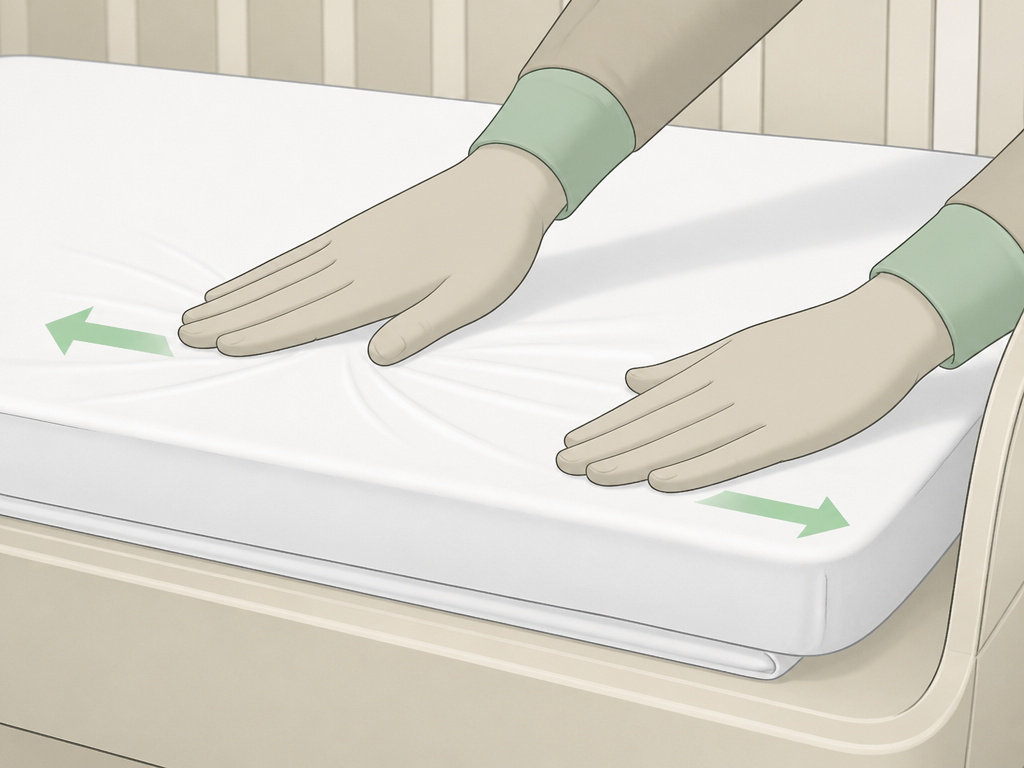
Throw out the idea that this is a simple “put it under the sheet” task. The order of operations and tension matter. Here’s how to layer a bassinet for safety, using a Nuna or UPPAbaby-style fixed pad as the example.
Before you start: Ensure the bassinet is on a flat, stable floor. Have your waterproof liner and approved fitted sheet ready. Wash and dry both according to their care labels first, new fabrics relax and shrink.
- Remove the pad. Take the mattress pad completely out of the bassinet frame. This is the step every video skips, but it’s the only way to get a truly flat, tight fit. You cannot properly secure a sheet or liner with the pad jammed in the frame.
- Lay the rubber sheet flat. Place the waterproof liner on top of the mattress pad, centered. Smooth it out with your hands from the center to the edges. There should be zero wrinkles or bunched material. If the liner is larger than the pad, fold the excess underneath the pad, not at the sides.
- Secure the fitted sheet. Now, put the crib sheets for baby on. Start with one long side, tucking the elasticated edge under the pad by a full 2 inches. Pull the sheet taut across the pad’s surface and repeat on the opposite side. Do the same for the short ends. The sheet should be drum-tight.
- Re-insert the pad. Carefully lift the now-layered pad and place it back into the bassinet. According to the Nuna MIXX manual, ensure the pad is “completely flush with the bottom.” Push down on all four corners to check. You should not see or feel the edges of the pad lifting.
- Final gap check. Run your hand between the bassinet fabric wall and the pad assembly. You should not be able to fit more than two fingers in the gap. If the gap feels wider, the pad isn’t flush, remove it and check for folded liner material underneath.
For a travel crib or Pack ‘n Play with a thinner, often vinyl-covered pad, the process is similar but the tolerance is tighter. These pads are floppier. Any lump from a poorly folded liner will be obvious. For these, I prefer a liner that’s slightly smaller than the pad surface, ensuring it never interferes with the edge seal.
Material & Safety Comparison: PVC vs. TPE vs. Cloth-Backed
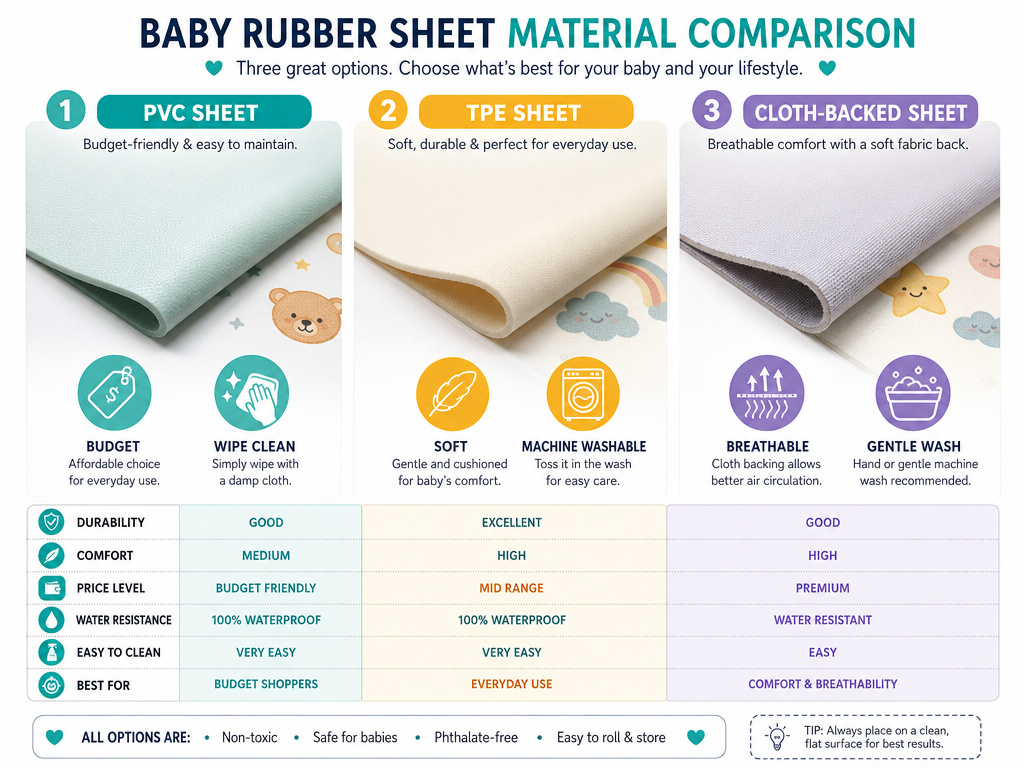
Not all rubber sheets are created equal. The material changes the feel, noise, care, and, indirectly, the safety by affecting how the top sheet grips.
| Material | Best For | Care & Caveats |
|---|---|---|
| PVC (Vinyl) | Budget option, heavy-duty protection. | Wipe clean only. Can feel sticky and make loud crinkling sounds. May contain phthalates—look for phthalate-free labels. |
| TPE (Thermoplastic Elastomer) | Everyday use, better feel. | Softer, quieter, and more flexible than PVC. Often machine-washable. More breathable but less waterproof over time. |
| Cotton-Backed Waterproof | Sensitive skin, breathability priority. | A layer of cotton knit bonded to a waterproof membrane. Feels like a regular sheet fabric but stops leaks. Must be washed gently to preserve the bond. |
I won’t use PVC liners in a bassinet. The crinkle sound wakes a light sleeper every time they shift, and the sticky surface can actually cause the fitted sheet to shift and bunch. TPE is worth the few extra dollars for uninterrupted sleep.
The breathability claim is real but minor. No waterproof layer breathes like pure cotton. Its job is to block liquids, not air. If moisture wicking is a top concern, prioritize organic crib sheets made from breathable materials like cotton jersey or linen, and use the liner only as a necessary barrier.
Where this goes sideways: Putting a cloth-backed liner in the dryer on high heat. The adhesive bonding the fabric to the waterproof membrane melts. You’ll get a lumpy, delaminated sheet that pools liquid. Always air-dry or use the lowest heat setting.
The Manufacturer Warranty Problem (UPPAbaby, Nuna, Chicco)
This is the legal and practical wall many parents hit. Your bassinet’s manual is a contract. Violate it, and you assume all risk.
The UPPAbaby Bassinet manual is unambiguous: “Use only the pad provided by manufacturer.” The UPPAbaby REMI manual adds, “using parts supplied by others may be unsafe.” Nuna’s manuals state to use “only the one provided by Nuna.” These clauses exist for liability and engineering reasons. Their product is certified as a system, pad, sheet, and frame.
Common mistake: Using a universal rubber sheet on a UPPAbaya or Nuna bassinet. If a leak soaks into the OEM pad and causes mold, and you used an unapproved liner, your warranty claim for a replacement pad will be denied. The manufacturer will cite “use of non-OEM parts.”
Does this mean you can’t use a liner? Not exactly. It means you use it at your own risk, understanding you may void the warranty on a $100+ replacement pad. Your safer path is to use the liner with an approved, tightly-fitting crib bedding sheet on top, and be hyper-vigilant about leaks. The moment a leak happens, you must strip the bed and ensure the OEM pad is completely dry.
For brands without explicit clauses, the principle remains. The safest liner is one that doesn’t alter the function of the original sleep system.
How to Choose the Right One for Your Bassinet
Stop looking for a “baby rubber sheet.” Start looking for a “waterproof bassinet pad liner that fits [Your Brand] Model X.” The specificity changes your results from generic to compliant.
- Measure your pad first. Get the exact length, width, and thickness. Note if it has rounded or square corners.
- Match the material to your need. For a primary sleep bassinet, choose soft, quiet TPE or a cotton-backed layer. For a travel crib used occasionally, a PVC wipe-clean option might suffice.
- Prioritize fit over features. A perfectly fitting basic liner is safer than a “breathable, organic” one that’s too big. The best crib mattress protectors are often sized for standard cribs, not bassinets, double-check dimensions.
- Read the care label. If it says “wipe clean only,” believe it. Machine-washing will destroy it and leave you with a leaky, brittle sheet.
If you can’t find a perfect match, a larger liner carefully folded underneath is better than a smaller one that doesn’t cover the full sleep surface. But this is a compromise. The ideal scenario is a liner sold by your bassinet’s brand or a third party that lists your exact model in the product description.
Frequently Asked Questions
Can I use a baby rubber sheet as a standalone sheet?
No. Never. A rubber sheet is a barrier. It must always be covered by a snug-fitting, breathable safe baby sheets that meets all safety standards for fit and fabric.
How often should I wash the rubber sheet?
Wash it only when soiled. Frequent washing, especially in hot water or a harsh dryer, degrades the waterproof membrane. Spot clean minor spills. For a full wash, follow the label: most TPE and cloth-backed liners can go in a cold, gentle cycle and should be air-dried.
Will it make my baby sweat or overheat?
The liner itself doesn’t generate heat. However, any waterproof layer reduces breathability compared to just a cotton sheet. This is why the overlying sheet’s material is critical. Use lightweight, breathable baby crib sheets like cotton jersey or muslin to help mitigate any reduced airflow.
Are there rubber sheets for portable cribs like the Pack ‘n Play?
Yes, but they are often called “travel crib waterproof liners” or “playard sheet protectors.” The key is finding one specifically sized for the thin, rectangular pad of your model. A standard crib liner will be too thick and small.
What’s the difference between this and a mattress protector?
Mattress protector is usually a padded, fitted cover that encases the entire mattress, often with a quilted top. A rubber sheet or liner is a thin, flat layer that goes under your existing sheet. Liners are less bulky and better suited for bassinets where fit is ultra-sensitive.
Before You Go
Using a baby rubber sheet correctly boils down to three things: fit, order, and intent. The fit must preserve the 2-inch tuck rule of the primary sheet. The order is pad out, liner flat, sheet tight, pad back in flush. The intent is purely protection, not comfort, not extra padding.
Measure your bassinet pad before you buy anything. Choose a TPE or cotton-backed liner for main sleep areas, and always pair it with high-quality, tightly-fitted infant bedding. And finally, respect the manufacturer’s warnings. The safest sleep surface is the one they designed and certified. Your liner is just a guard for that system, not a modification to it.
