
How to Use a Baby Pillow | The Essential Safety Rule Guide
This post contains affiliate links. As an Amazon Associate we earn from qualifying purchases.
You cannot safely use a traditional baby pillow for an infant under one year old for sleep or unsupervised lounging. Federal law bans loosely filled, conforming infant pillows outright. For regulated products like nursing pillows and infant support cushions, safe use means following the manufacturer’s instructions to the letter, using them only for their intended purpose under direct supervision, and moving a sleeping infant immediately to a crib or bassinet.
That distinction between a banned product and a regulated one is where most of the confusion, and danger, lies. A pillow labeled for “tummy time” is not a sleep surface. A nursing pillow is not a lounger.
What follows is a breakdown of the new federal rules that took effect in 2025, the specific performance standards they mandate, and the only scenarios where using a cushion-like product with your baby is considered safe. By the end, you’ll be able to read any product label and know exactly what it’s for and what it is not.
Key Takeaways
- Infant pillows (loosely filled, conforming) are banned for under-1s; nursing pillows and infant support cushions are regulated but not for sleep.
- Any product manufactured after April 23, 2025 (nursing pillows) or May 5, 2025 (infant support cushions) must meet strict new federal standards for firmness and design.
- The single most important rule: never leave a baby unattended on any pillow or cushion, and always move a sleeping infant to a firm, flat sleep surface like a crib.
- “Dual-use” products that market a nursing pillow as a lounger are now illegal under the new infant support cushion safety standard.
- For safe sleep, the only acceptable accessories are a firm baby mattress and a tight-fitting crib sheet.
What Does the Federal Ban Actually Say?
The rules changed in 2025. It’s not a matter of best practice anymore; it’s codified in the Code of Federal Regulations. Understanding the legal definitions is the first step to safe use.
The Consumer Product Safety Commission (CPSC) defines two separate categories: banned infant pillows and regulated durable products. The banned category is in 16 CFR § 1500.18(a)(16). A product falls under this ban if it has a flexible fabric covering, is loosely filled with granular material like polystyrene beads, is easily flattened, can conform to an infant’s face or body, and is intended for a child under one.
Common mistake: Assuming a “baby pillow” is just a small adult pillow. The federal ban targets products that mold around an infant’s airway, creating a suffocation risk that is not present with firmer, structured products.
The regulated categories are different. Nursing pillows (16 CFR Part 1242) are for supporting an infant during feeding while a caregiver is actively holding them. Infant support cushions (16 CFR Part 1243) include products like tummy time pillows or supervised loungers. Crucially, a product cannot be both a compliant nursing pillow and a lounger anymore, that “dual-use” marketing is now illegal.
The government’s own CPSC infant pillows webinar slides make the distinction clear. The hazard data drove the rule.
The Three Pillars of the New Safety Standard
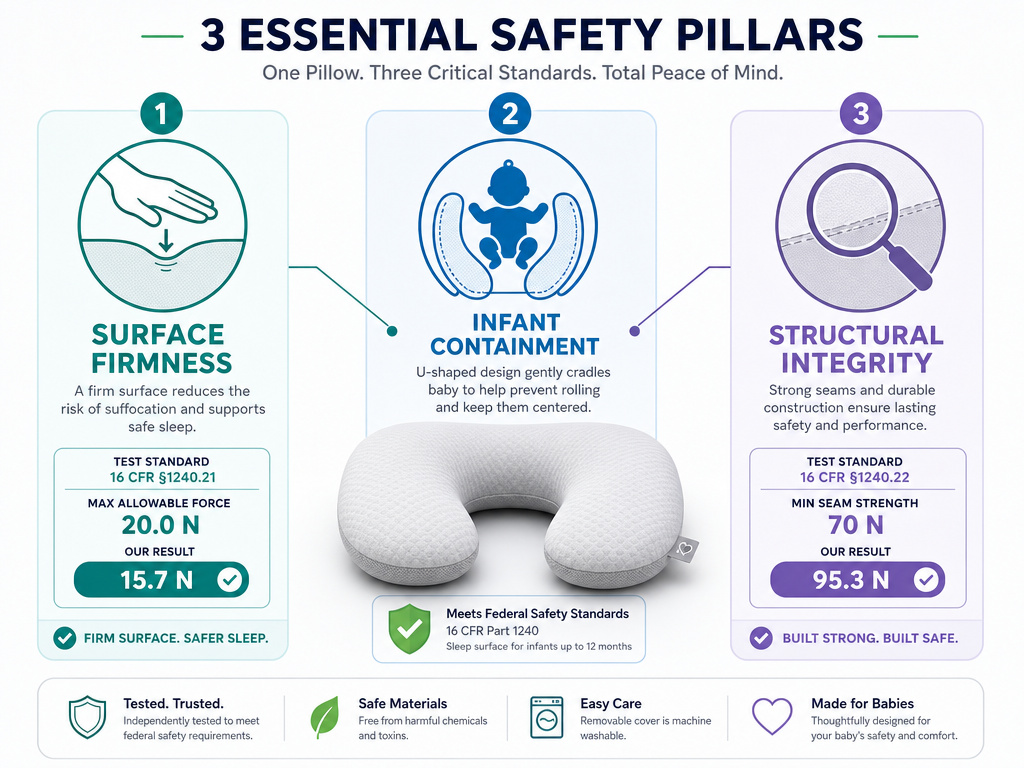
If a product is legally sold as a nursing pillow or infant support cushion after the 2025 effective dates, it must pass a battery of tests. These aren’t suggestions. They are pass/fail gates monitored by the CPSC.
The standards focus on preventing suffocation, falls, and entrapment. They translate into three concrete design mandates you can look for.
| Safety Pillar | What It Means | How It’s Tested (CFR Reference) |
|---|---|---|
| Surface Firmness | The cushion must not conform to an infant’s face. | A 3-inch probe must require more than 10.0 Newtons (2.24 lb) of force to depress the surface 1 inch. (§1242.5(d-f)) |
| Infant Containment | The baby cannot roll into a trapped position. | A 9-inch diameter “head probe” must not contact surfaces within the caregiver opening. (§1242.5(g)) |
| Structural Integrity | The product won’t fall apart and create hazards. | Seams and attachments are tested for strength and must not fail to create small parts or sharp edges. (§1242.5(h-i)) |
These technical requirements exist for a reason. The firmness test directly addresses the suffocation incidents cited in the Federal Register infant support cushion rule, where soft products conformed to infants’ faces. The containment test prevents a baby from sliding into a gap where they can’t breathe.
The short version: a compliant product feels surprisingly firm to the touch and has a rigid, well-defined shape. If a cushion feels cloud-soft and molds to your hand, it does not meet the standard.
When Can You Use a Baby Pillow? (The Only Safe Scenarios)
Given the bans and regulations, safe use is narrow and specific. It always involves direct, attentive supervision and a clear understanding of the product’s intended purpose.
For Supervised, Awake Tummy Time
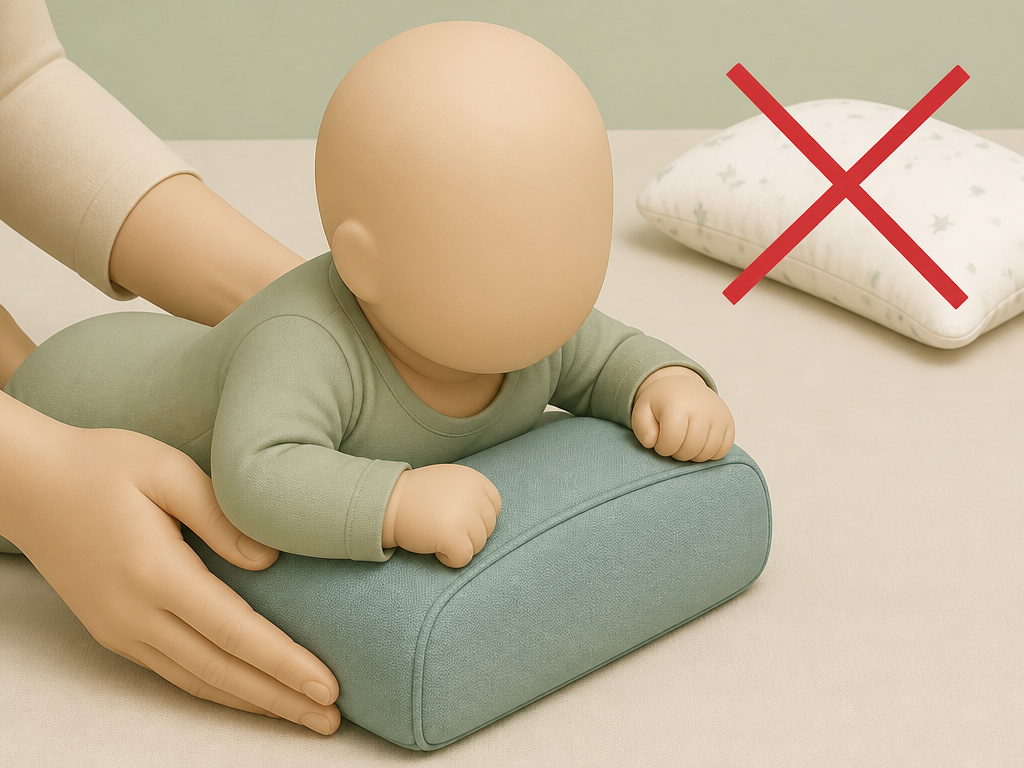
This is the primary safe use for an infant support cushion. A proper tummy time pillow is designed to prop an infant’s chest slightly off the floor, relieving pressure and building neck strength.
- The Rule: Always place the pillow on a firm, flat floor, never on a bed, sofa, or elevated surface. Stay within arm’s reach. The moment the baby shows signs of drowsiness, end the session.
- The Why-Layer: An elevated surface adds a fall risk. A soft surface like a bed allows the pillow to shift unpredictably. Drowsiness precedes sleep, and an asleep infant on a pillow is at immediate risk.
- Product Choice: Look for a product marketed explicitly for “tummy time” that complies with 16 CFR Part 1243. Our guide to the best tummy time pillows reviews models that meet these criteria.
For Feeding Support (Nursing or Bottle)
A nursing pillow is a tool to position the baby at breast or bottle height, reducing strain on the caregiver’s arms and back. The baby is being held on the pillow, not left on it.
- The Rule: The caregiver must be seated, alert, and actively supporting or feeding the infant. The pillow wraps around the caregiver’s waist; the infant is cradled in the caregiver’s arms on top of the pillow. Never place the baby on the pillow unsupervised, even for a moment.
- The Consequence: A baby can wiggle off the pillow onto the floor, or roll into the “well” of a C-shaped pillow and suffocate against the side. Incidents in the CPSC data often involved caregivers stepping away briefly.
- Product Choice: Select a pillow that meets the new CFR nursing pillow safety standard. Brands like Boppy have redesigned their products for compliance. Our review of the best nursing pillows details which models fit the bill.
For Older Children (Toddlers and Up)
Once a child has fully transitioned to a toddler bed, typically after age 2, the risks change. The American Academy of Pediatrics states a small, firm pillow can be introduced around this age.
- The Rule: Choose a pillow that is the right size: toddler pillows are typically 13″ x 18″. It must be firm enough not to fold over the child’s face. This is part of creating a safe sleep environment with appropriate baby bedding.
- The Why-Layer: A toddler has the motor skills and strength to move their head and body away from obstructions. The hazard shifts from suffocation to potential neck strain from an overly thick pillow.
- Product Choice: Move from infant products to properly sized pillows for kids. For a specific age, see our recommendations for pillows for 5 year olds.
What Does “Dual-Use” Mean and Why Is It Dangerous?
This is the marketing trap the new law explicitly closes. A “dual-use” product was one marketed as both a nursing pillow and a lounger or sleeper. You might see old marketing images of a baby sleeping peacefully on a nursing pillow.
Where this goes sideways: Using a nursing pillow as a lounger. The product’s shape creates a concave surface. An infant can roll to the side, their face can press against the pillowy wall, and they may not have the strength to turn back. This specific scenario is cited in fatal incident data.
The official infant support cushion safety standard now states that a nursing pillow that also meets the definition of an “infant lounger” is subject to the stricter infant support cushion rules. In practice, manufacturers must now choose one intended use and label it correctly.
When shopping, be wary of any product that shows images of unsupervised infants on the pillow. Look instead for clear statements of intended use: “for supervised tummy time only” or “for feeding support while holding your baby.”
How to Read Warning Labels and Manuals
The warnings on compliant products are not fine print. They are a direct map of the hazards. The new federal rules standardize these warnings for a reason.
Every regulated product must have a label that is easy to read and permanent. For an infant support cushion without a tummy time feature, the mandatory warning includes these exact statements:
* “Using this product for sleep or naps can kill.”
* “Stay near and watch baby during use.”
* “If a baby falls asleep, move baby to infant sleep product, such as a crib or bassinet.”
The label will also include pictograms. If you see a circle with a slash through an image of a sleeping baby, that means no sleep. Ever.
Worth knowing before you start: The manual is a legal document. Manufacturers like UPPAbaby state in their bassinet manual: “NEVER add a mattress, pillow, comforter, or padding. Use ONLY the pad provided by the manufacturer.” Ignoring this voids warranties and introduces documented risks.
Your diligence should match that of the engineers who wrote the manual. Check it before first use, and keep it for future reference.
What to Use Instead for Safe Sleep
The safe sleep environment for an infant under one is boring by design. It is a firm, flat, bare surface. All the cuteness and fluff lives outside the crib.
- A Certified Crib or Bassinet: Use a product that meets CPSC standards for full-size cribs, non-full-size cribs, bassinets, or bedside sleepers. The Sealy Baby bedside sleeper manual, for example, specifies a maximum 1/2-inch gap when attached to an adult bed.
- The Mattress It Came With: Only use the mattress or pad provided by the crib/bassinet manufacturer. After-market mattresses or “toppers” can create deadly gaps.
- A Fitted Sheet: Use only a tight-fitting sheet designed for that specific mattress. Loose sheets are a suffocation hazard.
- Nothing Else: No pillows, quilts, comforters, sheepskins, stuffed animals, or bumper pads. The child should be placed on their back, dressed in a sleep sack or wearable blanket if needed.
This minimalist approach is the only one backed by pediatricians and safety data. It leaves no room for the hazards that pillows for flat head or other positional devices claim to solve. Positional plagiocephaly is treated with supervised tummy time and repositioning, not with sleep aids.
Frequently Asked Questions
Can I use a pillow to prop my baby up for feeding?
No. Propping a bottle with a pillow is a choking hazard and violates the intended use of any regulated pillow. The baby must be held during feeds. For reflux, a doctor may recommend elevating the head of the crib mattress slightly, not using a pillow under the baby.
Are baby head shaping pillows safe?
No. Pillows marketed to prevent or treat flat head syndrome (positional plagiocephaly) are considered infant support cushions. They are not safe for sleep or unsupervised use. Their use during sleep is a direct violation of the “firm, flat, bare” safe sleep rule and the new federal standards.
What about travel pillows for car seats or strollers?
Never add any pillow or padding to a car seat harness system. It compromises the safety engineering. Some stroller bassinets, like the UPPAbaby, come with a specific, approved pad. The manual is absolute: “NEVER add a mattress, pillow, comforter, or padding.” After-market products are not tested with the seat and can create dangerous gaps.
How do I know if my old nursing pillow is still safe?
Check the label and recall notices. If it was manufactured before April 23, 2025, it does not meet the new mandatory standard. More importantly, if it is plush and conforming, it presents a higher risk. The safest choice is to replace it with a compliant model and use it only for feeding while holding your baby.
When is it safe to give my toddler a pillow?
Most experts agree it’s safe after the transition to a toddler bed, usually between ages 2 and 3. Start with a small, firm, flat pillow. Observe your child. If they constantly end up with the pillow over their face or never use it, you can wait longer. The right pillows for toddlers are specifically sized for their smaller bodies.
The Bottom Line
Using a baby pillow safely means not using one for sleep, ever, with an infant. The landscape is now defined by federal law: dangerous, conforming pillows are banned, and specific products like nursing pillows and tummy time cushions are highly regulated for supervised, awake use only.
Your best tools are the product’s warning label and manual. They tell you exactly what the product is for, and what it is lethally not for. For sleep, the answer remains a certified crib, a firm mattress, a fitted sheet, and nothing else. Everything else is a supervised activity, not a restful one. Choose products that comply with the 2025 standards, use them with unwavering attention, and when in doubt, stick to the firm, flat floor.
