
How Are Infants Supposed to Sleep for Safety? Expert Advice
This post contains affiliate links. As an Amazon Associate we earn from qualifying purchases.
Infants are supposed to sleep on their backs, on a firm and flat surface, in a safety-approved crib, bassinet, or play yard. The sleep surface must not incline more than 10 degrees. They should sleep alone in that crib, no pillows, blankets, toys, or loose bedding, and in the same room as a caregiver for at least the first six months. This “Back to Sleep” protocol, backed by the American Academy of Pediatrics (AAP) and federal law, is proven to dramatically reduce the risk of Sudden Infant Death Syndrome (SIDS) and other sleep-related deaths.
That 10-degree rule is federal law for any product sold for infant sleep under five months, a direct response to the inclined sleeper recalls that killed babies. The difference between a safe 5-degree bassinet and a deadly 15-degree lounger is a slope you can barely see, but it changes how an infant’s airway collapses.
What follows is the breakdown of why each rule exists, the specific products that meet them, and the edge cases every new parent faces, from a baby who rolls over to one with reflux. This is about giving you a clear, non-negotiable checklist so you can set up the sleep space and walk away knowing you’ve done everything right.
Key Takeaways
- The Back is Non-Negotiable: Placing an infant on their back for every sleep reduces SIDS risk by over 50%. Even if they roll over later, you always start them on their back.
- Flat Means Under 10 Degrees: The CPSC’s 2021 rule bans sleep products with a seat back angle over 10 degrees. This outlawed inclined sleepers, pods, and nests.
- Alone in the Crib Means Empty: A safe sleep surface has only a fitted sheet. No pillows, blankets, bumpers, stuffed animals, or loose bedding of any kind.
- Room-Sharing is Protective, Bed-Sharing is Not: Having the baby’s crib in your room for at least 6 months lowers SIDS risk. Bringing them into an adult bed raises the risk of suffocation 22-fold.
- Firmness is a Physical Test: A crib mattress should not conform to the shape of your hand when you press on it. If it sinks, it’s too soft.
The ABCs of Safe Sleep: Back, Alone, Crib
This is the core mantra. Forget the complicated lists for a moment. If you remember Back, Alone, Crib, you’ve covered 90% of what keeps a sleeping baby safe.
Back for every sleep. Alone in the crib. Crib, bassinet, or play yard that meets current safety standards. This three-word framework is the foundation of all modern safe sleep guidance from the American Academy of Pediatrics.
Back is about airway anatomy. An infant’s airway is like a soft, collapsible tube. On the back, gravity pulls the tongue forward, keeping the passage open. On the stomach, the tongue can fall back, the jaw can shift, and the airway can kink. The evidence is overwhelming: back sleeping cut SIDS rates in half in the 1990s and it remains the single most effective protective step.
Alone means the sleep space contains nothing but the baby and a tight-fitting sheet. This eliminates risks of entrapment, strangulation, and suffocation. That cute crib bumper, the cozy blanket, the lovey placed just for comfort, they are all hazards. A baby does not need a pillow. Their head is proportionally large, and a pillow can tilt it forward, compromising the airway. The desire to make a crib look cozy is understandable, but safety is stark.
Crib (or bassinet, or play yard) is the only acceptable sleep location. Not a couch, not an armchair, not an adult bed, not a swing or car seat outside the car. These products are not designed for unsupervised sleep. Their soft, angled, or confined surfaces create gaps and positions where breathing can be blocked.
Where This Goes Sideways: The “Just This Once” Trap
Common mistake: Bringing a fussy baby into your bed “just until they settle.” Adult mattresses are too soft, bedding is heavy, and pillows are everywhere. A parent in deep sleep may not feel a baby shifting into a dangerous position. The risk of accidental suffocation is highest in the first three months, precisely when exhaustion is peaking.
If you need to feed or comfort in bed, remove all pillows and blankets first. The moment you feel drowsy, place the baby back in their separate sleep space. Have that space, a bedside bassinet or bedside crib, within arm’s reach so the transfer is easy.
The Sleep Surface: Firm, Flat, and 10 Degrees or Less
“Firm and flat” sounds simple. The government now defines it with a number: 10 degrees. This is the most significant recent change in safe sleep rules.
In June 2021, the U.S. Consumer Product Safety Commission (CPSC) passed a rule mandating that any product marketed for infant sleep for babies up to 5 months must meet the existing federal safety standards for cribs, bassinets, play yards, and bedside sleepers. A key part of this rule is the incorporation of the ASTM F3118 standard, which states the sleep surface must not exceed a 10-degree incline.
Why 10 degrees? Independent infant testing for the CPSC concluded that beyond this angle, an infant’s head can tilt forward, chin-to-chest. This position can compress the trachea, restricting airflow. It also makes it harder for a baby to lift its head or turn it if its face becomes obstructed.
| Product Type | Safe for Sleep? | Key Feature | Risk If Used for Sleep |
|---|---|---|---|
| Flat Bassinet | Yes | Rigid, flat bottom, breathable sides. | None when used correctly. |
| Inclined Sleeper/Rocker | No | Seat back angle >10°. | Airway compression, positional asphyxia. |
| Baby Box | It depends | Must have a firm, flat insert. | If the insert is soft or absent, suffocation risk. |
| Travel Crib/Play Yard | Yes | Includes a firm, flat mattress pad. | Pad must be used; gaps between pad and sides are a hazard. |
| Car Seat | No | Designed for vehicle travel only. | Head can fall forward, causing airway blockage. |
This table makes the distinction clear. A product meant for soothing or lounging is not a product meant for sleep. The Fisher-Price Rock ‘n Play Sleeper, recalled after being linked to over 100 infant deaths, had a 30-degree incline. The danger was in the name itself, calling it a “sleeper” implied it was safe for sleep.
Firmness Test: Press your hand firmly into the center of the crib mattress and then release. The mattress should snap back immediately. It should not conform to the shape of your hand. A soft mattress creates a pocket that can trap carbon dioxide around a baby’s face, leading to rebreathing and suffocation. When choosing a safe infant mattress, firmness is the first spec to verify.
Room-Sharing vs. Bed-Sharing: The Critical Difference
This is the most emotionally charged rule. The instinct to keep your baby close is powerful. The science shows you should, just not in the same bed.
Room-sharing, placing the baby’s crib, bassinet, or play yard in your bedroom, is recommended for at least the first six months, ideally up to one year. Studies cited in the AAP safe sleep evidence base show this practice can reduce the risk of SIDS by as much as 50%. It allows for easier feeding, comforting, and monitoring.
Bed-sharing, also called co-sleeping, is when the infant sleeps on the same surface as an adult. The AAP advises against this entirely due to the dramatically increased risk of accidental suffocation, strangulation, and overlay. Adult beds have soft mattresses, heavy comforters, and pillows. A tired parent may not wake if they roll over.
The part nobody mentions: The risk isn’t just about rolling over. An adult mattress is designed for an adult’s weight. When a baby lies on it, their lighter body can’t depress the surface, but a parent’s body can. This creates a slight incline or a trough where the baby can roll into and become trapped against the parent or the bedding.
The safe compromise is a separate, attached sleep surface. A bedside bassinet sleeper that securely attaches to the side of the adult bed provides a barrier-free reach for the parent while maintaining a firm, flat, independent sleep space for the baby. It satisfies the need for closeness without the risks of bed-sharing.
What to Put in the Crib (Spoiler: Almost Nothing)
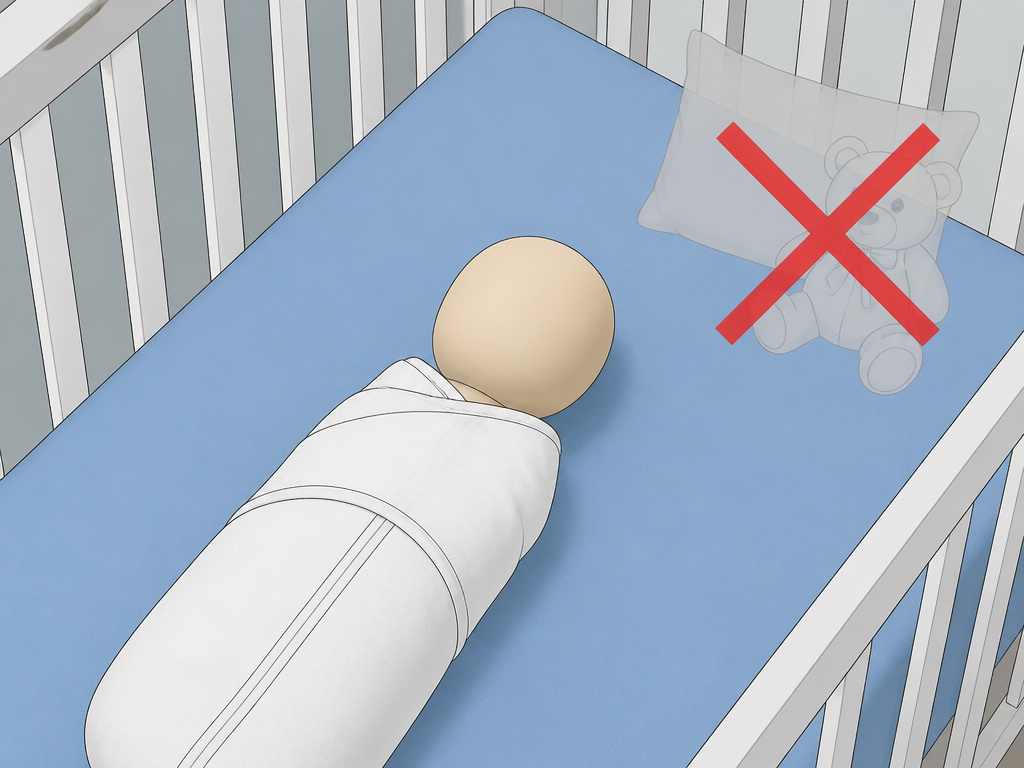 A properly set-up crib is a minimalist’s dream. Here is the complete, non-negotiable list of what belongs inside it with a sleeping baby:
1. A firm, flat mattress covered by a tight-fitting sheet. Not a “snug” sheet, a sheet specifically sized for that exact mattress model.
2. The baby. In a wearable sleep sack or swaddle if needed for warmth. That’s it.
Let’s run through the common items and why they are excluded:
- Crib Bumpers (Padded or Mesh): Banned by the CPSC as of 2022. They pose a suffocation, strangulation, and entrapment risk. A baby can press their face against them or use them as a step to climb out later.
- Blankets, Pillows, and Stuffed Animals: Soft bedding is the leading cause of accidental suffocation in infants. A blanket can cover a baby’s face; a pillow can tilt the head; a stuffed animal can block the nose and mouth.
- Positioners, Wedges, and Nests: These aftermarket products claim to keep a baby in place or alleviate reflux. They are not tested to safe sleep standards and create entrapment zones and suffocation hazards.
- Loose Sheets or Mattress Pads: Any bedding that can be gathered or pulled loose is a risk. The mattress pad should be secured underneath the fitted sheet.
Warmth comes from appropriate clothing. Use a wearable blanket or sleep sack. Swaddling is acceptable until the baby shows signs of rolling, which can happen as early as 2-3 months. A swaddled baby who rolls onto their stomach cannot use their arms to push up or turn their head, creating an extreme suffocation risk.
Navigating the Gray Areas: Rolling, Reflux, and Grandparents
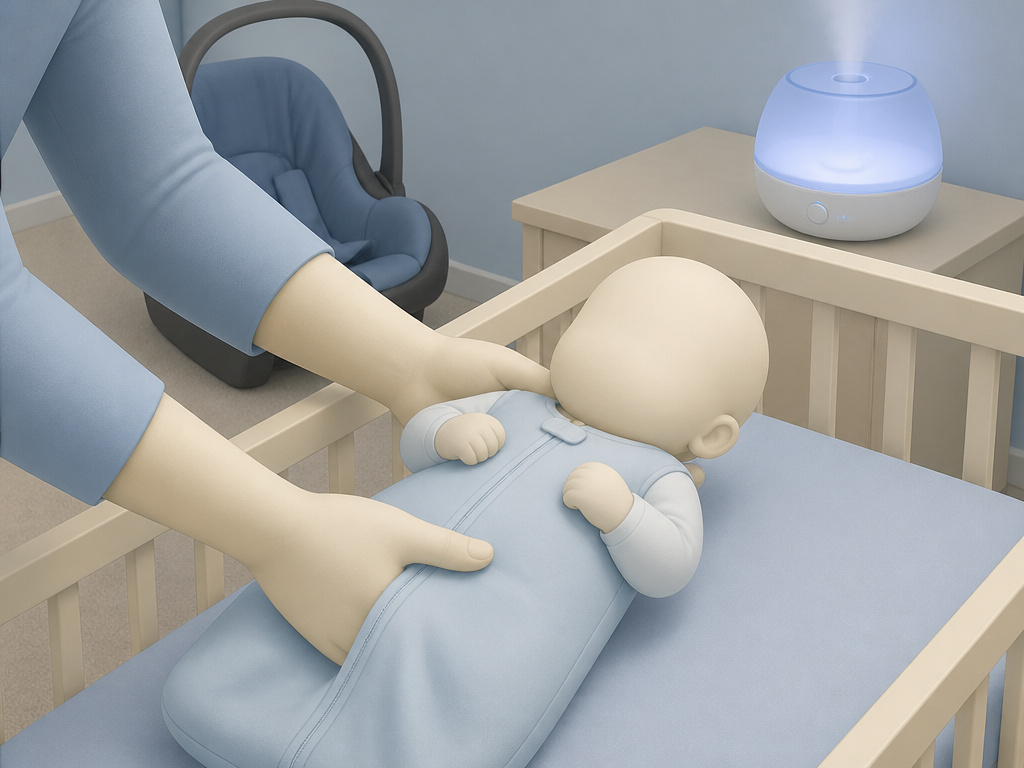 The rules are absolute, but babies are not. Here’s how to handle the situations where the “always” seems to conflict with reality.
When Your Baby Rolls Over: This is a major milestone that causes panic. The AAP guideline is clear: you always place them on their back to sleep. If they independently roll to their stomach or side during sleep, you do not need to reposition them. By the time they can roll both ways, they have the strength and developmental maturity to move their head to breathe. However, you must stop swaddling immediately at the first sign of attempted rolling.
Infants with Reflux or Congestion: Many parents are tempted to incline the mattress or use a wedge. Do not do this. The AAP states that the back sleep position on a flat surface does not increase choking risk, even for babies with reflux. Inclining the sleep space is not proven to help reflux and absolutely increases the risk of SIDS and suffocation. For congestion, use a cool-mist humidifier and saline drops with suction.
The Grandparent’s House (or Any Caregiver): Consistency saves lives. You must be the enforcer. Send a CDC infant sleep environment guide link ahead of time. Be blunt: “Our pediatrician said the crib must be empty, and she only sleeps on her back. Here is the sleep sack she uses.” If they have an old crib, check for recalls, missing hardware, and slat spacing (must be ≤ 2-3/8 inches). A proper crib mattress safety check is non-negotiable there, too.
The Car Seat Nap: If a baby falls asleep in a car seat during travel, that’s fine, the seat is doing its job. Once you reach your destination and the car stops, they are no longer in a properly positioned seat. Transfer them to a firm, flat surface as soon as it is safe and practical. Do not let them continue sleeping in the car seat carrier inside the house.
The Science Behind the Rules: The Triple-Risk Model
Understanding why reduces the urge to bend the rules. SIDS is not fully understood, but the leading framework is the Triple-Risk Model.
- A Critical Developmental Period: The peak risk is between 1 and 4 months of age, when an infant’s cardiorespiratory and arousal systems are still immature and stabilizing.
- An Exogenous Stressor: This is the unsafe sleep environment, prone position, soft bedding, overheating, or an inclined surface.
- An Intrinsic Vulnerability: Some infants may have an underlying biological vulnerability, such as a subtle brainstem abnormality affecting breathing or arousal.
SIDS is believed to occur when all three factors overlap. A vulnerable infant, during a critical period, encounters a stressor they cannot overcome. We cannot identify or change intrinsic vulnerabilities. We cannot skip the developmental period. The only factor we have 100% control over is removing the exogenous stressors. That’s what the safe sleep rules do. They create an environment where, even if a vulnerability exists, there is no external trigger to set a fatal sequence in motion.
This model explains why “my parents did it and I was fine” is dangerous logic. It’s a game of Russian roulette where the unsafe practice adds another bullet to the chamber. Your job is to empty the chamber entirely.
Building Your Safe Sleep Checklist
Use this as your pre-baby and daily audit list. Print it.
The Sleep Space:
- [ ] Crib/Bassinet/Play Yard: Manufactured after June 2021 (post-CPSC rule) or verified to meet current consumer product safety standards. No drop-side cribs.
- [ ] Mattress: Firm, flat, and no more than a 10-degree incline. Fits snugly with ≤ 3 cm gap on any side. A breathable crib mattress can add an extra layer of safety.
- [ ] Sheet: One tight-fitting sheet only.
The Baby:
- [ ] Position: Placed on back for every sleep, nap, and night.
- [ ] Clothing: In a sleep sack or wearable blanket. No hats indoors once home from the hospital.
- [ ] Swaddle: Stopped at first sign of rolling.
The Environment:
- [ ] Location: In your room, at least 6 months.
- [ ] Empty Crib: No bumpers, blankets, pillows, toys, or positioners.
- [ ] Temperature: Room temperature comfortable for a lightly clothed adult (68-72°F). Baby is not sweating or hot to the touch.
- [ ] Pacifier: Offered at nap/bedtime after breastfeeding is established (associated with reduced SIDS risk).
Your Habits:
- [ ] Feeding: Breastfeeding is associated with lower SIDS risk. If you bring baby into bed to feed, remove all soft bedding first.
- [ ] Smoking: Keep baby in a smoke-free environment. Prenatal and secondhand smoke are major risk factors.
- [ ] Sober Care: Never sleep with baby on a couch/armchair or if you are impaired by alcohol, sedatives, or extreme fatigue.
Frequently Asked Questions
What if my baby spits up while sleeping on their back?
They will not choke. An infant’s airway anatomy has protective reflexes. In the back position, the esophagus (to the stomach) is below the trachea (to the lungs). Spit-up will be swallowed again or pool in the cheeks, not enter the lungs. The AAP confirms back sleeping is safe even for babies with reflux.
When can I introduce a pillow and blanket?
Not until at least 18-24 months, and even then, wait until the toddler transitions to a toddler bed. A pillow and blanket in a crib with crib rails is a strangulation and entrapment hazard. The safest practice is to wait until the child is out of the crib entirely.
Are bedside sleepers or in-bed sleepers safe?
Bedside sleepers that attach to the adult bed and have a firm, flat, independent surface meeting CPSC standards can be safe. True in-bed sleepers (a small bassinet that sits directly in the adult bed) are not recommended. A CPSC review found deaths and injuries from these products, primarily from entrapment in gaps or improper assembly.
Is it okay for a baby to sleep on my chest if I’m awake?
This is a common and cherished practice, but it carries risk. If you are seated and awake, alert, and in a position where you cannot fall asleep, it’s generally considered safe for bonding. The moment you feel drowsy, place the baby in their crib. Falling asleep with a baby on your chest on a couch or armchair is extremely dangerous.
How do I know if my crib mattress is firm enough?
Use the hand test. Press firmly on the center and edges. It should feel solid, with almost no “give.” Compare it to a new, firm adult mattress, it should be significantly more rigid. When shopping for a mattress for newborn safety, firmness is the first spec on the list.
Before You Go
Safe infant sleep is a set of public health standards written from tragedy and proven by data. The rules, back, alone, crib, flat, are simple because they have to be.Exhausted brains need simple.
Your job is to follow the checklist, communicate it to every caregiver, and trust the science over well-meaning advice. Choose a safe crib mattress, set up a bedside crib in your room, and use a sleep sack. Then, focus on the rest of parenting. You’ve already built the safest possible foundation for every dream to come.
