
What Is a Toddler Bed Sheet | The Exact Size & Safety Specs
This post contains affiliate links. As an Amazon Associate we earn from qualifying purchases.
A toddler bed sheet is a fitted or flat sheet designed to fit a standard crib mattress, which measures a minimum of 51 5/8 inches long by 27 1/4 inches wide. This size is defined by federal safety standards for the bed itself, not the sheet. The sheet’s job is to cover that mattress snugly and safely for a child aged 15 months and up.
That mattress size is the anchor. The federal Consumer Product Safety Commission rule for toddler beds, 16 CFR Part 1217, incorporates the ASTM F1821 safety standard. That standard defines a toddler bed as a frame intended to hold that specific crib mattress. Sheets follow the mattress, not the bed’s decorative theme.
What follows: the precise dimensions you must match, why material choice is a safety decision, how to verify your mattress before buying, and the bedding layers that actually matter for sleep.
Key Takeaways
- Toddler bed sheets fit a standard crib mattress (51 5/8″ x 27 1/4″), not a “toddler” mattress.
- The bed frame itself is regulated by the ASTM F1821 safety specification; sheets are not, but they must not create entanglement or suffocation risks.
- Fitted sheets with deep pockets and full elastic are non-negotiable for a safe, tight fit that won’t come loose.
- Material affects temperature and skin sensitivity; organic cotton is the default for breathability, while bamboo suits hot sleepers.
- Always use a waterproof mattress protector under the sheet; it’s the most practical layer for managing accidents.
The Exact Dimensions of a Toddler Bed Sheet
Forget “toddler size.” The only size that matters is the crib mattress size. This isn’t a marketing convention. It’s a safety rule.
The official toddler bed requirements in 16 CFR Part 1217 mandate that a toddler bed must be “intended to accept a full-size crib mattress.” That mattress has minimum dimensions of 51 5/8 inches in length and 27 1/4 inches in width. The standard also specifies a maximum thickness, usually around 6 inches. Your sheet must be made for this exact rectangle.
A toddler bed sheet is a bedding layer cut to fit a full-size crib mattress, which measures a minimum of 1310 mm by 690 mm (51 5/8 in. By 27 1/4 in.). The sheet’s safety function is to remain securely fitted to the mattress without creating loose fabric that could pose an entanglement or suffocation hazard, complementing the regulated safety of the bed frame itself.
This means a sheet labeled “crib” and a sheet labeled “toddler bed” are the same product. Manufacturers use both terms, but they refer to the identical mattress footprint. The confusion starts when parents see “toddler bed” and assume it needs a special, smaller sheet. It does not.
Check your mattress label before buying any sheets. If it’s the original mattress from your child’s crib, it’s almost certainly a standard crib size. If you’re shopping for a new mattress, look for “standard crib” or “full-size crib” dimensions. Twin or twin XL sheets will not fit.
| Mattress Type | Standard Dimensions (Inches) | Sheet Type Needed |
|---|---|---|
| Full-Size Crib | 51 5/8 x 27 1/4 | Crib Sheet / Toddler Bed Sheet |
| Mini Crib | 38 x 24 | Mini Crib Sheet |
| Toddler Bed (Frame) | N/A – holds a crib mattress | Crib Sheet |
The frame’s safety is a separate issue. The ASTM F1821 safety specification governs the bed’s structure, guardrail height, spacing between slats, and mattress support, to prevent entrapment. A sheet can’t fix a poorly designed bed. But a poorly fitting sheet can introduce new risks on a safe bed.
Why Safety Standards Dictate the Mattress (and Therefore the Sheet)
The link between a federal rule and your child’s sheet is indirect but absolute. The U.S. Consumer Product Safety Commission (CPSC) doesn’t regulate sheets as a children’s product category in the same way it regulates beds. But the bed’s legally mandated mattress size sets the sheet’s required dimensions.
The current mandatory standard for toddler beds is ASTM F1821-19ε1. It will update to ASTM F1821-26 in August 2026. These standards exist to minimize risks from normal use and foreseeable misuse. The key hazards they address, entrapment in gaps, falls, and head/neck entrapment, are about the hard structure of the bed.
A sheet interacts with these hazards in two ways. First, a sheet that is too small or lacks adequate elastic will pop off, creating loose fabric. Second, a sheet that is too thick or padded can effectively reduce the height of a guardrail, negating its safety function.
Where this goes sideways: Using a flat sheet instead of a fitted sheet. A flat sheet tucks in loosely and can be kicked free, becoming a loose fabric hazard in the sleep space. A fitted sheet with full perimeter elastic is the only safe choice.
Your sheet is part of a safety system. The CPSC toddler bed business guidance for manufacturers details compliance, but the takeaway for parents is simple: the bed must be certified to the standard, and the bedding must not compromise its safe operation. This means no pillows, heavy blankets, or padded bumpers for children under 12 months, and always a tight-fitting sheet.
Material Choices: Breathability, Durability, and Sensitive Skin
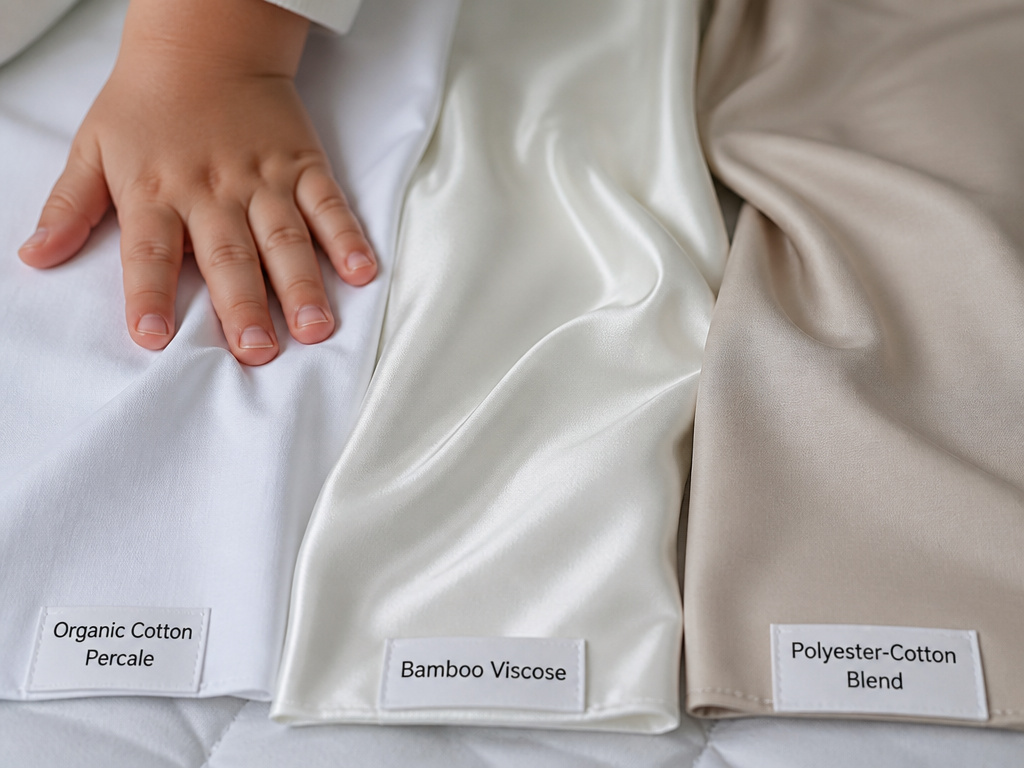
Cotton is the default, but it’s not the only player. The fabric of a toddler bed sheet determines how it feels, how it wears, and how it manages moisture and heat. This is a comfort decision with safety-adjacent consequences, a child who overheats sleeps restlessly and is more likely to kick off covers.
Organic cotton is the benchmark for breathability and gentle touch. It’s naturally hypoallergenic, durable through washes, and gets softer over time. Look for Global Organic Textile Standard (GOTS) certification to ensure the entire processing chain meets strict environmental and social criteria.
Bamboo viscose (often labeled just “bamboo”) is cooler to the touch and highly absorbent, wicking moisture away from the skin. It’s an excellent choice for hot sleepers or warm climates. The feel is silky-smooth. The caveat is that its production involves chemical processing, so the “eco-friendly” claim depends heavily on the manufacturer’s closed-loop systems.
Polyester or polyester blends are the workhorses. They’re wrinkle-resistant, durable, and inexpensive. The drawback is breathability; polyester tends to trap heat. For a child who runs cool or in a well-air-conditioned room, a high-thread-count cotton-polyester blend can be a practical, easy-care option.
| Material | Best For | Considerations |
|---|---|---|
| Organic Cotton | Sensitive skin, all seasons | Requires ironing if you want a crisp look |
| Bamboo Viscose | Hot sleepers, night sweats | Check for Oeko-Tex certification for chemical safety |
| Polyester Blend | Budget, easy care | Can feel less breathable on very warm nights |
The weave matters too. Percale is a crisp, matte finish that breathes well. Sateen has a softer, silkier feel with a slight sheen, but it can be warmer. For a child’s sheet, prioritize breathability and softness over thread count alone. A 200-300 thread count in a good quality cotton is perfectly adequate.
How to Choose Safe and Comfortable Toddler Bedding
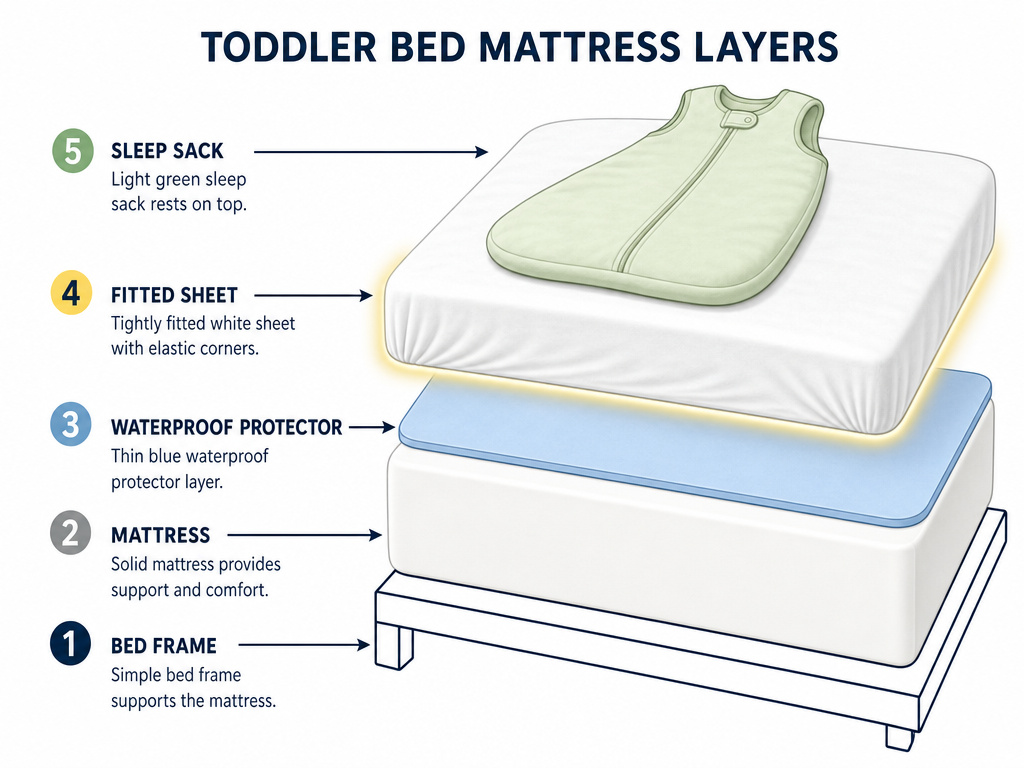
A sheet is one component of a complete toddler bedding sets. The goal is to create a sleep environment that is secure, comfortable, and simple. Start with the mattress, then build out.
First, invest in a high-quality waterproof protectors. This goes directly on the mattress, under the sheet. It protects the mattress from accidents, spills, and allergens. Look for one that is quiet (not crinkly) and breathable, so it doesn’t make the sleep surface hot.
Next, choose your fitted sheets. Have at least two or three sets. This lets you change sheets quickly after an accident without doing laundry at midnight. For the top layer, skip the adult-style flat sheet and top blanket for younger toddlers. Instead, use a wearable sleep sack or a appropriately sized toddler blankets that are lightweight and small enough not to tangle.
Pillows are not recommended until at least age 2, and even then, choose a very flat, firm, small pillows for toddlers designed specifically for that age group. The same goes for stuffies, keep the sleep space clear for babies under 12 months.
Here’s the order of layers, from bottom to top: 1. Toddler Bed Frame (ASTM F1821 compliant) 2. Standard Crib Mattress 3. Waterproof Mattress Protector 4. Fitted Crib/Toddler Bed Sheet 5. Sleep Sack or Lightweight Toddler Blanket
This system is easy to strip and wash, and it minimizes loose fabric in the crib. When shopping for eco-friendly kids bed sheets, apply the same safety checklist: tight fit, breathable material, and no decorative ties or loops that could pose a strangulation risk.
Toddler Bed Sheets vs. Other Kids’ Bedding
Sheets are a commodity; the bed is the regulated product. This distinction clarifies the entire category.
A toddler bed sheet is functionally identical to a crib sheet. They are interchangeable terms for the sheet that fits the standard crib mattress. A bunk bed sheet is a different product altogether, made for a twin or twin XL mattress. The naming (“toddler”) refers to the life stage, not a unique size.
The bedding for bunk beds has its own challenges, like deep-pocket fits for thick mattresses and tucking strategies for safety rails. Toddler bed sheets have one job: hug a small, rectangular mattress tightly.
When your child eventually transitions to a larger bed, you’ll move from crib sheets to twin sheets. The toddler bed phase is the last time you’ll use this specific size. That’s why investing in two or three good-quality sets makes sense, they’ll get daily use for a couple of years, then be retired.
Frequently Asked Questions
Are toddler bed sheets the same as crib sheets?
Yes. They are both made to fit a standard full-size crib mattress, which measures approximately 52 inches by 28 inches. Any sheet marketed for a crib will fit a toddler bed, and vice versa.
What size mattress does a toddler bed use?
Toddler bed uses a standard full-size crib mattress. The federal safety standard (ASTM F1821) defines a toddler bed as a frame intended to accommodate this specific mattress size: a minimum of 51 5/8 inches long by 27 1/4 inches wide.
When should I switch from a crib sheet to a toddler bed sheet?
You don’t switch sheets. You switch beds. When you transition your child from a crib to a toddler bed, you use the same crib mattress and therefore the same sheets. The “toddler bed sheet” label is just marketing aimed at parents making that transition.
Can I use a regular flat sheet on a toddler bed?
No. You should only use a fitted sheet designed for a crib mattress. A flat sheet is not secure and can come loose, creating a risk of entanglement or suffocation. The sleep surface for a young child should be free of loose bedding.
How many toddler bed sheets do I need?
Minimum of two, but three is ideal. This allows you to have one on the bed, one in the wash, and one spare for immediate changes during the night due to accidents or spills.
What material is best for toddler bed sheets?
Organic cotton is the best all-around choice for breathability, durability, and gentle feel on sensitive skin. Bamboo viscose is a great alternative for hot sleepers, as it feels cooler and wicks moisture well.
Before You Go
A toddler bed sheet isn’t a special product. It’s a crib sheet used on a different frame. The safety comes from the regulated bed and the snug-fitting sheet.
Match the sheet to the mattress, not the bed’s name. Choose a fitted sheet in a breathable material like organic cotton. Always use a waterproof protector underneath. Keep the rest of the bedding minimal, a sleep sack or light blanket is enough.
That’s the system. It’s simple, safe, and designed for the reality of life with a toddler. The right kids bed sheets are the ones that fit perfectly, wash easily, and let your child sleep comfortably. Everything else is just decoration.
