
Why Won’t My Baby Sleep?” Solve the 29-Minute Sleep Gap
This post contains affiliate links. As an Amazon Associate we earn from qualifying purchases.
A baby won’t sleep through the night due to one of three core issues: a developmental phase (like the 4-month sleep regression), an environmental problem (too hot, too loud, unsafe surface), or a learned sleep association (needing to be rocked or fed to fall asleep). The clinical definition of a problem is taking 30 minutes or more to fall asleep or waking repeatedly most nights for at least four weeks.
That 30-minute threshold marks the line where occasional fussing becomes a disorder that affects family functioning. The fix almost always involves adjusting the sleep environment for safety and consistency, then teaching your baby to fall asleep independently in their crib.
What follows is a breakdown of the evidence: why behavioral interventions add an average of 29 minutes of nighttime sleep, the one safe sleep rule that halves SIDS risk, and the step-by-step method that works for 94% of families when applied consistently.
Key Takeaways
- A 2013 meta-analysis found behavioral sleep interventions add a mean of 29 minutes of nighttime sleep at 6 weeks compared to ordinary practice.
- Room sharing, baby in your room but on a separate surface, can decrease the risk of SIDS by as much as 50%.
- A sleep problem is clinically defined as taking ≥30 minutes to fall asleep or waking repeatedly most nights for ≥4 weeks.
- Two-thirds of infants sleep through the night regularly by age 6 months; before that, night wakings are biologically normal.
- Long naps after 4 PM or an inconsistent bedtime directly fuel night wakings by disrupting circadian rhythm.
The Evidence-Based Reasons Babies Fight Sleep
You’re not imagining the struggle. Infant sleep is a developing skill, not a switch you flip. The research points to a few predictable, physical reasons the crib becomes a battleground.
First, know the baseline. About two-thirds of infants are able to sleep through the night on a regular basis by age 6 months. Before that milestone, waking for food or comfort is standard biological programming. The problem starts when those wakings stretch past 20 minutes, happen hourly, or require complex rituals to resolve.
The official medical definition frames the severity. According to diagnostic criteria, a sleep onset and night waking disorder involves a child taking 30 minutes or more to fall asleep and waking repeatedly most nights per week. The child must be at least 6 months old, and symptoms must last for at least 4 weeks. That timeline matters. A bad week during a growth spurt isn’t a disorder. A month of nightly battles is.
Where this goes sideways: Assuming all night wakings are hunger. After 6 months, most overnight feeds are a habit, not a necessity. Continuing them teaches your baby to wake for the bottle or breast as a sleep cue, cementing the cycle.
Why do these patterns lock in? Sleep is governed by a fragile mix of circadian rhythm, sleep pressure, and environmental cues. An overtired baby has a harder time falling asleep, not an easier one. Their system floods with cortisol, a stress hormone that acts as a stimulant. Missing the sleep window by even 30 minutes can trigger a cascade of false-starts and night terrors.
| Biological Cause | What It Looks Like | The Fix Window |
|---|---|---|
| Undeveloped Circadian Rhythm | Day/night confusion, long late naps | Establish consistent light/dark cues by 8 weeks |
| Sleep Regression (4 months) | Suddenly waking every 2 hours, short naps | Wait 2-3 weeks; then reinforce independent sleep |
| Separation Anxiety (8-10 months) | Crying when you leave the room, clinginess | Practice brief separations during the day |
| Teething or Illness | Fussy at bedtime, waking in pain | Treat symptoms; return to routine once healthy |
The goal is to shorten the duration of wakings and reduce the need for your intervention. That’s where the data on behavioral interventions becomes non-negotiable.
The Most Common Culprit: Sleep Onset Associations
This is the engine behind most chronic sleep problems. A sleep onset association is the specific condition your baby needs to fall asleep. If they fall asleep nursing in your arms, they will need nursing in your arms to reconnect sleep cycles at 2 a.m. The association isn’t the problem, the dependency is.
Rocking or feeding to sleep is a trap. It works until it doesn’t. The baby learns that your arms are the cue for sleep onset, not their own crib. When they wake between cycles, the crib feels wrong and they signal for you to restore the “right” conditions.
The American Academy of Sleep Medicine’s practice parameters are blunt on this. Of 52 studies on behavioral interventions for bedtime problems and night wakings, 94% reported clinically significant improvements. The most effective methods all revolve around breaking the link between you and the moment of sleep.
Here are the two evidence-backed paths, with the trade-off each requires:
Full Extinction (Often called “Cry It Out”):
You put your baby down awake at bedtime, then do not re-enter for checks until a set morning time. It’s brutal for two nights. By night three or four, most babies are falling asleep within 10 minutes with minimal fussing. This method works fast because it removes all mixed signals.
Graduated Extinction (The “Chair Method”):
You put baby down awake, but stay in a chair next to the crib to offer quiet reassurance. Every few nights, you move the chair farther away until you’re out the door. It takes longer, often 10 to 14 nights, but feels more manageable for many parents.
The common failure point is inconsistency. Switching methods mid-week or caving after 45 minutes teaches your baby that longer crying eventually works. Pick one plan, commit to a 7-night trial, and watch the clock, not the monitor.
The Safe Sleep Non-Negotiables
Before you change any behavior, the environment must be safe. This isn’t about comfort; it’s about physiology. An unsafe setup can actively prevent sleep and carries fatal risks.
The American Academy of Pediatrics is unequivocal. The single most effective thing you can do is room sharing, keeping the baby’s sleep surface in your room for at least the first six months. This practice can decrease the risk of SIDS by as much as 50%. The proximity allows for subtle auditory and sensory regulation without the dangers of bed-sharing.
Your baby’s sleep surface is the next line of defense. Any surface that inclines more than 10 degrees is not safe for infant sleep. This rules out most loungers, dock-a-tots, and inclined rockers marketed for overnight use. Since June 2021, all infant sleep products sold must meet the same federal safety standards as cribs or bassinets. Look for a JPMA certification sticker.
Before you start: The crib must be bare. No pillows, blankets, stuffed animals, or bumper pads. Use a firm mattress with a fitted sheet and a wearable blanket for warmth. Soft objects are suffocation hazards and disrupt the uniform surface a baby needs for stable sleep.
This is non-negotiable. A safe sleep space is a simple sleep space. The AAP safe sleep policy guide states that blankets, pillows, and soft bedding increase the risk of suffocation and SIDS. The best baby bedding is minimal bedding.
The Step-by-Step Reset for Night Wakings
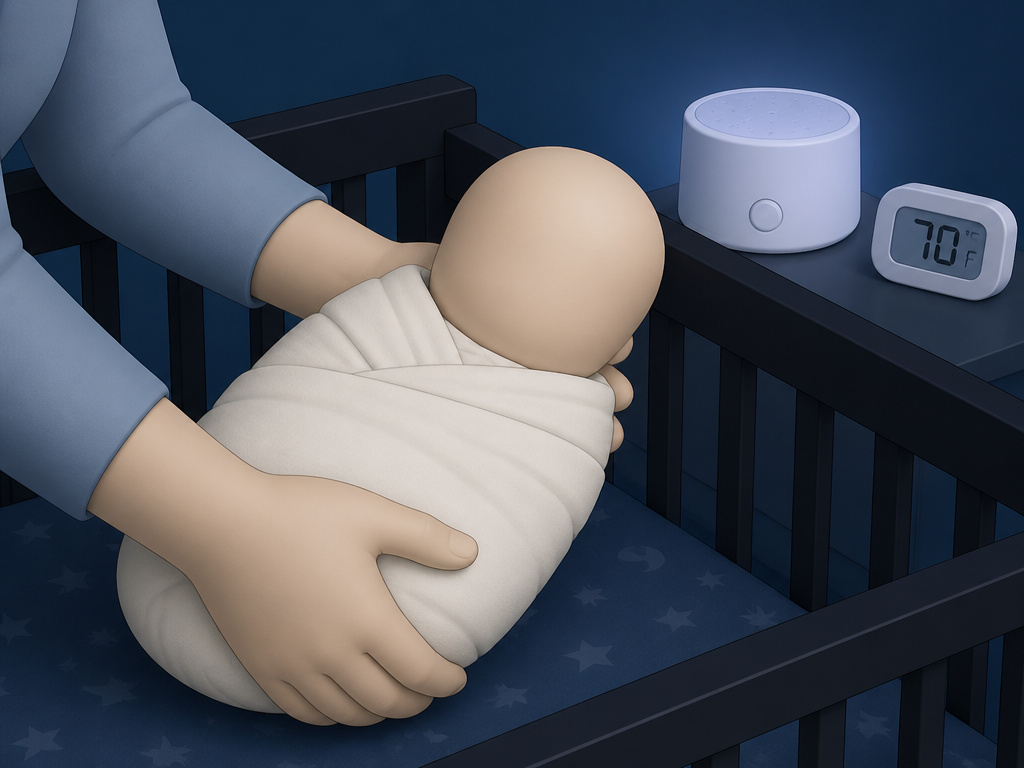 When you’re ready to make a change, follow this sequence. Each step builds on the last. Skipping to the behavioral fix before securing the environment and schedule guarantees frustration.
1. Audit the Environment (Night 1)
- Temperature: 68–72°F (20–22°C). Feel the back of their neck, it should be warm, not sweaty.
- Darkness: Pitch black. Use blackout curtains and cover any LED lights. Darkness cues melatonin production.
- Sound: Consistent white noise. A simple machine set to 50–60 decibels masks household bumps.
2. Fix the Schedule (Nights 2–3)
- Set a consistent bedtime within a 30-minute window every night.
- Cap daytime naps so total daytime sleep doesn’t exceed recommended amounts for age.
- Eliminate naps that end after 4:00 PM. A late nap resets sleep pressure and pushes bedtime later.
3. Establish a Boring Bedtime Routine (Nights 4–5)
- Keep it short and predictable: feed, bath, book, bed.
- Do the final feeding before the book, not while in the crib. Separate eating from sleeping.
- Put your baby down drowsy but awake. This is the single most important skill.
4. Choose and Execute Your Behavioral Method (Nights 6–7+)
- For a baby over 6 months, decide between full or graduated extinction.
- Start at bedtime, not for a middle-of-the-night waking. Bedtime sleep pressure is highest.
- Be consistent with your response for all wakings before, say, 5:00 a.m.
The AASM bedtime problems practice parameters note that these interventions are most effective when parents commit to a single approach. The first night is always the hardest. Improvement is often visible by night three.
When to Pause and When to Call the Doctor
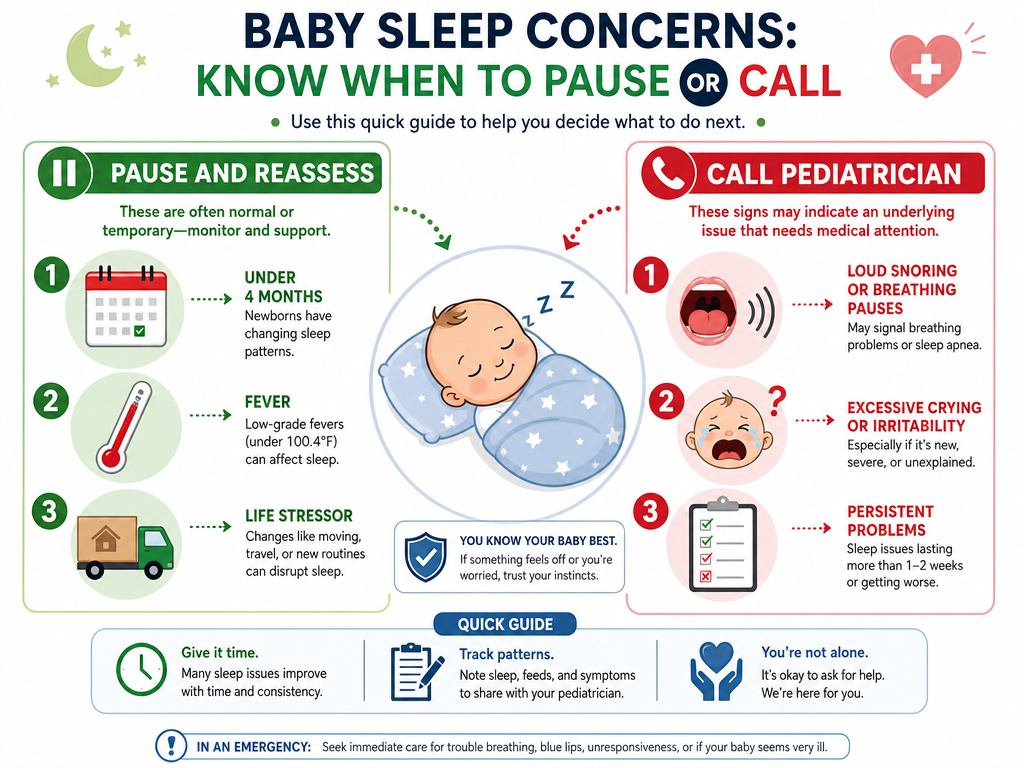 Not every sleep battle is behavioral. Some signs mean stop the sleep training and investigate further.
Pause and reassess if:
- Your baby is under 4 months old. Their nervous system is too immature for formal sleep training.
- They show signs of illness: fever, congestion, pulling at ears.
- There’s a major life stressor: moving, a new caregiver, you returning to work.
Call your pediatrician if:
- Your baby snores loudly or seems to gasp or pause breathing during sleep. This could indicate sleep apnea.
- They have extreme difficulty falling asleep even when held, or seem excessively irritable. This could point to reflux or an allergy.
- Sleep problems persist despite 2 weeks of perfect consistency. Rule out physical causes like iron deficiency or tongue tie.
The StatPearls SIDS overview notes that certain factors, like preterm birth, multiply risk. If your baby was premature or had a low birth weight, discuss any sleep plan with your doctor first. Their guidance overrides any article.
Frequently Asked Questions
What is the 4-month sleep regression?
It’s a permanent change in sleep architecture, not a temporary phase. Around 3-5 months, a baby’s sleep cycles mature to resemble an adult’s, with distinct light and deep sleep phases. They now wake fully between cycles, every 60-90 minutes. If they don’t know how to fall asleep independently, they’ll call for you at each transition. This is why sleep associations become a crisis at this age.
Is it okay to use a pacifier for sleep?
Yes, and it may reduce SIDS risk. The trick is to offer it at sleep onset but not reinsert it all night. If the baby can’t find and replace it themselves, it becomes a negative sleep association. Many parents introduce the pacifier at bedtime but don’t use it for overnight wakings after 6 months.
How long should I let my baby cry?
There’s no universal timer. With full extinction, you might not re-enter until morning. With graduated extinction, you might check in at increasing intervals (5, 10, 15 minutes). The critical factor is that the intervals don’t get shorter. If you check at 10 minutes one night, don’t check at 5 the next. Consistency tells the baby the rules are stable.
My baby sleeps great in the swing but not the crib. What do I do?
The motion of a swing is a powerful sleep association. It also becomes unsafe once a baby can roll. You must transition to the crib. Start with one nap a day in the crib, using white noise and a dark room to mimic the swing’s sensory blockade. Use your chosen behavioral method for that nap. It will be rough for a few days. Expand to more naps and then bedtime once the first nap stabilizes.
Are weighted sleep sacks safe?
The AAP has not issued specific guidance on weighted products. Many pediatricians caution against them due to the potential for chest restriction and overheating. A standard, well-fitting sleep sack made of breathable cotton or muslin is the safer, recommended choice for maintaining a safe sleep temperature.
Before You Go
Sleep isn’t a measure of your parenting. A baby who fights sleep has a strong will and a healthy attachment, traits you’ll celebrate later. The fix is part science, part endurance.
The science says a firm, flat surface in your room adds safety. A consistent routine and an awake put-down build skill. The data from the Bryanton meta-analysis is clear: structured intervention adds nearly 30 minutes of sleep within six weeks.
The endurance is quieter. It’s committing to a plan for seven nights even when night two feels worse. It’s recognizing that a bedside sleeper facilitates safe room-sharing, and a proper crib mattress is the foundation. The goal is a secure baby who knows how to find sleep in their own safe space.
