
A Parent’s Guide on How to Choose a Mattress for a Child
This post contains affiliate links. As an Amazon Associate we earn from qualifying purchases.
Choose a mattress for a child by matching three non-negotiable criteria: the exact safety standards for their bed type (crib, twin, full), a certified firm sleep surface that prevents suffocation risk, and materials that manage allergens and heat for their specific age and health needs. For a crib, the federal rule is a corner gap under 3.15 inches; for a big-kid bed, it’s support that keeps their spine aligned as they grow.
That 3.The 15-inch corner gap is the legal line between a safe fit and an entrapment hazard, codified in 16 CFR 1241.2.Get that wrong, and nothing else about the mattress matters. The rest of the decision, foam vs. Springs, organic vs. Standard, twin vs. Full, flows from this foundation of verified safety.
What follows is the breakdown most guides skip: the specific regulations that define a safe mattress, the physical tests those mattresses must pass, and how to translate a label’s marketing into a real choice for your child’s bed. We’ll cover crib standards, big-kid bed transitions, and the material specs that actually affect sleep.
Key Takeaways
- A full-size crib mattress must leave a corner gap under 3.15 inches when tested with a pre-shrunk cotton sheet, this is federal law, not a guideline.
- The mandatory safety standard for crib mattresses updates to ASTM F2933-25 on May 3, 2026, requiring longer pre-conditioning to catch underinflated mattresses.
- Firmness is a tested performance metric, not a feel; look for certifications that reference firmness testing to AS/NZS 8811.1:2013.
- For a child over age 3, prioritize edge support and a support core that won’t sag under their growing weight, a hybrid often outlasts all-foam.
- “Hypoallergenic” is a marketing term; for allergy management, seek specific certifications like GREENGUARD Gold for low VOC emissions.
The Non-Negotiable Safety Standards (And the 3.15-Inch Gap)
Start with the bed frame, not the mattress. The safety rules are dictated by the product: a crib, a toddler bed, a twin, or a full. Each has a different set of regulatory requirements, and the mattress must be built and tested for that exact use.
For a crib, this is a matter of federal law. The Consumer Product Safety Commission (CPSC) enforces the standard, and the details are precise.
A full-size crib mattress must measure at least 27 1/4 inches wide by 51 5/8 inches long. When placed in the crib with a test sheet, a 100% cotton sheet washed and dried twice on high heat, the gap in any corner cannot exceed 3.15 inches (80 mm). This is the measurement that prevents an infant from rolling into a dangerous space.
The “test sheet” clause is critical. A tight-fitting mattress can develop a gap when a real, shrunken sheet is pulled over it. The regulation anticipates this. If you’re measuring at home, use a fitted sheet that’s been through the dryer.
The legal source for these dimensions is 16 CFR 1241.2 requirements, which incorporates the ASTM F2933 standard by reference. This isn’t just about size. The same regulation covers firmness testing, label permanency, and instructions.
What most people get wrong: They assume a mattress sold as “crib-sized” automatically meets the standard. It doesn’t. You must verify it complies with ASTM F2933. The label should state this compliance clearly. If it doesn’t, walk away.
| Bed Type | Governing Standard | Critical Requirement | What Happens If It’s Wrong |
|---|---|---|---|
| Full-Size Crib | 16 CFR § 1241.2 / ASTM F2933-25 | Corner gap ≤ 3.15 in. With test sheet | Entrapment risk; illegal to sell in the US. |
| Non-Full-Size Crib (Mini, Portable) | ASTM F406 (via 16 CFR § 1241.2) | Mattress must be tested with the specific crib model. | Mattress may rock, lift, or create unsafe gaps unique to that crib’s design. |
| After-Market Play Yard Mattress | ASTM F406 & F2194 | Must be tested with each play yard/bassinet model it’s intended for. | Can collapse sides, create suffocation pockets, or fail bassinet stability tests. |
| Toddler Bed & Larger | No specific federal standard | Mattress must fit frame with ≤ 2 in. Gap on any side. | Limb entrapment; mattress shifting causing falls. |
For non-full-size cribs and play yards, the rules get more specific. An after-market mattress must be tested with the exact product. A mattress marketed as “fits most play yards” is a red flag unless the manufacturer lists the specific brands and models it’s been tested with. The CPSC crib mattress guidance is blunt on this: generic fit claims are insufficient.
The standard itself is evolving. The new ASTM F2933-25, which becomes mandatory in May 2026, adds a crucial pre-conditioning step. Mattresses must now sit for at least 24 hours (or per manufacturer instructions) before testing. This catches underinflated air mattresses or compressed foams that might pass a test at 8 hours but fail when fully expanded. The update, noted in the Federal Register, closes a real safety gap.
Firmness & Support: Reading Beyond the Label
“Firm” is the most important word on a crib mattress label, and also the most abused. In a regulatory sense, firmness is a measurable performance characteristic, not a subjective feel. The updated ASTM F2933-25 standard incorporates a firmness test based on AS/NZS 8811.1:2013, a method that uses a calibrated probe to measure indentation.
Why does this technical detail matter? Because a mattress that feels firm to your hand can still be dangerously compressible under an infant’s face, creating a suffocation risk. The test provides a pass/fail threshold.
For a child’s first mattress for a toddler transitioning out of a crib, firmness remains vital but shifts toward support for spinal alignment. A too-soft mattress lets the hips sink, curving the spine. A too-firm one offers no pressure relief for side sleepers. The sweet spot is a mattress that keeps the spine in a neutral, straight line from neck to tailbone.
You assess this by looking at the support core, not the top quilt. A high-density polyfoam core (1.8 pcf or higher) or an innerspring unit with a high coil count provides the necessary foundation. Many recommended mattresses for children in the twin and full sizes use a hybrid design, pocketed coils plus foam, for this reason. It combines durable support with contouring comfort.
Where this goes sideways: Choosing a mattress based on a 2-inch “plush” pillow top. That top layer will compress flat within a year of nightly use. The support core underneath is what you’re actually buying. Ignore it, and you’re shopping for a temporary feel, not a lasting bed.
Here’s how to decode the layers when you read a product description:
- Support Core: This is the base. Look for “high-density foam,” “individually pocketed coils,” or “continuous coil system.” This layer defines the mattress’s lifespan and primary support.
- Comfort Layer: This is the cushion on top. Memory foam, latex, or polyfoam. Its job is to relieve pressure points. For kids, it should be relatively thin (1-3 inches) so it doesn’t undermine the support below.
- Cover: It should be removable, washable, and preferably waterproof. A protective mattress cover is a non-negotiable add-on, but an integrated waterproof barrier is a bonus.
A flippable design, like on the Nectar Kids, can extend usability. One side is firmer for toddlers; flip it over for a plusher feel for older kids. It’s a smart feature, but only if both sides have a quality support core.
Size & Fit: From Crib to College
The right size is a function of age, room dimensions, and how long you want the mattress to last. The most common pivot points are crib to toddler bed (around age 3), and twin to full (around age 8-12).
- Crib/Toddler: A standard crib mattress (28″ x 52″) fits most toddler bed frames. This is the easiest transition.
- Twin (38″ x 75″): The workhorse of kids’ rooms. It fits most children comfortably until early adolescence. It’s the default choice for a first big-kid bed and works well in shared rooms with bunk beds.
- Full (54″ x 75″): Offers significantly more width for growing kids who sprawl, share a bed with a parent occasionally, or need room to last into the teen years. It requires more floor space.
The fit within the bed frame is a safety check. For any bed with side rails (toddler beds, bunk beds, some daybeds), there must be no more than a 2-inch gap between the mattress and the rail. Measure this yourself. A mattress that’s too narrow or too short can slide, creating a fall or entrapment hazard.
For a long-term investment, a full-size mattress often wins. A child can use it from age 8 through high school. While a best twin mattress for kids is a perfectly valid and common choice, the extra width of a full accommodates growth spurts and changing sleep habits. If the room can fit it, you buy one mattress instead of two.
Material & Construction: Beyond the Buzzwords
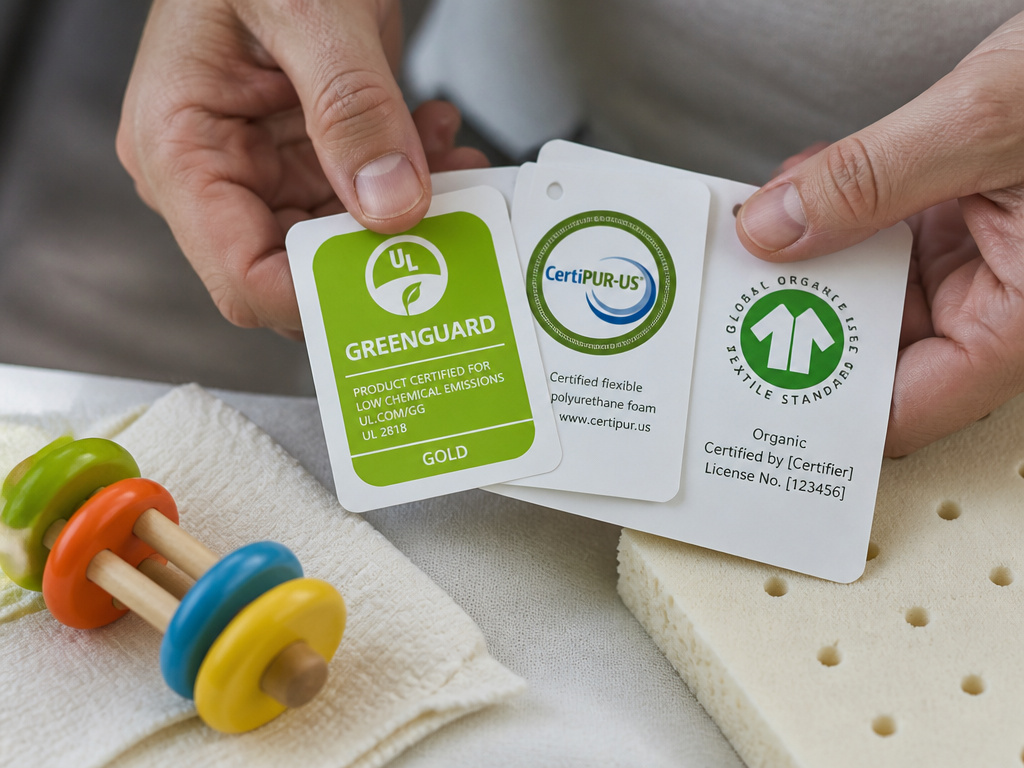
“Organic,” “non-toxic,” “natural”, these terms are largely unregulated in the mattress industry. A label that says “made with organic cotton” might refer only to the fabric cover, while the foam inside contains chemical flame retardants. You have to dig deeper.
Look for third-party certifications that verify claims:
- GREENGUARD Gold: Certifies low chemical emissions (VOCs). This is the most meaningful certification for indoor air quality and is crucial for kids with asthma or allergies.
- CertiPUR-US: Certifies that the polyurethane foam is made without certain harmful chemicals (PBDEs, TDCPP, mercury, lead, etc.). It’s a baseline for foam safety.
- GOTS (Global Organic Textile Standard): For textiles like cotton or wool. Requires a high percentage of organic fibers and restricts toxic inputs in processing.
- GOLS (Global Organic Latex Standard): The equivalent for natural latex.
An organic kids mattress like the Birch Kids Natural Mattress will carry several of these. They are not marketing fluff; they require auditing and testing.
Construction choices also affect temperature and durability. Kids are hot sleepers.
- Memory Foam: Contours well but can sleep hot. Look for gel-infused or open-cell versions.
- Latex (Natural or Synthetic): Sleeps cooler, is responsive (bouncy), and is naturally dust-mite resistant. Durable but often more expensive.
- Innerspring/Hybrid: Offers the best airflow. Pocketed coils minimize motion transfer. The most durable option for active, growing bodies.
The cover material matters just as much. A removable, machine-washable cover is a sanity-saver. A waterproof barrier built into the cover or as a separate kids’ mattress protector is essential for potty training, spills, and illness.
The Age-by-Age Breakdown
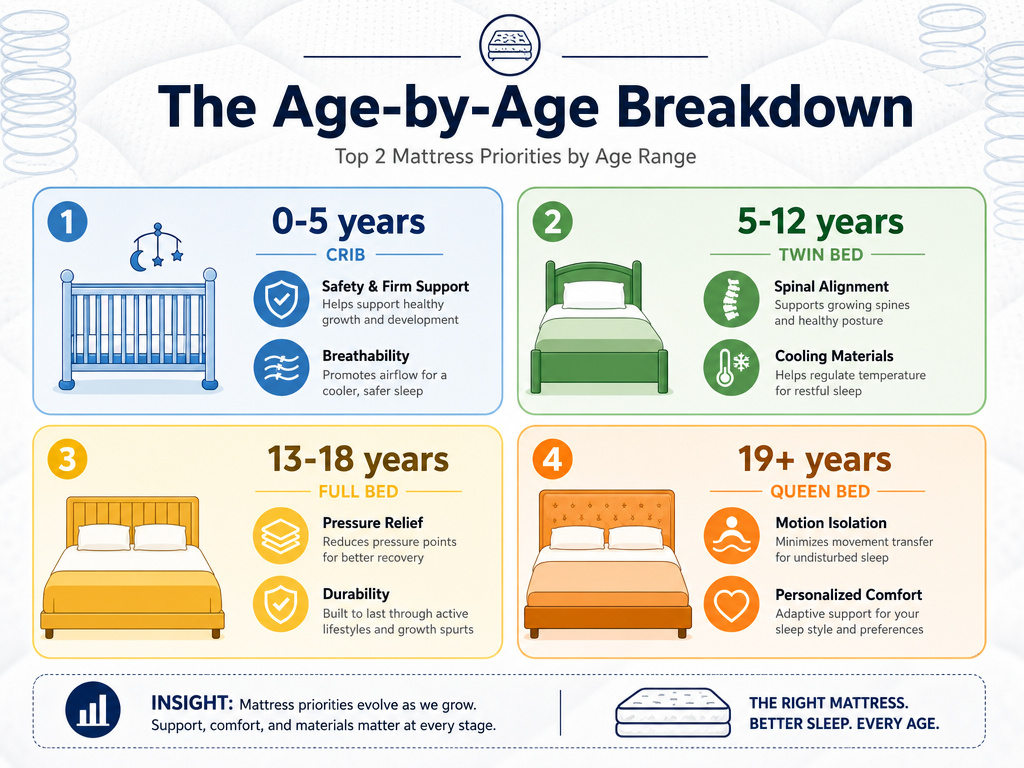
Your child’s age dictates their primary safety and support needs. This table matches the stage to the key mattress feature.
| Age Range | Bed Type | Priority #1 | Priority #2 | Sample Product Fit |
|---|---|---|---|---|
| 0–2 years | Crib | Certified firmness (ASTM F2933) | Exact dimensional fit (≤3.15″ gap) | Any CPSC-compliant crib mattress. |
| 2–5 years | Toddler Bed / Twin | Firm support core | Waterproof, washable cover | Helix Kids (flippable, zip-off cover). |
| 5–12 years | Twin or Full | Spinal alignment / edge support | Cooling materials / durability | Brooklyn Bedding BB Kids (hybrid, good edge support). |
| 12+ years | Full or Queen | Adult-level support & comfort | Motion isolation (if sharing) | Birch Kids Natural Mattress (latex hybrid, durable). |
Infants (0-2): It’s all about the crib. Beyond the legal standards, consider a dual-firmness mattress if you plan to use it for a second child later. The best mattress for 2 year old transitioning to a toddler bed is often the same crib mattress.
Toddlers & Preschoolers (2-5): They’ve graduated from the highest suffocation risk, but are active and often wet the bed. A firm, supportive twin mattress with a bombproof waterproof protector is the goal. This is where a flippable mattress like the Nectar Kids adds value.
Big Kids (5-12): Growth is rapid. Support that adapts is key. This is the prime range for a hybrid mattress. They need edge support for sitting on the bed to read or get dressed. A full-size mattress becomes a serious consideration here for longevity.
Teens (12+): Their sleep needs resemble an adult’s. They may have specific preferences for plush or firm. Involving them in the choice from a pre-vetted list (like a best mattress for teenager guide) can help. Durability and warranty length are critical now.
Before You Start: The Pre-Purchase Checklist
Don’t buy a mattress based on an online photo. Use this list to filter your options down to two or three, then read the detailed specs and return policies.
- [ ] Verify the Standard: For a crib, does the product page/list compliance with ASTM F2933? For other beds, does the brand provide detailed specs (foam density, coil count, coil gauge)?
- [ ] Check the Fit: Will this mattress fit the bed frame I own or am buying? Have I accounted for the required gap limits (3.15″ for crib, ≤2″ for other sided beds)?
- [ ] Research the Return Policy: What is the trial period? Is it a true “sleep trial” or just a return window? Who pays for return shipping? Is there a restocking fee?
- [ ] Read the Fine Print on Warranties: What is covered (sagging over a certain depth, defects)? What is excluded (stains, normal softening)? What is the proration schedule?
- [ ] Plan for Protection: Have I selected a compatible, high-quality waterproof protector? Does the mattress cover come off for washing?
One final, practical tip: if you’re choosing between a highly rated twin bed mattress for children and a full bed for a child, and space allows, go with the full. The cost difference is marginal over the 8-10 years of use you’ll get from it. The comfort dividend for your growing child is substantial.
Frequently Asked Questions
What is the most important safety feature in a crib mattress?
The most important safety feature is compliance with the mandatory federal standard, ASTM F2933, which enforces firmness and a precise fit. The mattress must be firm enough to prevent suffocation and must fit the crib with a corner gap of 3.15 inches or less when a standard fitted sheet is on it. This isn’t a feature you add; it’s the foundation the mattress is built upon.
How often should I replace my child’s mattress?
Replace a crib mattress if it shows any signs of damage, sagging, or if it was used by a previous child and is over 3-5 years old. For a big-kid mattress, plan on replacement every 6-8 years, or sooner if you notice visible sagging (greater than 1.5 inches) that doesn’t rebound, or if allergies suddenly worsen. Children’s bodies change rapidly, and support needs evolve.
Can I use a regular twin mattress for my toddler?
You can, but it’s not ideal. A regular twin mattress may be too soft for a toddler’s developing spine. Look specifically for a kids’ twin mattress or a “youth mattress” that is designed with firmer support for lighter body weights. These often have better edge support for climbing in and out safely, too.
Are organic mattresses worth the higher cost?
They can be, for specific reasons. If your child has severe allergies, eczema, or chemical sensitivities, an organic mattress for children with certifications like GOTS and GOLS ensures materials are grown and processed without pesticides and harsh chemicals. For the average child without sensitivities, a high-quality conventional mattress with a GREENGUARD Gold certification for air quality may offer the best value.
What’s better for a child: foam or spring?
For cribs, high-density foam is standard and excellent. For older children, a hybrid (pocketed springs with a foam comfort layer) often provides the best balance: the durable, supportive bounce of springs with the pressure relief of foam. It also sleeps cooler than all-foam. An all-spring mattress can be too bouncy and lack contouring; an all-foam mattress can sleep hot and lack edge support for sitting.
How do I clean and maintain a kids’ mattress?
Immediately use a waterproof, breathable mattress protectors for kids. This is your first and most important defense. For the mattress itself, vacuum the surface monthly with an upholstery attachment. For spills or accidents, blot (don’t rub) with a damp cloth and mild soap, then air dry completely. Check if the cover is removable and machine-washable, this is a key feature to look for when buying.
The Bottom Line
Choosing a mattress for a child starts with a ruler and the law, measure the gap, verify the standard. From there, match the support core to their weight and growth trajectory, and let material certifications, not marketing words, guide you on chemicals and air quality. The right mattress is the one that disappears as a concern, giving you years of quiet nights knowing the foundation of their sleep is safe, sound, and supportive.
