
Is a Toddler Bed a Twin? | The 2-Inch Gap That Decides
This post contains affiliate links. As an Amazon Associate we earn from qualifying purchases.
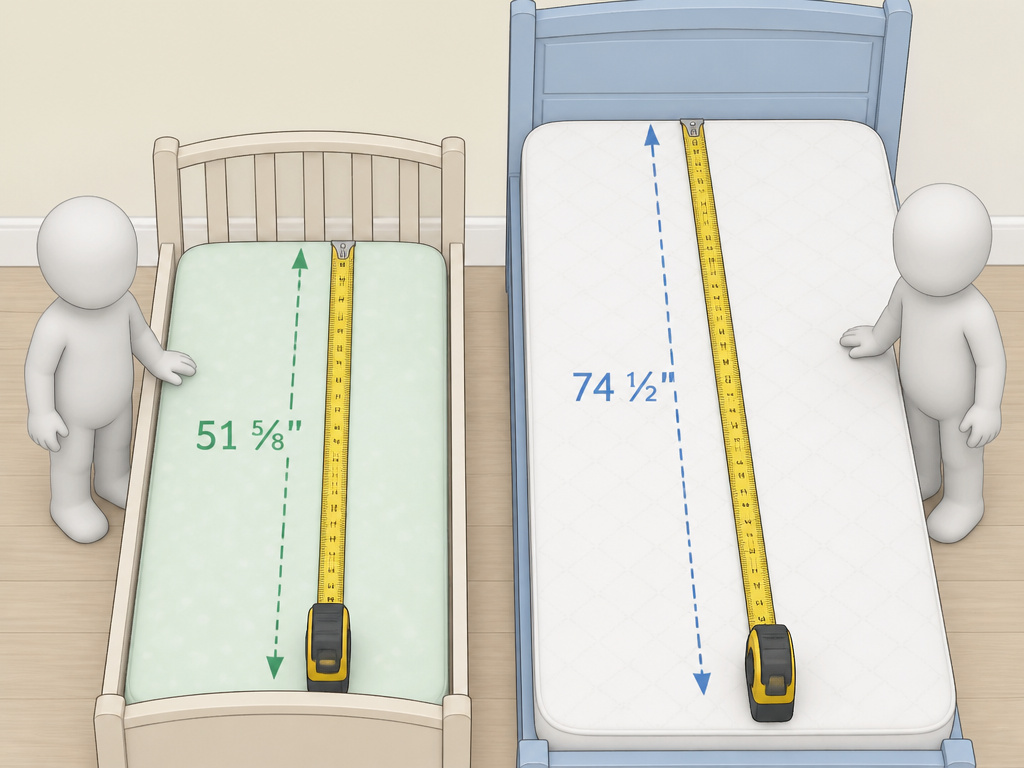
No, a toddler bed is not a twin bed. A toddler bed is a federally regulated safety product designed to hold a standard crib mattress (51 5/8″ x 27 1/4″ x 4″) for a child aged 15+ months up to 50 lbs. A twin bed is a standard adult-sized bed (38″ x 74 1/2″) that can hold a 200-lb adult. The critical difference is a 2-inch gap, put a crib mattress in a twin frame, and that gap creates a documented entrapment hazard.
That gap is where the law draws the line. The federal standard for toddler beds exists because children have died from entrapment in poorly fitting beds. This isn’t about mattress compatibility; it’s about a bed frame engineered to eliminate dangerous spaces a child’s body can slip into.
What follows is the breakdown: the specific federal safety regulations that define a toddler bed, the incident data that prompted them, and a clear decision guide based on your child’s age, weight, and climbing skills. By the end, you’ll know exactly which bed meets the legal definition of safety for your child’s stage.
Key Takeaways
- A toddler bed is legally defined by the ASTM F1821-26 safety standard and must snugly fit a specific crib mattress size to prevent entrapment.
- 78% of toddler bed injuries reported to the CPSC involved falls; head and limb entrapment in gaps caused fractures and sprains.
- The minimum user age is 15 months and the maximum weight is 50 lbs (27.7 kg per the standard), exceeding either voids the bed’s safety certification.
- Convertible cribs that become toddler beds must still meet all federal toddler bed safety requirements, the conversion kit isn’t optional.
- Choose a twin bed only when your child is at least 3 years old, exceeds 50 lbs, and can safely climb in and out of a standard-height bed.
The Critical 2-Inch Gap That Defines a Toddler Bed
The entire legal distinction between a toddler bed and a twin bed hinges on mattress fit. A toddler bed’s frame is engineered to the exact dimensions of a full-size crib mattress: 51 5/8 inches long, 27 1/4 inches wide, and no more than 4 inches thick. This creates a snug, gap-free fit.
A twin bed frame can physically accommodate a crib mattress because it’s larger, but it is not intended to. This leaves a gap of roughly 2 inches or more on each side, a space where a toddler’s head, neck, or limb can become trapped.
This isn’t theoretical. The ASTM voluntary standard, which forms the basis of the federal toddler bed safety regulations, was revised in 2026 specifically to change the wording from “sized to accept” to “intended to accept” a crib mattress. This clarification, noted in a 2026 Federal Register entry, was made to prevent the misinterpretation that a twin bed could be used as a toddler bed just because the mattress fits inside the frame. The gap is the hazard.
Where this goes sideways: Assuming any small bed is a toddler bed. Using a crib mattress in a daybed or a junior-sized twin frame creates the exact entrapment gaps the standard is designed to prevent. The CPSC toddler bed business guidance is explicit: the mattress must be supported and contained to prevent hazardous movement.
Safety Stats: What the CPSC Data Shows
The federal rules weren’t created in a vacuum. They are a direct response to injury and fatality data. Between 2005 and 2010, the U.S. Consumer Product Safety Commission (CPSC) recorded 122 incidents involving toddler beds, including 4 fatalities and 43 injuries.
A deeper look at a 41-incident sample from 2009-2010 reveals the most common failure modes:
| Reported Hazard | Number of Incidents | Common Injuries |
|---|---|---|
| Falls out of bed to a lower level | 78% of NEISS-reported injuries | Head injuries (31%), fractures (22%) |
| Broken, loose, or detached parts (guardrails, hardware) | 14 incidents | Lacerations, bruises |
| Limb entrapment in gaps | 10 incidents | Fractures, sprains, bruises |
| Inadequate mattress fit | 3 incidents | Entrapment risk |
Common mistake: Thinking guardrails are just for preventing falls. Their primary safety function, per the ASTM F1821 safety specification, is to maintain a gap-free perimeter around the mattress to prevent torso and limb entrapment. A loose or missing guardrail creates an immediate hazard.
The data shows head and face injuries accounted for 59% of treated cases, with limbs at 25%. While 97% of children were treated and released, the mechanisms, falls and entrapment, are preventable with the right equipment. This is why the CPSC mandatory standard approval in 2011 made compliance with these design rules the law for manufacturers.
Toddler Bed vs. Twin Bed: A Side-by-Side Breakdown
Choosing the right bed isn’t just about size; it’s about matching a regulated product to your child’s developmental stage. Here’s how the two categories compare on every metric that matters.
| Specification | Toddler Bed | Twin Bed |
|---|---|---|
| Defining Standard | ASTM F1821-26 (incorporated into 16 CFR 1217.2) | No specific federal safety standard for beds for this age group. |
| Mattress Size | Full-size crib mattress: 51 5/8″ L x 27 1/4″ W x 4″ T max. | Standard twin mattress: 38″ W x 74 1/2″ L x 6-8″ T common. |
| Primary Safety Feature | Integrated guardrails and gap-free mattress fit to prevent entrapment. | May accept aftermarket bed rails for kids, but frame is not designed for them. |
| Minimum Age | 15 months. | Varies by manufacturer; typically 3+ years for standard twin frames. |
| Maximum Weight | 50 lbs (22.7 kg per most product labels; 27.7 kg per ASTM standard). | Typically 200-250 lbs for a standard twin bed frame. |
| Mattress Support | Solid panel or closely spaced slats (≤ 2.4″ apart) to prevent entrapment. | Slatted foundation; gaps often exceed safe limits for a toddler. |
| Height from Floor | Low profile (often < 20″) for easy, safe access and egress. | Standard height (varies, but often > 24″); requires climbing. |
The weight limit is a hard stop. Putting a 60-lb child in a toddler bed rated for 50 lbs stresses the joints and guardrail attachments in a way they were not tested to withstand. Similarly, the age minimum correlates with mobility and the reduced risk of certain entrapment scenarios.
If you’re transitioning from a crib, a dedicated toddler bed or a convertible crib to toddler bed is the only path that guarantees continued compliance with regulated safety design.
When to Move From a Toddler Bed to a Twin Bed
The move isn’t dictated by a birthday. It’s triggered by three concrete conditions: your child outgrows the bed’s physical limits, demonstrates the motor skills to use a taller bed safely, and is too large for the crib-mattress sleeping surface.
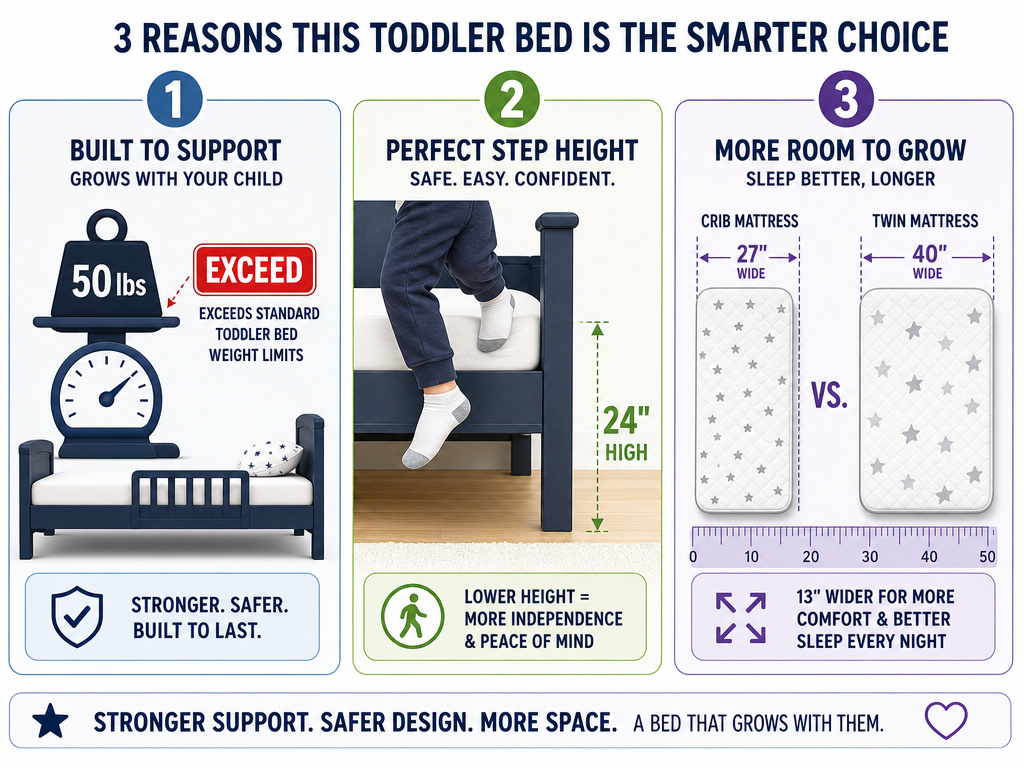
- They exceed the weight limit. The label on your toddler bed states a maximum weight, usually 50 lbs. This is a structural limit, not a suggestion. Discontinue use immediately when this limit is reached.
- They can climb in and out confidently and safely. This means navigating the height of a standard twin frame (often over 24 inches from the floor) without stumbling, and understanding not to jump off. If they still roll to the edge in their sleep, they’re not ready.
- They need the larger sleeping space. A child who is tall or active in their sleep may simply find the crib mattress dimensions (27″ wide) too restrictive. A twin mattress for kids offers nearly 40 inches of width.
Most children hit these markers between ages 3 and 5. When you do make the switch, the first step is selecting a proper twin bed for kids with a sturdy frame. Then, add a twin mattress for toddler that provides the right support, firmness is still key for growing bodies. Finally, install a set of bed rails for children on the new twin bed. Even though the frame isn’t designed for them, quality aftermarket rails are essential for the first year or two in the taller bed to prevent falls.
Skip the “grow-with-me” toddler-to-twin convertible beds if your child is a vigorous sleeper. The ones that transform from a toddler to a twin bed often have plastic joint mechanisms that can loosen over time. For a child who weighs over 50 lbs and moves constantly, a solid wood or metal twin bed for toddlers is a more durable long-term investment.
How to Verify Your Bed Meets Safety Standards
You cannot eyeball safety compliance. You must check for specific, permanent labels and markings that indicate the bed was manufactured and tested to the mandatory standard.
Look for this label on the bed frame itself: It should state “Conforms to ASTM F1821” or “Meets the requirements of 16 CFR 1217.2.” This is the manufacturer’s declaration that the product adheres to the federal toddler bed safety regulations.
Check the warning labels and instructions: The required CPSC business education materials for manufacturers dictate specific warning statements. These must be permanently attached to the bed and address entrapment, strangulation (e.g., keeping beds away from window cords), and the minimum age (15 months).
Inspect the physical design before use:
- Guardrails: Must be permanently attached or require a tool to remove. They should run the full length of the bed on both sides.
- Openings: No openings between components (like slats or decorative cut-outs) should be between 0.2 and 0.4 inches, which can trap tiny fingers.
- Mattress Fit: With the correct toddler mattress installed, you should not be able to fit more than two fingers between the mattress and the bed frame at any point.
The part nobody mentions: Storing a spare toddler bed in a hot attic or damp basement can degrade the materials and weaken plastic joints or adhesives. The Delta Children’s Products manual explicitly warns that extreme storage conditions “can cause a loss of structural integrity.” If you’re pulling a bed out of storage, inspect it twice as hard.
If any label is missing, illegible, or the bed shows signs of modification, do not use it. Contact the manufacturer for a replacement label or guidance. Your child’s safety relies on this product being exactly what the label says it is.
Frequently Asked Questions
What is the actual size difference between a toddler bed and a twin bed?
Toddler bed uses a crib mattress measuring 51 5/8″ long by 27 1/4″ wide. A standard twin bed frame holds a mattress that is 74 1/2″ long by 38″ wide. The twin is both significantly longer and over 10 inches wider. The toddler bed’s smaller size is a safety feature to prevent dangerous gaps.
Can I just use a twin bed with guardrails for my toddler?
It is not recommended and does not meet the safety standard. A twin bed frame is not designed to create a gap-free fit with a crib mattress, which is the core entrapment prevention requirement. Aftermarket guardrails address fall risk but not the fundamental mattress-frame gap hazard that the ASTM F1821 safety specification is designed to eliminate.
My convertible crib turns into a toddler bed. Is it safe?
Yes, but only if you install the official toddler bed conversion kit according to the instructions. Cribs that convert to toddler beds must comply with all toddler bed safety standards once converted. Using the crib as a toddler bed without the conversion kit (e.g., just removing one side) is unsafe and non-compliant, as it likely leaves hazardous gaps or unstable sides.
Why is the weight limit on toddler beds only 50 lbs?
The 50-lb (27.7 kg) limit is the test parameter used in the federal safety standard. The bed’s structural integrity, guardrail strength, and stability are all tested with this maximum weight in mind. Exceeding it means the bed is operating outside its certified safety parameters, increasing the risk of collapse or failure.
What is the best mattress for a toddler bed?
You must use a firm, full-size crib mattress that does not exceed 4 inches in thickness. Look for a toddler mattress certified by the Juvenile Products Manufacturers Association (JPMA) for meeting ASTM standards. Avoid all-foam or water mattresses, as they can conform to a child’s face and pose a suffocation risk, and they often don’t provide the firm, flat surface required.
Before You Go
A toddler bed is a piece of safety equipment, not just a piece of furniture. Its entire design, from the exact mattress dimensions to the integrated guardrails, is dictated by federal law written in response to real injuries. A twin bed is an adult-sized product that a child grows into.
The decision is clear. For a child between 15 months and 50 lbs who is transitioning from a crib, choose a dedicated, labeled toddler bed. When they outgrow those limits and can climb safely, move them to a sturdy twin bed for kids with a quality mattress and temporary safety rails. This progression isn’t just about comfort; it’s about following the engineering that keeps them safe while they sleep.
