
What Kids Bed Rails Are Made Of: A Material & Safety Guide
This post contains affiliate links. As an Amazon Associate we earn from qualifying purchases.
Kids bed rails are made from four core materials: a metal frame (steel or aluminum), plastic components for hinges and locks, a fabric mesh panel (typically polyester), and foam padding. The specific grades, thicknesses, and assembly of these materials are dictated by the mandatory federal safety standard ASTM F2085-19, which is incorporated into law at 16 CFR § 1224.2. A rail that meets this standard has passed rigorous tests for structural integrity, entrapment gaps, and durability.
That standard is the mandatory line between a product that restrains a rolling child and one that creates a fatal gap. The frame metal determines the rail’s rigidity under weight.The plastic dictates whether the hinge holds or fails on the third nightly deployment. The mesh is what actually catches a knee or elbow without tearing.
What follows is a breakdown of each material’s job, the specific safety tests it must pass, and how to read a product’s construction to spot the difference between compliant hardware and a dangerous shortcut. By the end, you’ll be able to look at any bed rail and know whether its materials are built for a two-year-old’s weight or a regulatory loophole.
Key Takeaways
- The federal ASTM F2085-19 standard legally dictates material strength, gap sizes, and locking mechanisms for all bed rails sold in the U.S. After May 2020.
- Steel frames are the default for durability; thin-gauge aluminum or plastic frames can flex under weight, creating dangerous entrapment gaps beside the mattress.
- The fabric mesh panel is a load-bearing safety component, not a decorative cover. It must be a tight-weave, tear-resistant polyester or nylon that prevents limb passage.
- Plastic hinges and locks are the most common point of mechanical failure. Look for thick, glass-filled nylon or ABS plastic with an audible, positive lock.
- Always verify model-specific mattress thickness limits (often 6-10 inches). Using a rail on a thicker mattress can defeat the securing straps and cause displacement.
The Four Core Materials in a Bed Rail
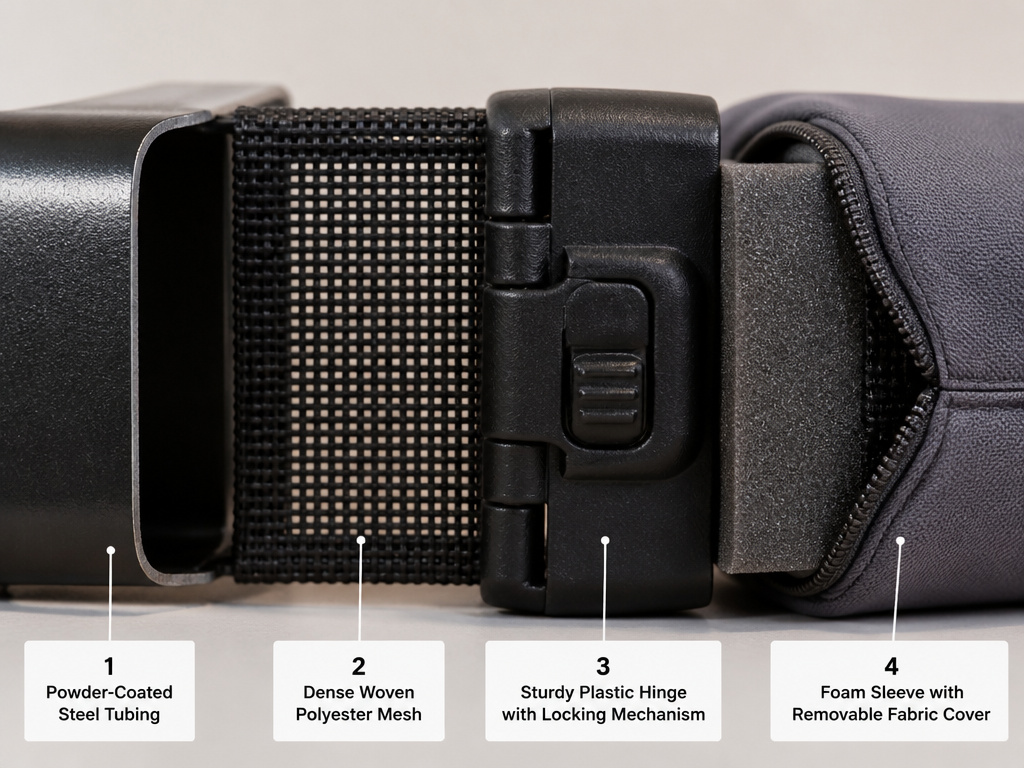
A bed rail is a deceptively simple device. Its material composition is a direct response to a specific, documented set of hazards. The mandatory ASTM F2085-19 standard exists because, from 2000 to 2010, 132 incidents involving portable bed rails were reported to the CPSC, including 13 fatalities. The standard’s material and construction requirements are engineered to prevent those failure modes.
ASTM F2085-19 Section 1.3 defines a portable bed rail as “a device intended to be installed on an adult bed to prevent children from falling out of bed. These bed rails are intended for children who can get in and out of an adult bed unassisted (typically from 2 to 5 years of age).” The materials must withstand the use and foreseeable misuse by a child in that age and weight range.
Here is what you are actually buying, layer by layer.
1. The Frame: Steel or Aluminum Tubing
The frame provides the structure. It must resist bending when a child leans, pushes, or climbs against it.
- Steel Tubing: This is the most common and reliable material. Frames are typically made from carbon steel tubing with a powder-coated finish to prevent rust. The gauge (thickness) of the tubing matters. Thinner tubing can flex, which is a critical problem. If the frame bends away from the mattress, it creates the exact head or chest entrapment gap the standard is designed to eliminate.
- Aluminum Tubing: Used in some lighter-weight or travel-oriented rails. While aluminum doesn’t rust, it is softer than steel. To provide equivalent strength, aluminum frames must use thicker-walled tubing. A rail with thin, lightweight aluminum is a red flag for potential flex.
- Plastic-Only Frames: Avoid these. They lack the structural integrity for a safety device meant to contain a 35+ pound child. They are not compliant with the serious intent of the ASTM standard.
The frame’s job is to stay put. Its connection to the bed is via fabric straps with buckles, but the frame’s own rigidity is what maintains a secure barrier.
2. The Mesh Panel: Woven Polyester or Nylon
This is the barrier that catches the child. It is not a simple dust cover.
The mesh must be a tight, durable weave that prevents a child’s limbs or head from pushing through. Polyester is the standard because of its high tensile strength and resistance to abrasion. Nylon is also used. The key specs are denier (thread thickness) and weave density.
Where this goes sideways: Using a rail with a loose, decorative mesh netting. A child’s fingers can get caught and tangled, or a knee can push through, destabilizing the entire rail. The mesh should have no stretch under hand pressure.
The mesh is permanently affixed to the frame, usually via a sewn sleeve that slides over the tubing and is secured with stitching or rivets. This connection point is also tested for durability.
3. The Plastic Components: Hinges, Locks, and Buckles
These are the moving parts, and they are the most frequent points of failure. They are typically made from engineering plastics like ABS (Acrylonitrile Butadiene Styrene) or glass-filled nylon.
- Hinges: Allow the rail to fold down for bed-making. They must lock securely in both the raised and lowered positions. A weak hinge can collapse under weight.
- Locking Mechanisms: These can be pinch-release levers or button locks. They must require a deliberate adult action to release. The Federal Register final rule notes that post-2010 incident reports included 8 cases of hinge-lock failure, resulting in 4 injuries and 1 fatality. The plastic must not become brittle or warp over time.
- Strap Buckles: These are often plastic side-release buckles. They must withstand repeated engagement and disengagement without cracking.
The quality of the plastic is felt in the action. A compliant lock engages with a solid, audible click. A cheap one feels vague and may not hold.
4. The Padding: Foam Sleeves
A soft foam sleeve wraps the top rail of the frame. It is usually a polyethylene or polyurethane foam covered in a removable, washable fabric sleeve. Its purpose is impact protection, padding a forehead that bumps against the rail, not structural support.
How Materials Dictate Safety and Failure Modes
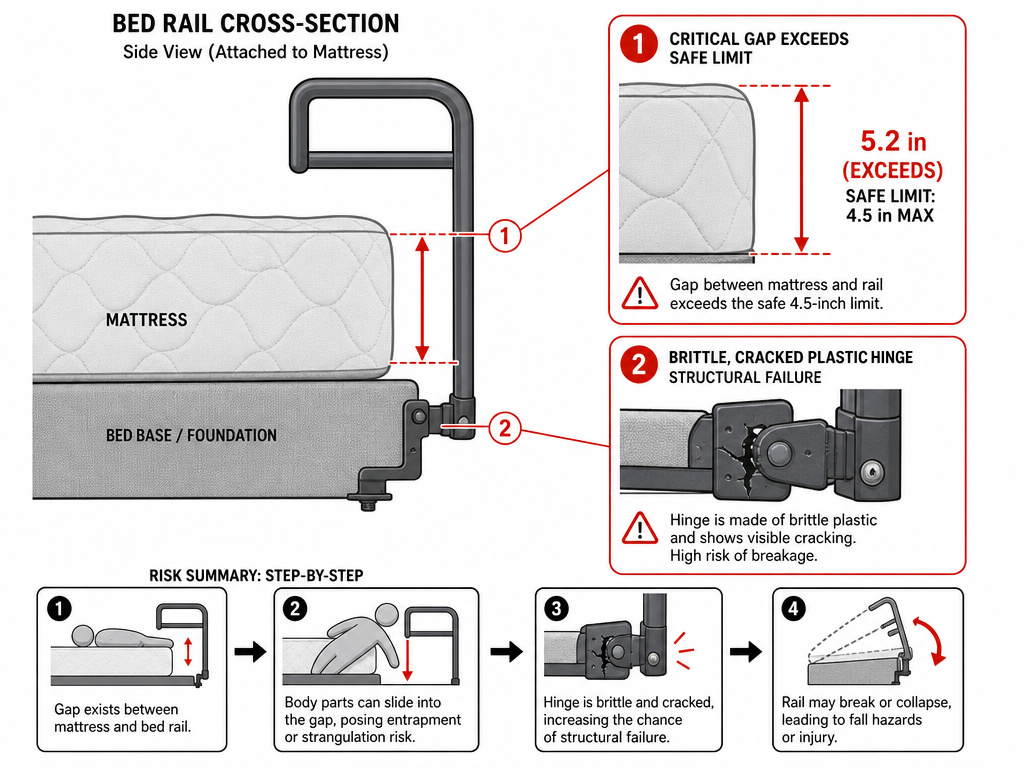
The choice of materials directly influences which of the two primary hazards a rail might introduce: entrapment or structural collapse.
Entrapment occurs when a gap exists between the rail and the mattress, or within the rail’s own design, that is large enough for a child’s body to pass through but not the head. This can lead to asphyxiation. The ASTM standard specifies maximum allowable gap sizes in various zones of the rail, which the materials must maintain even under load.
Structural Collapse happens when a component breaks or bends, causing the rail to fall over or create a large, unexpected opening. This is a materials failure.
| Material Failure Point | How It Happens | Timeline & Consequence |
|---|---|---|
| Frame Flex (thin metal) | Child repeatedly leans or pushes against rail. | Over weeks, tubing permanently bends. Creates a >4.5-inch gap at mattress, risking entrapment. |
| Mesh Tear (low-denier fabric) | Child kicks or claws at barrier. | Can happen on first use if weave is weak. Limb passes through, child may fall or become tangled. |
| Hinge/Lock Failure (brittle plastic) | Daily raising/lowering fatigues plastic. | Lock fails to engage within 2-3 months. Rail collapses suddenly when child rolls against it. |
| Strap Detachment (weak stitching) | Straps are tugged during installation/child movement. | Strap pulls free from mesh or frame. Rail displaces from mattress edge, creating a dangerous V-shaped gap. |
The CPSC business guidance document outlines these exact hazards for manufacturers. For parents, the lesson is tactile. Press on the center of a raised rail. It should not give more than an inch. Examine the stitching where straps meet mesh. It should be double or triple-stitched with heavy-duty thread.
The Mandatory Standard: ASTM F2085-19 and What It Tests
You cannot evaluate materials without understanding the benchmark they must meet. In the United States, the Consumer Product Safety Improvement Act of 2008 required the CPSC to create safety rules for durable infant products. This led to the mandatory standard for portable bed rails.
ASTM F2085-19 is incorporated by reference into federal law at 16 CFR § 1224.2, meaning every portable bed rail sold must comply with all its provisions.Products manufactured or imported on or after May 20, 2020, must meet this version.
The standard performs specific, brutal tests on the materials:
1. Displacement Test: A force is applied to the top rail to simulate a child pushing against it. The rail must not move away from the mattress more than a specified, tiny distance.
2. Entrapment Probe Tests: Various sized probes (simulating a child’s torso, head, and limbs) are attempted to be passed through openings in the assembled rail. Certain openings are prohibited entirely.
3. Structural Integrity Tests: The rail is subjected to cyclic loads, repeatedly pushing and pulling on it, to simulate long-term use. After this, it must still pass the displacement and entrapment tests.
4. Lock/Latch Mechanism Test: The locking mechanism is cycled hundreds of times. It must still function correctly and securely afterward.
A product that meets ASTM F2085-19 has had its specific combination of steel, plastic, and fabric validated against these engineered simulations of real-world failure. This is why checking for this certification is the single most important step when choosing any kids’ bed rails.
Choosing by Material: A Decision Framework
Not all material combinations are equal, and your child’s age and behavior should guide your choice. This isn’t about color preference.
Common mistake: Choosing the rail with the most padding, thinking it’s the softest or safest. The padding is cosmetic comfort. The frame gauge and lock mechanism are what keep your child safe.
Use this framework to match materials to your situation:
| Child Profile | Recommended Material Focus | Product Examples & Why |
|---|---|---|
| New to a big bed (Age 2-3, ~30 lbs) | Maximum rigidity, simple lock. Prioritize a steel frame with a thick gauge and a very obvious, audible locking hinge. | Summer Infant Double Bedrail: All-steel frame with a simple, robust push-button lock on the support leg. The mesh is tightly woven. |
| Active sleeper (Age 3-5, 35+ lbs) | Reinforced hinge points, heavy-duty straps. Look for frames with reinforced welding or casting at hinge joints. Straps should be wide and stitched with bar-tacking. | Regalo Steel Swing Down Bed Rail: Features a steel hinge mechanism that is bulkier and more robust than typical plastic housing. |
| For a specific kids’ bed (e.g., twin, bunk) | Exact compatibility. Rail must match the mattress thickness and bed type. Never use a universal rail on a bunk bed or a loft bed upper bunk. | Oeuf Universal Security Rail: Specifically engineered for Oeuf twin beds with a strict 6-8 inch mattress thickness limit. Its mounting system is integral, not strap-based. |
The mattress is part of the system. Every rail manual states a maximum mattress thickness, like the 2774 Baby Bed Rail‘s limit of 270mm (10.6 inches). Exceed this, and the securing straps cannot pull the rail flush against the mattress side, creating a lethal gap. Always measure your kids’ mattress first.
Installation and Maintenance: The Material’s Second Test
The best materials can be defeated by incorrect installation. The rules are absolute because the physics are unforgiving.
- Follow the Gap Rule: The rail must be at least 9 inches from the headboard and footboard. This prevents a child from becoming trapped in the corner. Some manuals, like the one for the 2774 model, specify a minimum of 250mm (10 inches).
- Tighten Straps Every Week. The tension that secures the rail relaxes as the mattress settles and the child moves. Weekly tightening is not optional. You should not be able to slip more than two fingers between the rail’s vertical bar and the mattress.
- Inspect for Material Fatigue Monthly.
- Metal: Look for any white stress marks in the powder coating, which indicate bending.
- Plastic: Check hinges and locks for cracks, especially at stress points.
- Fabric: Look for fraying, loose threads, or stretched mesh panels.
- Stitching: Ensure all straps are still securely sewn to the mesh and frame.
If any component is damaged, stop use immediately. The rail is a single, integrated safety system. A failure in one material compromises the whole device.
Frequently Asked Questions
Are wooden bed rails safe?
Traditional solid wooden bed rails that are part of a bed frame are governed by a different standard (ASTM F1821 for toddler beds). Portable bed rails made primarily of wood are extremely rare and not recommended. They lack the flexible-yet-strong barrier that mesh provides and can splinter. The modern safety standard was developed around the performance of metal and fabric constructions.
Can the fabric mesh be replaced if it tears?
No. The mesh is an integral, load-bearing safety component attached during manufacturing. A tear means the product has failed and must be discarded. Do not attempt to sew or patch it, as this creates uneven stress points and unpredictable weakness. This is why investing in a rail with high-denier, tear-resistant mesh from the start matters for longevity alongside safety.
What does “ASTM F2085-19” mean on the label?
It means the product has been designed and tested to meet the 2019 version of the Standard Consumer Safety Specification for Portable Bed Rails. This is your assurance that the materials and construction have passed the federal tests for strength, entrapment gaps, and durability. Look for this designation on the product packaging or in the online description. It is more important than any star rating.
Is a heavier bed rail always better?
Not necessarily. Weight can indicate a robust steel frame, which is good. However, the design of the locking mechanism and the quality of the plastic are equally critical. A very heavy rail with a flimsy plastic hinge lock is more dangerous than a moderately weighted one with a superb, over-engineered lock. Heft is one data point, not the final answer.
How do I clean a bed rail without damaging the materials?
Surface clean only. Use a damp cloth with mild soap on the metal and plastic parts. For the fabric mesh and padding sleeve, follow the label, usually spot cleaning or wiping with a damp cloth. Do not submerge the rail, use bleach, or put the fabric cover in a washing machine unless the instructions explicitly permit it. Aggressive cleaning can degrade the plastic’s strength and weaken fabric fibers.
The Bottom Line
A bed rail’s materials are a contract between manufacturer and parent. The steel, plastic, and polyester are a specific recipe written by ASTM F2085-19 to solve a specific, deadly set of problems documented over a decade.
Your job is to verify that contract. Check for the ASTM label. Feel the rigidity of the frame. Listen for the solid click of the lock. Understand that the mesh is doing the hard work of containment. Match the rail’s stated limits to your child’s weight and your mattress’s thickness.
This device sits at the boundary between sleep and a fall. Its materials are the only thing on duty. Choose them with the same rigor you would apply to a car seat or a crib, because the stakes, as the federal data shows, are precisely that high. Start your search with a focus on certified, well-constructed toddler bed rails and ensure your child’s entire sleep space, from the twin bed frame to the kids bedding and mattress protector, is geared towards secure, restful sleep.
