
Do Baby Mattresses Expire? The Key Safety Rule Explained
This post contains affiliate links. As an Amazon Associate we earn from qualifying purchases.
Baby mattresses don’t have a printed expiration date, but they have two effective end points: when the materials break down and compromise safety, or when the mattress no longer meets the current mandatory safety standard. The 2025 update to the ASTM F2933 crib mattress standard introduced a 24-hour pre-conditioning rule that effectively defines a mattress’s “working life” for compliance testing.
That pre-conditioning rule is the hidden clock. A mattress must fully recover to its intended size after 24 hours in a controlled environment to pass the corner-gap test. If it stays compressed or sags, it fails the federal safety standard the moment it leaves the factory. Material fatigue, foam that won’t rebound, coils that lose tension, covers that rip, just accelerates that failure.
What follows is the breakdown of those two clocks: the physical wear you can see and feel, and the regulatory benchmarks you can’t. By the end, you’ll know how to inspect a mattress, interpret recall notices like the IKEA VYSSA or Hush Hutting cases, and make a replacement decision based on safety, not guesswork.
Key Takeaways
- The ASTM F2933-25 standard requires a 24-hour pre-conditioning test; a mattress that doesn’t fully recover to its intended size and firmness in that time is non-compliant.
- Look for physical failure signs: a permanent sag deeper than 1.5 inches, torn seams, persistent odors, or moisture damage that can’t be cleaned.
- Corner gaps exceeding 3.15 inches with a fitted sheet on violate federal law (16 CFR § 1241.2) and pose a direct entrapment risk.
- Mattresses involved in recalls, like specific IKEA VYSSA models or Hush Hutting play yard mattresses, are expired for safety use immediately.
- A high-quality, firm organic crib mattress from a reputable brand typically outlasts a cheaper foam model by years, but all mattresses have a finite functional lifespan.
The Two-Part Answer: Wear vs. Regulation
When you ask if a baby mattress expires, you’re really asking two questions. First, does the physical object wear out? Second, does the legal definition of “safe” change out from under it? The answer to both is yes.
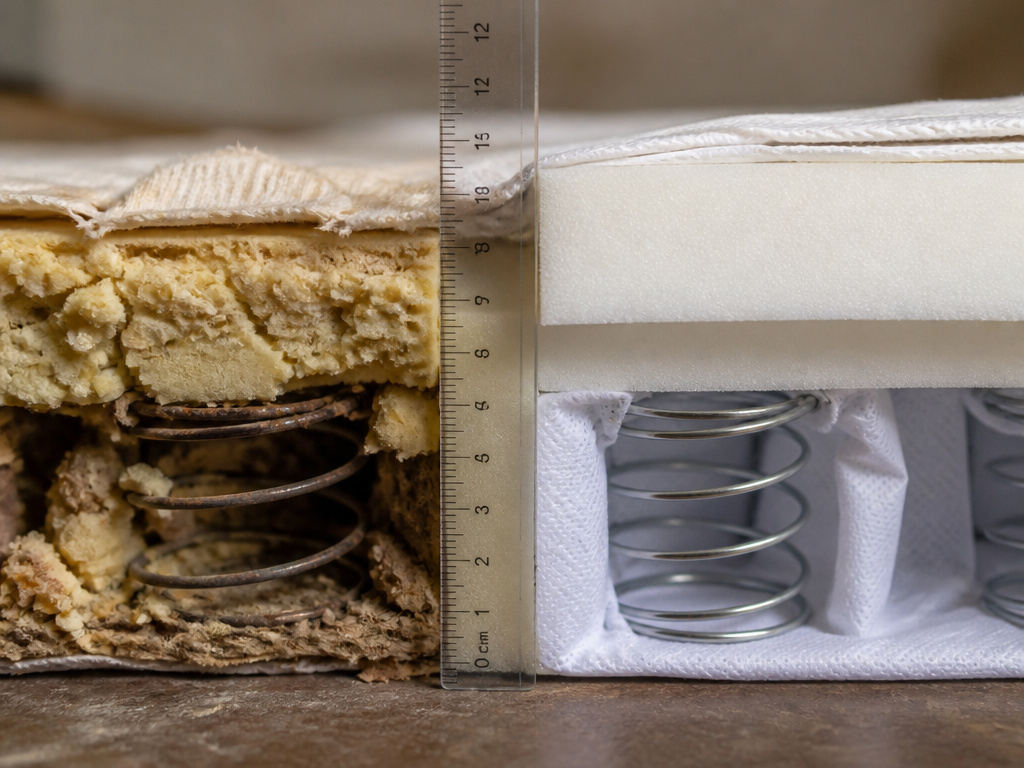
Material wear is the slow variable. Foam loses resiliency. Innerspring coils fatigue. Fabric covers abrade and seams split. This degradation directly impacts the mattress’s performance, its firmness, its support, its ability to stay clean and dry. A sagging mattress creates uneven sleep surfaces and dangerous pockets where an infant can roll and struggle to breathe.
Regulatory change is the step function. Safety standards evolve. The ASTM F2933 crib mattress standard is updated periodically, and each new version, like the 2025 edition, can introduce stricter tests. The U.S. Consumer Product Safety Commission (CPSC) then incorporates these updates into mandatory federal law. A mattress manufactured to the 2010 standard might be grandfathered for sale, but it wouldn’t pass the 2025 tests. For parents, using an older mattress means accepting a safety gap newer models are designed to close.
A mattress that cannot return to its specified dimensions and firmness after 24 hours of controlled pre-conditioning fails the ASTM F2933-25 test. This isn’t a suggestion, it’s the benchmark for whether the product still performs as certified.
The intersection of these two forces is where expiration happens. Physical wear makes a mattress fail the newer standards faster. The most current CPSC crib mattress business guidance is built on preventing the failures seen in recalls, where wear and non-compliance meet.
The Hidden Clock: Material Breakdown
You can’t see molecular bonds breaking, but you can see the results. The breakdown isn’t just about comfort; it’s about the mattress’s structural ability to do its job.
Foam and Fiber Collapse: Polyurethane foam oxidizes and crumbles. Low-density “egg crate” toppers are the worst offenders, sometimes flattening within a year of nightly use. This isn’t just a soft spot. A depression creates a concave surface that can hinder an infant’s movement and increase re-breathing risk. Memory foam is particularly temperature-sensitive and may not rebound fully in a cool room, failing the pre-conditioning test before its time.
Coil System Fatigue: An innerspring unit in a crib mattress is a tightly wound system. Over years, the tempered steel can take a “set,” especially if the mattress is frequently folded for storage or used by a toddler who jumps on it. This permanent compression reduces firmness and support. You’ll feel it as a general hammocking effect, not just a localized sag.
Barrier Failure: The waterproof barrier and fire-retardant sock are critical safety components. Punctures, peeling laminate, or degraded seams compromise these barriers. Once the core is exposed to moisture, mildew and bacteria have a direct path in. No amount of surface cleaning fixes a breached internal barrier.
The Regulatory Expiration Date You Didn’t Know About
Forget a date stamp. The real expiry is tied to a mattress’s ability to pass the battery of tests in the current safety standard. The 2025 update to ASTM F2933 made this link explicit with one new requirement.
The 24-Hour Pre-Conditioning Rule: Before testing for firmness and corner gaps, the standard now requires mattresses to sit for at least 24 hours (or per manufacturer instructions) at 73°F ± 9°F and 20-70% relative humidity. The goal is to let the mattress “fully inflate or recover to the intended size.” If it doesn’t, it fails. This means a mattress that has permanently compacted due to material fatigue is, by definition, non-compliant with the latest consumer safety specification F2933.
The Corner Gap Mandate: This is the non-negotiable number. Federal regulation 16 CFR § 1241.2 states that with a standard fitted sheet on, the gap between the mattress and the crib corner must not exceed 3.15 inches (80 mm). A sagging, thinner, or misshapen mattress will create a larger gap. This isn’t a design flaw; it’s a violation of law and a documented entrapment hazard, as seen in recalls like the one for IKEA VYSSA mattresses.
Firmness as a Performance Metric: The latest standards have moved towards quantifying firmness. A mattress that feels “soft” to your hand likely fails the objective test. This firmness is what prevents the conforming pocket that can surround an infant’s face.
| Regulatory Trigger | What It Means | Consequence of Failure |
|---|---|---|
| Failed Pre-Conditioning | Mattress doesn’t recover size/firmness in 24 hours. | Deemed non-compliant; likely already sagging. |
| Corner Gap > 3.15 inches | Measured with a fitted sheet per 16 CFR § 1241.2. | Illegal entrapment hazard; requires immediate replacement. |
| Recall Notice | CPSC declares product defective (e.g., Hush Hutting). | Stop use immediately; product is “expired” for safety. |
| Barrier Compromise | Waterproof or fire-resistant layer is punctured. | Core is vulnerable to mold, bacteria, and may not meet flammability standards. |
When You Must Replace a Baby Mattress: The Failure Signs
Some signs are urgent red flags. Others suggest the clock is ticking. Knowing the difference keeps your child safe.
Common mistake: Trying to “fix” a sagging mattress with a extra pad or topper. This increases total stack height, which can create dangerous gaps with crib sides and bypasses the compromised support of the core mattress. It’s a cover-up, not a repair.
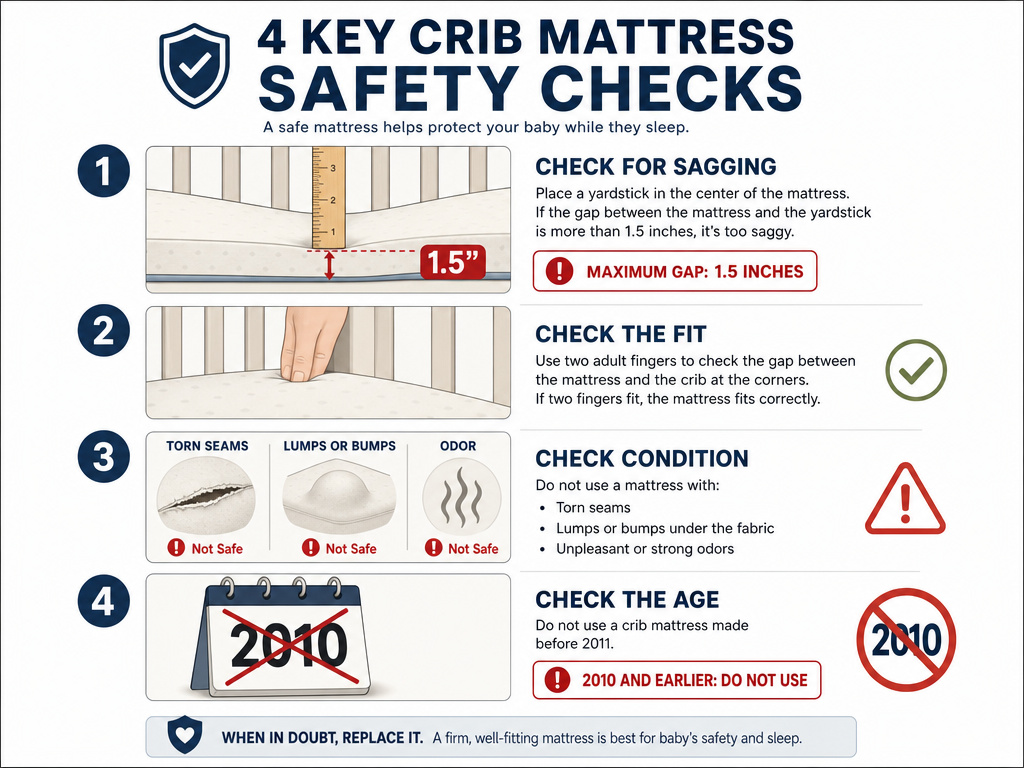
1. The Sag Test. Place a straightedge (like a yardstick) across the width of the mattress. Measure the deepest gap between the straightedge and the mattress surface. A permanent depression deeper than 1.5 inches is a fail. This sag often appears in the middle third of the mattress, where the child’s weight is concentrated.
2. The Gap Test. This is the federal test. Put a snug, 100% cotton fitted sheet on the mattress. Push the mattress firmly into one corner of the crib. Can you fit more than two adult fingers (about 3.15 inches) into the triangular gap at the corner? If yes, the mattress is too small or has shrunk and is unsafe. This was the specific defect in the IKEA VYSSA recall.
3. The Integrity Check. Look for:
* Torn seams or fabric, especially along the edges.
* Lumps or shifted filling you can feel through the cover.
* Persistent odor that doesn’t air out, indicating microbial growth or chemical off-gassing from broken-down foam.
* Stains from moisture that soaked through the barrier.
4. The History. Was the mattress in a flood or heavily soiled? Did a previous owner use it for 5+ years? Is it a hand-me-down from before 2010? History matters. When in doubt, the safest choice is a new, certified safe crib mattress that meets the latest standards.
How to Extend Your Mattress’s Safe Life
You can’t stop time, but you can slow the decay. Proper care adds functional years to a quality mattress.
Use a Quality Protector. This is non-negotiable. A fully encasing, waterproof, and breathable mattress cover is the primary shield. It prevents moisture, bacteria, and allergens from reaching the core. Don’t use a plastic sheet; use a modern, fabric-backed waterproof protector. It’s the single best investment to preserve mattress hygiene and integrity. Pair it with a good crib mattress pad for added comfort and protection.
Rotate and Flip (If Allowed). Many modern one-sided crib mattresses can only be rotated head-to-toe. Do this every 2-3 months to distribute wear evenly. If your mattress is double-sided, flip it according to the manufacturer’s schedule.
Clean Spills Immediately. If moisture gets past the protector, blot, don’t rub, the area. Use a mild soap and water solution, then dry the surface thoroughly. Never soak a crib mattress. For a deeper clean, follow the maker’s instructions to the letter.
Store It Correctly. If storing, clean it first, let it dry completely, and place it flat in a cool, dry place. Never store it on its edge or folded, as this can cause permanent creasing and core damage. A well-made organic crib mattress with durable materials will withstand storage better than a budget foam model.
Choose Durability from the Start. A mattress built with high-density foam, durable coils, and a strong, dual-barrier cover will last longer. Brands that openly comply with the latest standards, including the ISO 23767 crib mattress standard for international safety, often use more robust materials. It’s the difference between a 2-year and a 5-year functional lifespan.
Frequently Asked Questions
Can I use a secondhand crib mattress?
It’s risky. You must know its full history, verify it’s never been recalled, and perform all the failure sign checks (sag, gaps, integrity). You cannot sanitize the interior. For absolute safety, a new mattress is always the best choice, especially for a newborn. A dedicated mattress for newborn ensures peak firmness and hygiene.
How long does a typical crib mattress last?
With proper care, a high-quality crib mattress should provide safe, firm support for 3-5 years of continuous use, covering one child from infancy through toddlerhood. Cheaper foam mattresses may show significant wear in 2-3 years. The need for a toddler bed mattress is different and often coincides with this natural replacement point.
Does the warranty indicate lifespan?
Not directly. A warranty covers defects in materials and workmanship, not normal wear and tear or safety compliance over time. A 10-year warranty doesn’t mean the mattress is safe for 10 years; it means the company will repair or replace it if it fails due to a manufacturing flaw within that period.
What about mattresses for portable cribs or mini-cribs?
The same principles apply, but fit is even more critical. An aftermarket mattress for a play yard or mini crib mattress must be the exact size of the original and lay perfectly flat. The 2024 Hush Hutting recall was specifically for aftermarket play yard mattresses that were too thick or undersized, creating suffocation risks.
Do organic mattresses last longer?
They can. High-quality organic materials like natural latex and organic cotton are often more resilient than low-density polyurethane foam. However, longevity depends more on construction density and care than the material source alone. A well-made breathable crib mattress with a robust core will outlast a flimsy one, organic or not.
Before You Go
A baby mattress expires when it can no longer guarantee a safe sleep environment. Watch for the two clocks: the slow grind of material fatigue and the step-change of updated safety rules. The 24-hour recovery test in the latest standard is your technical guide. The 3.15-inch corner gap is your legal bright line.
Don’t wait for a total collapse. If your mattress sags deeply, smells off, or came from a questionable source, replace it. The peace of mind is worth the cost. Invest in a high-quality protector today to extend the life of your current crib mattress, and when it’s time for a new one, choose a model that meets the strictest current standards. Your child’s safety literally rests on it.
