
What Is a Duvet | The Science of Sleep & Bed Cave Humidity
This post contains affiliate links. As an Amazon Associate we earn from qualifying purchases.
A duvet is a large, soft bed covering, a cloth bag filled with feathers, down, wool, or synthetic fibers, designed to keep you warm. Unlike a traditional comforter, it’s almost always used inside a removable, washable duvet cover for hygiene and easy style changes.
That definition covers the basics, but it misses the engineering. A duvet’s real job is to manage two conflicting physical demands: retaining body heat while transporting moisture vapor away from the skin. Get that balance wrong, and the space under the blanket, the “bed cave”, becomes a damp, uncomfortable microclimate. For a child, that can mean restless sleep, night sweats, or waking up chilled.
What follows is a breakdown of how duvets actually work, grounded in sleep science and recent consumer testing. We’ll cover the measurable specs that matter, the common labeling pitfalls, and the specific safety standards that apply to kids’ bedding. By the end, you’ll be able to read a product tag and know exactly what you’re getting, or not getting.
Key Takeaways
- Duvets are rated by thermal resistance (Rc) for warmth and water vapor resistance (Re) for breathability; the ideal balance prevents the “bed cave” humidity from rising above 60%.
- Label fraud is real: a 2025 test found duvets labelled “100% wool” containing only 23% wool, a direct violation of EU Regulation 1007/2011.
- For children under 36 months, look for duvets conforming to safety standard EN 16779-1:2018, which governs cot duvets specifically.
- The “sushi roll” or burrito method is the fastest, least frustrating way to put on a duvet cover.
- Frequent washing damages most duvet fills; using a protective duvet cover is the best way to maintain hygiene and longevity.
The Core Definition: More Than Just a Blanket
At its simplest, a duvet is a fabric shell stuffed with insulating material. You sleep under it. But that’s like calling a car a seat with wheels, it’s technically true but ignores everything that makes it functional.
The key differentiator is the duvet cover. This is a super-sized, removable pillowcase that zips, buttons, or ties shut around the duvet insert. This system turns the duvet from a single, hard-to-wash item into a modular sleep tool. The cover gets laundered weekly with your bedding, while the insert only needs occasional cleaning. It also lets you change your room’s look instantly, swapping a flannel cover for winter with a linen one for summer.
A duvet’s thermophysiological comfort is determined by balancing dry heat insulation (measured as thermal resistance, Rc) with moisture vapor transport (measured as water vapor resistance, Re). An Rc value of 0.75–1.00 m²K/W indicates a warm winter duvet, while an Re value below 60 m²Pa/W signals good breathability.
This cover system is why duvets dominate in Europe and have gained popularity elsewhere. They’re pragmatic. For a child’s bed, where spills and accidents happen, the ability to strip and wash a cover is a non-negotiable advantage over a sewn-shut comforter.
The Science of Sleep Comfort: Rc, Re, and the “Bed Cave”
When your child sleeps, their body releases heat and moisture. About 80% of that output goes upward into the duvet. The duvet’s job is to trap enough heat to prevent cooling (thermal insulation) while allowing sweat vapor to pass through so the child doesn’t wake up damp (breathability).
These aren’t abstract ideas. They are measured in a lab with a sweating thermal manikin named Sherlock.
- Thermal Resistance (Rc): Measured in m²K/W, this is the duvet’s warmth rating. The test chamber is set to 15°C (59°F), and scientists measure how much power is needed to keep the manikin’s surface at a constant 31°C. A higher Rc number means more insulation.
- Water Vapor Resistance (Re): Measured in m²Pa/W, this quantifies breathability. It’s how easily moisture can escape. A lower Re number is better, it means less resistance to vapor flow.
Research using Sherlock found that the relative humidity in the “bed cave”, the microclimate between body and duvet, can spike from 54% to over 67% depending on the duvet. From a physiological perspective, humidity above 60% is perceived as unpleasantly wet. The goal is a duvet with an Re low enough to keep that number in check.
| Duvet Type (from study) | Thermal Resistance (Rc) | Water Vapor Resistance (Re) | Best For |
|---|---|---|---|
| Summer Duvet (M28) | 0.56 m²K/W | 51.89 m²Pa/W | Warm climates, hot sleepers |
| All-Season Duvet | 0.61 – 0.72 m²K/W | 55 – 85 m²Pa/W | Most climates, year-round use |
| Winter Duvet (M7) | 1.00 m²K/W | ~104 m²Pa/W | Cold climates, needs more airing |
The takeaway? You can’t judge a duvet by thickness alone. A puffy synthetic duvet might have a high Rc (warm) but also a very high Re (non-breathable), creating that clammy feeling. Natural fills like down and wool often strike a better balance, but you have to check the specs, or trust a brand that publishes them.
Filling Materials: From Down to Synthetic
The material inside the shell defines the duvet’s personality, its care needs, and often, its price. Each has a different performance profile.
Down (Goose or Duck): The gold standard for warmth-to-weight ratio. High-quality down clusters create millions of tiny air pockets that trap heat. It’s also naturally breathable. The fill power (the volume one ounce of down occupies) indicates quality, higher is better. Down is a poor choice for allergy sufferers unless it’s thoroughly cleaned and certified hypoallergenic.
Wool: A fantastic temperature regulator. Wool fibers can absorb moisture vapor without feeling wet, then release it into the air. This makes wool duvets excellent for climates with temperature swings or for kids who sweat. They are naturally resistant to dust mites and mildew. Pure wool duvets are heavy, though, which some children dislike.
Polyester (Synthetic): The affordable, hypoallergenic, and machine-washable workhorse. Modern hollow-core polyester fibers mimic down’s loft. The downside? Synthetics tend to have higher vapor resistance (lower breathability) and can retain body odors more than natural fibers. They also compress over time, requiring fluffing.
Silk: Rare and expensive. Silk is lightweight, hypoallergenic, and excellent at moisture-wicking. It’s also delicate, many silk duvets cannot be washed and must be dry-cleaned, which is a significant drawback for kids’ bedding.
Where this goes sideways: Buying a “wool” duvet that isn’t wool. A 2025 Consumer Council test found two models labelled 100% wool contained only 50.5% and 23.1% wool, with the rest being cheaper polyester. That’s not a minor discrepancy; it’s label fraud.
Your choice here depends on your child’s needs. A kid with allergies might do best with a tightly-woven down alternative or wool. A child who kicks off blankets might prefer a lightweight toddler blanket as a transition before moving to a full duvet.
Safety & Standards for Children’s Duvets
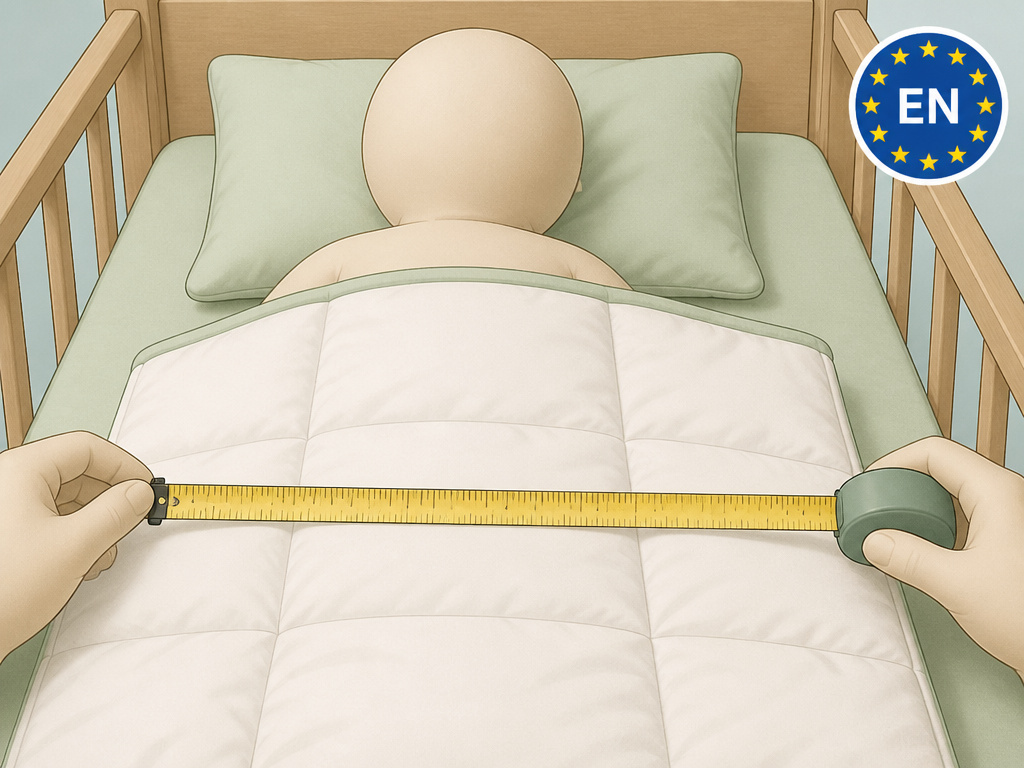
For infants and toddlers, bedding safety is paramount. The blanket advice for babies under 12 months is a bare crib with a firm mattress and a fitted crib sheet, no loose blankets, pillows, or duvets due to suffocation risk.
Once a child moves to a toddler bed, a duvet can be introduced. Here, specific standards apply.
EN 16779-1:2018 is the European safety standard for children’s cot duvets for kids up to 36 months. It covers duvets with permanent covers (often called cot quilts) and sets requirements for: * Size: To prevent overlaying and entrapment. * Thermal resistance: To limit overheating risk. * Filling security: To prevent leakage of small particles that could be inhaled. * Flame retardancy: Tested via a smoldering cigarette test.
Before you start: Always use a duvet appropriate for your child’s age and mobility. For a newborn, a wearable sleep sack or a lightweight swaddle blanket is safer than any loose bedding. Transition to a duvet only when the child is in a toddler bed and can easily move it on and off.
If you’re using a duvet for a young child, ensure it’s lightweight and the right size, it should cover the mattress without excessive overhang. For children who crave deep-pressure comfort, a properly sized kids weighted blanket (typically 10% of body weight plus a pound) is a safer, more controlled option than a heavy duvet.
How to Choose & Care for a Duvet
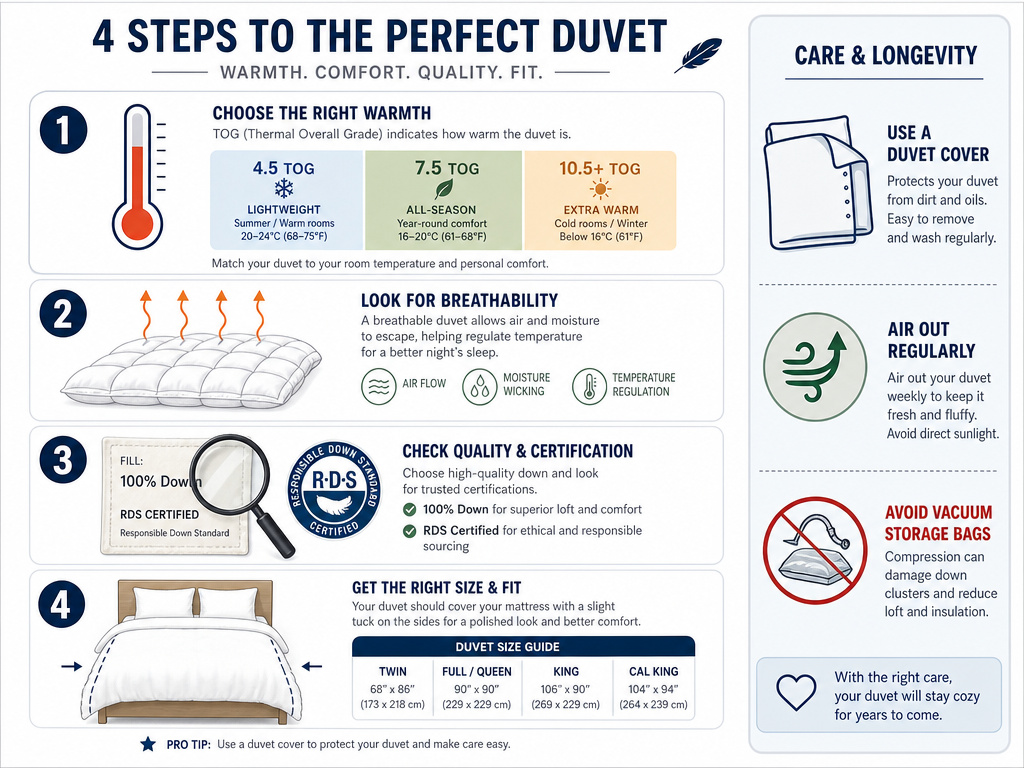
Choosing a duvet isn’t about finding the fluffiest one. It’s about matching technical performance to your child’s sleep habits and your local climate.
Step 1: Determine the needed warmth (TOG/Rc). While Rc is the scientific metric, many brands use the simpler TOG rating. A 4.5-7.5 TOG is good for summer or warm rooms; 10.5+ TOG is for winter. Most kids do well with an all-season 7.5-10.5 TOG duvet.
Step 2: Prioritize breathability if your child sweats. Look for natural fills (down, wool) or synthetic brands that explicitly market “moisture-wicking” or “temperature regulation” technology. This is more important than extreme warmth.
Step 3: Check the label, twice. Look for compliance with regulations like EU 1007/2011 for fill composition. Trust brands that list exact percentages, not vague terms like “feather blend.”
Step 4: Get the right size. A duvet should be large enough to tuck in slightly but not so large it piles on the floor. Standard sizes align with mattress sizes (Twin, Full, Queen).
Duvet Care: The Rules Most People Break
- Use a cover. Always. It protects the insert from stains, sweat, and dust mites. Wash the cover weekly.
- Wash infrequently. Washing, especially machine washing, degrades fills. Down clumps, wool felts, synthetics lose loft. Air it out regularly instead. Spot clean when you can.
- Dry thoroughly. If you must wash it, dry it completely, this can take multiple cycles. A damp duvet will grow mold inside.
- No direct sun for wool or silk. Ultraviolet rays degrade these delicate fibers. Air them in shaded, ventilated areas.
- Store it loose. Never compress a duvet in a vacuum bag for long-term storage; you’ll break the fiber structure.
For a baby’s space, the care focus shifts to the simpler layers. Frequent washing is expected for baby blankets and sheets for cots, which is why durability and easy-care fabrics matter most.
Frequently Asked Questions
What’s the difference between a duvet and a comforter?
Comforter is a single, decorative bedding piece that is often quilted and sold as part of a set. It’s meant to be used as-is. A duvet is a plain insert designed to go inside a removable, washable cover. Duvets are more versatile and hygienic; comforters are simpler but harder to clean.
Can a toddler use a duvet?
Yes, but not until they have transitioned from a crib to a toddler or regular bed, typically after age 2. The duvet should be appropriately sized (not too large or heavy) and used in conjunction with a fitted bottom sheet. For younger toddlers, a blanket for infants or sleep sack is a safer choice.
How often should you wash a duvet insert?
As rarely as possible, maybe once or twice a year, or at the change of seasons. Frequent washing damages the fill. The daily hygiene comes from the washable duvet cover. Always follow the care label: some down duvets can be machine-washed on gentle, while wool often requires professional cleaning.
What is a good duvet fill for a child with allergies?
Look for hypoallergenic options. Tightly-woven down alternative (polyester) duvets are inherently resistant to dust mites. Wool is also naturally hypoallergenic and mildew-resistant. If considering down, ensure it’s certified as “allergy-free” or “thoroughly washed,” as processed down can have allergens removed.
What is the easiest way to put on a duvet cover?
Use the “burrito” or “sushi roll” method. Lay the duvet insert flat. Turn the cover inside-out and lay it on top, aligning all corners. Tie the inner corner ties if present. Starting at the closed end, roll both together tightly into a log. Then, reach into the open end of the cover, grab the roll, and flip the cover right-side-out over it. Unroll, and you’re done.
The Bottom Line
A duvet is a sleep system, not just a blanket. Its value is in the combination of a warm, breathable insert and a protective, washable cover. For your child, the right choice balances measurable warmth (Rc/TOG) with proven breathability to keep the bed cave dry. Always verify the fill material on the label, what’s advertised isn’t always what’s inside.
Start with a quality insert suited to your climate, pair it with a soft, durable duvet cover, and care for it with more airing than washing. That’s how you build a comfortable, healthy sleep layer that lasts for years. For the youngest sleepers, remember that safety trumps all, follow age guidelines and use simpler, safer blankets for newborns until they’re ready for the upgrade.
