
Is It Ok for Newborns to Sleep on Your Chest? Safety Guide
This post contains affiliate links. As an Amazon Associate we earn from qualifying purchases.
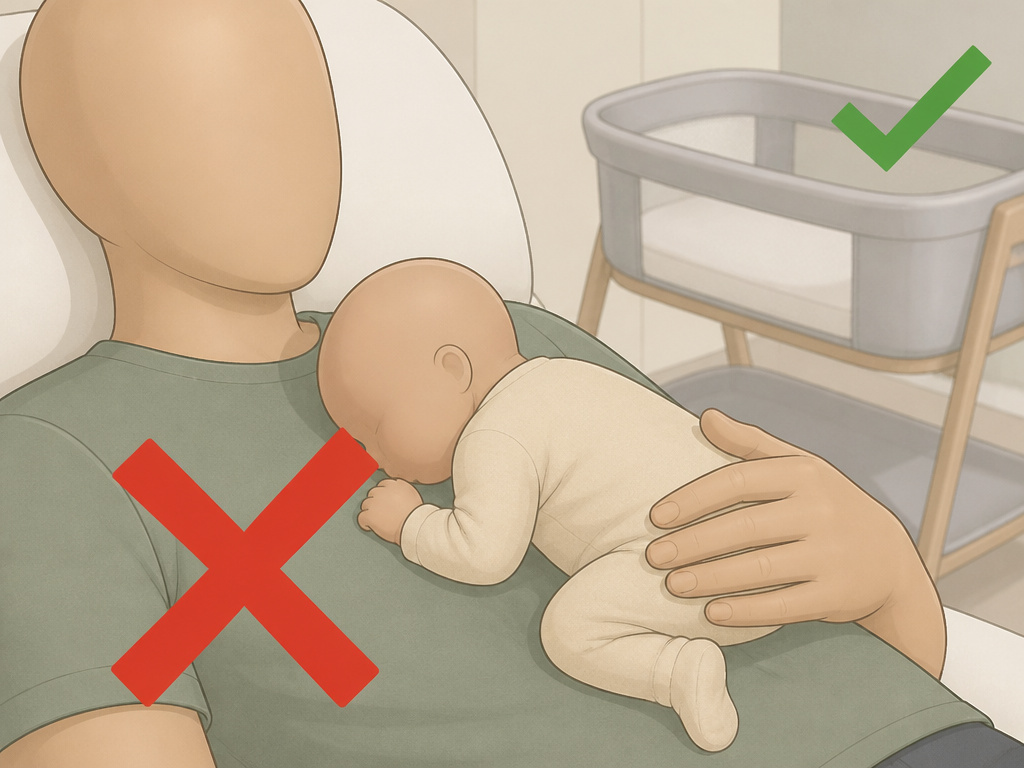
It is safe for a newborn to sleep on your chest only while you are fully awake and alert. The moment you feel drowsy or fall asleep, you must move the baby to a firm, flat, separate sleep surface like a crib or bassinet. This single rule separates a beneficial bonding practice from a situation that can increase the risk of Sudden Infant Death Syndrome (SIDS) by more than tenfold for infants under three months.
That distinction between awake contact and asleep contact is the line every parent needs to see. The official guidance from the American Academy of Pediatrics (AAP) and the CDC is clear: babies should sleep alone, on their back, in their own safe sleep space for every sleep. But that doesn’t mean chest contact is off-limits, it just has a strict time limit defined by your own alertness.
What follows is a breakdown of the science behind that rule, the specific risks that change at the three-month mark, and how to navigate the very real debate between absolute safety protocols and the practical, biological need for closeness that defines early parenting.
Key Takeaways
- Chest sleeping is only safe when the adult is wide awake. Transfer the baby to a crib before you feel sleepy.
- The risk of SIDS from prone (stomach) sleeping, including on a sleeping adult’s chest, is over ten times higher for infants under three months old.
- Room sharing, placing the baby’s crib or bassinet in your room, cuts SIDS risk by up to 50% and is the recommended alternative to bedsharing.
- Never use weighted sleep sacks or swaddles, and avoid any sleep surface with an incline greater than 10 degrees.
- The “Back to Sleep” campaign, which began in 1991, led to an over 80% drop in SIDS rates by promoting back sleeping.
The Critical Difference: Awake vs. Asleep
The safety of your baby sleeping on your chest hinges entirely on your state of consciousness. This is a binary switch, not a subtle guideline.
Common mistake: Letting a baby sleep on your chest while you doze off. The transition from awake cuddles to shared sleep is often gradual and unintentional, but it changes the risk profile completely.
When you are awake, you are an active safety mechanism. You can feel the baby’s position, monitor their breathing, and ensure their airway stays clear. Organizations like The Lullaby Trust in the UK explicitly state that chest contact while a parent is awake “has not been shown to be a risk, and such close contact is in fact beneficial.” This skin-to-skin time regulates the baby’s temperature, heart rate, and stress hormones, and supports breastfeeding.
The mechanism changes the second you fall asleep. You lose the ability to consciously respond to the baby’s movements. Your own body can shift, potentially covering the baby’s nose and mouth or causing them to slump into a position that restricts their airway. The sleep surface, your body, is also soft and uneven, which can increase the risk of rebreathing exhaled carbon dioxide.
This is why the first line of the CDC safe sleep guidelines is to place the baby on their back in a safety-approved crib. A crib provides a firm, flat, static surface. Your chest, once you’re asleep, does not.
How to Make Awake Time Safe (and When to Stop)
- Sit upright in a firm chair, not a soft sofa or recliner. Sofas are exceptionally dangerous for accidental co-sleeping.
- Keep the baby’s head turned to the side, with their nose and mouth completely unobstructed by your clothing or a blanket.
- Set a timer. If you’re feeding in the middle of the night, set a 20-minute alarm as a reminder to check your own alertness.
- The stop signal is drowsiness. The moment your eyes feel heavy, move the baby. Do not wait until you’re actually asleep.
The goal is to enjoy the bonding benefits of closeness while creating a hard boundary against the risks of shared sleep. For a safe, close alternative that maintains this boundary, many parents use a bedside bassinet that attaches securely to the adult bed, allowing proximity without sharing a surface.
Why “Back to Sleep” Isn’t Just a Slogan
The recommendation to avoid prone (stomach) sleeping is the practical result of one of the most successful public health interventions in history.
In 1991, the “Back to Sleep” campaign launched in the US and UK, educating parents and caregivers to place infants on their backs to sleep. The result was an over 80% drop in SIDS rates. The evidence was so conclusive that it reshaped global pediatric guidance overnight.
Placing a baby to sleep on their stomach or side on a soft surface greatly increases the risk of SIDS. This risk is due to a combination of factors: potential airway obstruction, impaired arousal from sleep, and rebreathing of exhaled air, which can lead to carbon dioxide buildup and oxygen depletion.
The logic extends directly to chest sleeping with a sleeping adult. From the baby’s perspective, they are in a prone position on a soft, yielding surface. A 2017 article in the Archives of Disease in Childhood by researchers Fleming, Blair, and Pease detailed the physiological reasons why this position is hazardous. The campaign’s legacy means we have decades of data showing what works: back, alone, in a crib.
Building a Safe Sleep Space
The alternative to chest sleeping is a dedicated, safe sleep environment. This is specifically about the details inside the crib.
| Sleep Surface Element | Safe Choice | Risk If Compromised |
|---|---|---|
| Mattress Firmness | Very firm; should not conform to the shape of the baby’s head. | Soft surfaces increase rebreathing and suffocation risk. |
| Bedding | Only a fitted sheet designed for the specific mattress. | Loose blankets, pillows, bumpers, and stuffed toys can obstruct airflow. |
| Incline | Perfectly flat (≤10°). | Inclines greater than 10 degrees can cause the baby to slump, compromising the airway. |
| Containment | A safety-approved crib, bassinet, or play yard with slats no more than 2-3/8″ apart. | Improper spacing can lead to entrapment. |
The foundation of this environment is a proper crib mattress that is firm and fits snugly within the crib frame. This single item is non-negotiable for reducing SIDS and suffocation risks, far more than any positioning gadget or monitor.
The 3-Month Mark: When Risks Shift
Infant vulnerability to SIDS isn’t constant. The risk curve peaks between one and four months of age, with the vast majority of cases occurring before six months. This timeline is critical for understanding the chest-sleeping question.
Research cited in a major shared sleeping surfaces report shows the risk associated with surface sharing is most pronounced in infants under three months old. For this group, sharing a sleep surface with a parent, including on a chest, can increase the risk of SIDS by more than ten times, even in the absence of other hazards like smoking.
After three months, the statistical risk decreases significantly. Some studies even suggest that for healthy, breastfed infants over three months with non-smoking, sober parents, the risk of bedsharing is very low. However, this does not make it safe by default. It means the extreme hazard for young infants has passed, but the fundamental mechanism of risk, prone positioning on a soft surface with a sleeping adult, remains.
Why Young Infants Are Most at Risk
- Neck and head control: Newborns cannot lift or turn their heads reliably to clear an airway obstruction.
- Arousal response: Their ability to wake up in response to breathing difficulties is underdeveloped.
- Small size: They can be easily overlain or trapped in bedding or body creases.
This is why a newborn bassinet placed right next to you is the safest compromise. It offers the protective benefit of room sharing, which the AAP notes can reduce SIDS risk by up to 50%, without the dangers of surface sharing. The baby is within arm’s reach for feeding and comfort, but on their own safe, flat surface.
Bedsharing Debate: Risk Elimination vs. Risk Minimization
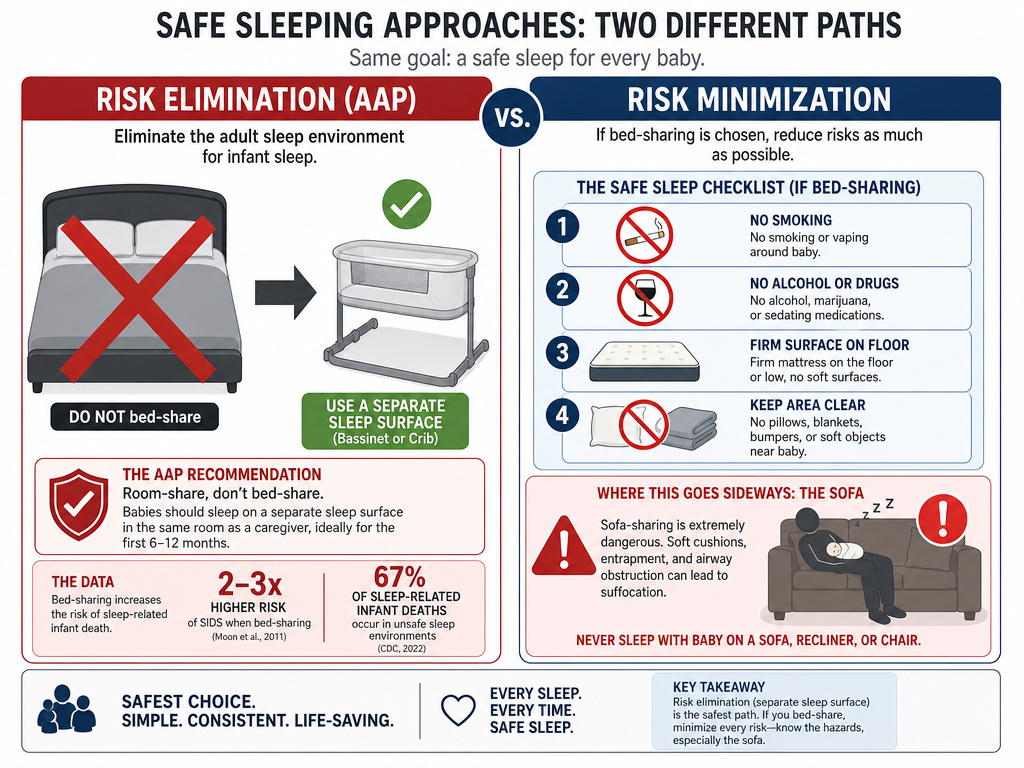
You will find two conflicting schools of thought on parent-infant sleep, and both are represented in official literature. Understanding this debate helps you parse the advice.
- Risk Elimination (AAP/CDC Stance): The official US position is a clear “never.” The AAP strongly recommends against any bedsharing under any circumstances to eliminate the risk entirely. This stance is reflected in the 2022 safe sleep study that forms the basis of current US guidelines.
- Risk Minimization (International Perspective): Researchers in the UK, Australia, and elsewhere argue that since many parents will bedshare unintentionally or by choice, blanket “never” advice can be counterproductive. It may lead to exhausted parents feeding babies on sofas, an exponentially more dangerous surface. This approach focuses on educating parents on how to make a shared sleep surface safer if it happens, while still promoting the crib as the ideal.
Where this goes sideways: A parent, fearing bedsharing, feeds the baby on a living room sofa and accidentally falls asleep. Sofa sharing carries a risk of infant death over twenty times higher than bedsharing.
The risk-minimization approach doesn’t endorse bedsharing. It acknowledges reality and provides a hierarchy of safety. If you are going to bedshare, you must eliminate the highest-risk factors first.
The “Safer” Bedsharing Checklist (If It Happens)
If you find yourself in a situation where you might fall asleep with the baby, these steps reduce (but do not eliminate) danger. The safest choice is always to place the baby in a safe sleep space.
- Both parents must be non-smokers.
- The adult must be sober, no alcohol, drugs, or sedating medications.
- The baby must be full-term, breastfed, and placed on their back.
- The adult must not be excessively fatigued.
- Use a firm, flat adult mattress on the floor, away from walls or furniture.
- Remove all pillows, heavy blankets, and duvets from the adult bed.
- The baby should wear a sleep sack, never an adult blanket.
This list is for risk reduction, not endorsement. The guaranteed safe path is a separate surface in your room, like a co-sleeping bassinet that gives the baby their own secure zone.
What to Absolutely Avoid (Beyond Chest Sleeping)
The focus on chest sleeping can obscure other products and practices that carry similar or greater risks. These are non-negotiable avoids.
- Weighted Sleep Sacks or Swaddles: The Michigan Department of Health and Human Services explicitly advises against them, noting the added weight could hinder breathing and that no studies prove their safety.
- Inclined Sleepers, Nappers, or Loungers: Any product that holds a baby at an angle greater than 10 degrees for sleep is unsafe. It can cause positional asphyxiation.
- Soft Bedding in the Crib: This includes pillows, blankets, bumper pads, and stuffed animals. A bare crib is a safe crib.
- Sleeping on a Sofa or Armchair: The risks of suffocation and entrapment are critically high.
Your investment is better placed in a quality, firm crib mattress and fitted sheets than in any gadget that promises to keep a baby on an incline or in a specific position. The simpler the sleep space, the safer it is.
Frequently Asked Questions
Can I let my newborn nap on my chest?
Yes, but only if you are guaranteed to stay wide awake. Sit upright in a firm chair, ensure the baby’s airway is clear, and move them to their crib the moment you feel tired. The nap should be a short, supervised period of bonding, not a substitute for crib sleep.
Why is back sleeping so important?
Back sleeping keeps the airway open and reduces the risk of the baby rebreathing their own exhaled carbon dioxide. Since the “Back to Sleep” campaign began, SIDS rates have fallen by over 80%, making it the single most effective SIDS prevention step.
Is it safe if I’m propped up on pillows?
No. Propping yourself up does not make you safe to sleep with the baby. It adds the danger of pillows around the infant, increasing suffocation risk. If you need to be propped up to feed, have a plan to place the baby in their bassinet immediately after.
What about those co-sleeper beds that attach to yours?
These are generally considered safe if they are CPSC-approved bedside sleepers or bassinets. They provide a separate, firm, flat surface for the baby that is attached to the adult bed frame, allowing for easy access while maintaining a safe sleep space. They are not the same as sharing the adult mattress.
My baby only sleeps well on me. What do I do?
This is incredibly common. The goal is to transition to the crib for sleep. Try warming the crib sheet with a heating pad (remove it before placing the baby down), using a swaddle or sleep sack, and employing gentle methods like placing the baby down drowsy but awake. For overnight feeds, a bedside crib minimizes disruption and helps everyone get back to sleep faster.
The Bottom Line
Chest sleeping with a newborn is a moment of connection, not a sleep solution. The rule is absolute: it ends before your alertness does. The science is unequivocal on the dangers of prone sleeping for young infants, and the safe alternative, room sharing with a separate, firm sleep surface, offers profound risk reduction without sacrificing closeness.
Your job is to build a system that protects your baby when you inevitably feel sleepy. That system is a bare crib in your room, a firm mattress, and a commitment to back sleeping.Everything else, including those precious awake chest cuddles, exists within the safety of that framework.
