
How to Put an Overtired Infant to Sleep & Break the Cycle
This post contains affiliate links. As an Amazon Associate we earn from qualifying purchases.
To put an overtired infant to sleep, you must first calm the emotional distress blocking sleep, then apply a consistent, safe wind-down routine. Research reframes “overtired” as a survival-state of anxiety, not just exhaustion. For infants over six months, evidence-backed methods like bedtime fading are as effective as controlled crying but gentler.
The key is the sequence: calm before sleep. Trying to force sleep while a baby is in that heightened state just escalates the crying. The emotional blockage has to come down first.
What follows breaks down the two-part process. First, the science of what’s actually happening in your baby’s nervous system. Second, a practical protocol to lower that distress and guide them into sleep, matched to their age and your comfort level.
Key Takeaways
- “Overtired” is often an emotional state of anxiety, not physical exhaustion. Calming this distress is the first step.
- For infants under six months, focus solely on soothing and safe sleep habits; formal sleep interventions are not recommended by research.
- Bedtime fading, temporarily delaying bedtime to match natural sleepiness, is a clinically supported gentle method for babies over six months.
- A safe sleep space is non-negotiable: a firm crib mattress in your room, with no loose blankets, pillows, or toys.
- Consistency in your response matters more than which specific soothing technique you use.
The Science Behind the ‘Overtired’ State
Most parents know the signs: the glassy-eyed stare, the frantic rubbing of the face, the cries that escalate instead of winding down. The standard advice says you missed the “sleep window.” But the research on overtired infants suggests something else is going on.
What we call overtiredness is frequently an emotional survival response, anxiety, distress, or fear that actively blocks the ability to fall asleep, even when the body is exhausted. The quickest way to help is to remove that emotional blockage by helping the child become calm.
This reframes the entire problem. You’re not battling a deficit of sleepiness; you’re managing an overflow of stress hormones. The baby’s system has tipped into a fight-or-flight state, and sleep is biologically off the table until that state passes.
This also explains why classic “drowsy but awake” placement often fails with an overtired baby. They are physiologically unable to self-soothe from that heightened place. Your job is to help them climb down first.
| Common Signal | Often Misread As | What It Might Actually Be |
|---|---|---|
| Arching back & crying | “Needs to burp” or “pain” | Overstimulation / frustration escape attempt |
| Rubbing eyes/face frantically | “So tired, will crash soon” | Self-stimulation trying to regulate nervous system |
| Glassy, unfocused stare | “Zoning out before sleep” | Sensory shutdown from overload |
| Crying that intensifies when rocked | “Not tired enough” | Stress system too activated for motion to soothe |
Where this goes sideways: Trying to solve this with more vigorous rocking or louder white noise. For a baby already in sensory overload, adding input can amplify the distress. The fix is often less: less light, less sound, less movement.
Your First Move: The Calm-Down Protocol (All Ages)
Before you can think about sleep, you need to lower the emotional charge. This is a reset, not a bedtime routine. Ditch the pajamas and the sleep sack for now.
Start with a full environmental change. Walk into a different room, the bathroom with the fan on for steady sound often works. The shift in scenery can interrupt the crying cycle. Hold your baby firmly against your chest, supporting their bottom and head. Your calm, steady breathing is the primary tool.
Speak in a low, monotone whisper. The content doesn’t matter; the steady, dull sound does. “You’re okay. We’re just here. It’s alright.” Avoid eye contact, which can be overstimulating. Just hold and breathe.
For some neurodivergent infants, touch itself can be irritating. If your baby pushes away or stiffens more when held, try proximity without contact. Sit them securely in your lap facing out, or lie them on a play mat next to you with your hand resting still on their back. The goal is presence without overwhelming their senses.
This phase ends when you feel the body in your arms go limp. The crying may slow to whimpers, then stop. The frantic movements cease. This is the gate opening. Now you can move toward sleep.
Building a Sleep-Conducive Environment
You cannot calm an overtired baby in a chaotic space. The environment must support sleep before you even start your routine. This is where safety and sensory details intersect.
The CDC safe infant sleep guide is the non-negotiable foundation. The sleep surface must be a firm, flat crib mattress with only a fitted sheet. No pillows, blankets, stuffed animals, or bumper pads. For the first six months, the bedside bassinet or bedside sleeper in your room is the safest location, reducing SIDS risk.
Beyond safety, manage sensory inputs: – Darkness: Use blackout curtains. A truly dark room signals the brain to produce melatonin. – Sound: Continuous white noise (a fan, a dedicated machine) masks disruptive household sounds and provides a sonic blanket. – Temperature: Keep the room cool, between 68–72°F (20–22°C). Overheating is a risk factor for SIDS and disrupts sleep. – Clothing: After the calm-down, dress them in a wearable sleep sack or swaddle if they’re not rolling. A safe swaddle or newborn swaddle prevents the startle reflex from waking them, but never use a loose blanket.
This environment should be consistent for every sleep. It becomes a powerful cue that tells your baby’s brain, “This is the place where we rest.”
Age-Specific Strategies: Under 6 Months vs. Over 6 Months
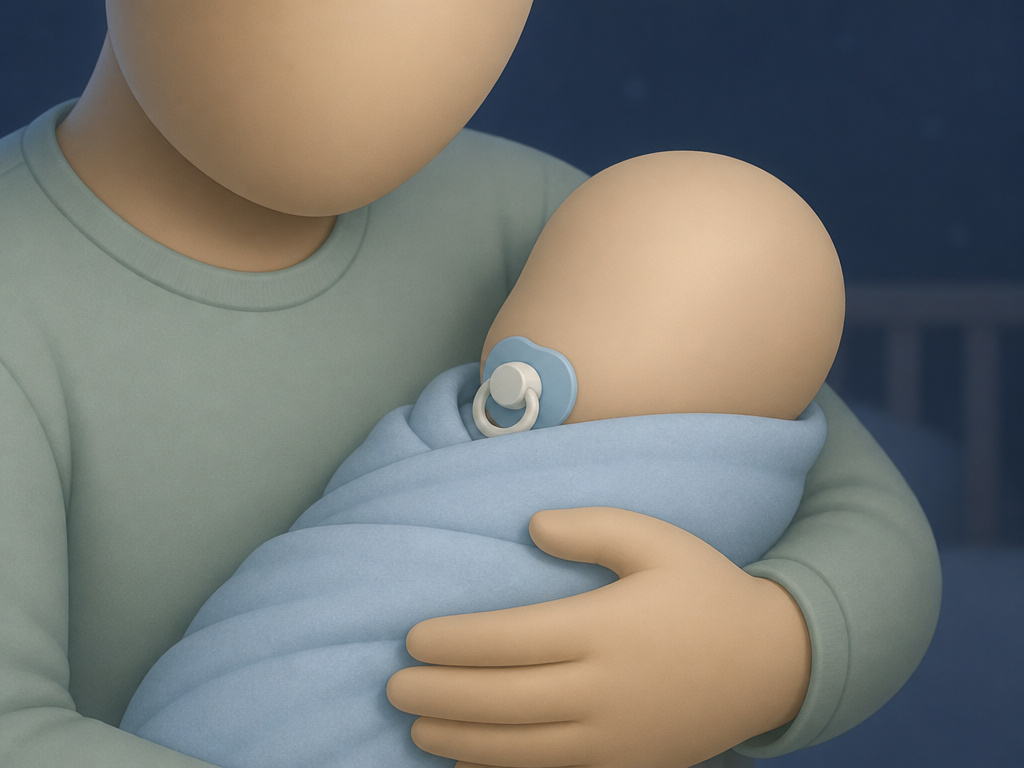
Your approach splits at the six-month mark. This isn’t arbitrary; it’s the threshold identified in the infant sleep scoping review PDF, which found a consensus against formal sleep interventions for infants under six months.
For Newborns to 6 Months
Your only tools are soothing and routine. The goal is to help them fall asleep, not to teach independent sleep. After the calm-down protocol, use motion, sucking, or warmth. – Motion: Slow, deep squats while holding them, or a side-to-side rock in a rocking chair. – Sucking: Offer a pacifier or a feed if it’s time. The sucking reflex is a powerful organiser for the nervous system. – Contact: Let them fall asleep on you, then hold them for 20 minutes until they reach deep sleep before attempting a transfer to their bedside sleeper.
Common mistake: Rigidly avoiding “sleep props” like feeding to sleep with a young infant. For a baby under four months, using a feed or a pacifier to achieve calm is a valid biological tool. You can gently shape habits later.
The routine is about predictability, not independence. A warm bath, a gentle massage with lotion, a quiet song, then a feed. Keep lights low and voices quiet. Use a swaddle blanket if they like it. Then help them the whole way to sleep.
For Infants 6 Months and Older
After six months, you can gently shape sleep skills. The behavioral sleep treatment guidelines cite two effective, recommended therapies: graduated extinction and bedtime fading with positive routines.
- Bedtime Fading (The Gentler First Option): This involves temporarily delaying your baby’s bedtime to match the time they actually fall asleep easily. If they typically fight sleep until 9:30 PM, make their bedtime 9:25 PM for a few nights. Once they’re falling asleep quickly at that time, move bedtime 15 minutes earlier every few nights. It uses the body’s natural homeostatic sleep drive, building sleep pressure, so they’re genuinely sleepy at the new time.
- Graduated Extinction: This is the “check and console” method. You put your baby down awake and leave the room. If they cry, you wait a predetermined interval (e.g., 5 minutes) before going in for a brief, boring check (no picking up, just a pat and a calm word). You then leave, increasing the interval each time.
The scoping review noted bedtime fading was as effective as controlled crying but preferable for infants with separation anxiety. It also found it less likely to lead to a post-intervention deterioration of sleep.
The short version: Try fading the bedtime first. It often fixes the problem without any crying-based intervention.
Step-by-Step Calm-Down Protocol
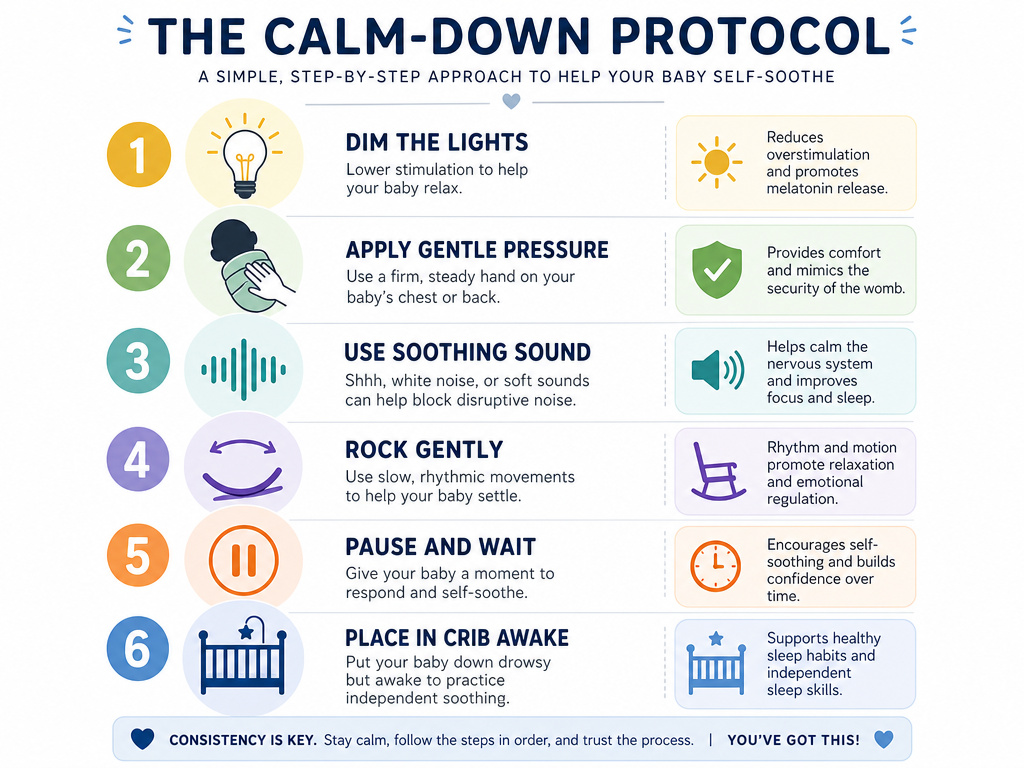
When you’re in the thick of it, you need a script. This sequence works after the initial full reset.
- Dim the Lights. Overhead lights off. Use a dim lamp or nightlight. Harsh light tells the brain it’s go-time.
- Apply Deep Pressure. Swaddle them if they’re young, or lay them on their back and press your hand firmly on their chest and tummy. The steady weight is regulating.
- Use Repetitive Sound. A slow, loud “shhhhh” right near their ear, or a white noise machine on a continuous setting. Match the volume of their cry, then gradually soften it as they calm.
- Introduce Rhythmic Motion. If holding them, a slow, small bounce or rock. If they’re in the crib, a firm, rhythmic pat on the back or bottom.
- Wait for the Pause. Do not stop when the crying stops. Continue the sound and motion for two full minutes of silence. This helps them transition out of the stress cycle.
- Attempt the Transfer. If they’re asleep, hold for 15-20 more minutes before moving them. If they’re calm but awake, you can now try placing them in their sleep space and using your chosen sleep method (fading, extinction, or staying until they’re asleep).
Skip step 4 if motion seems to make them more upset. Skip the swaddle in step 2 if they are rolling or fight it. The protocol is a toolkit, not a lockstep law.
What Not to Do: Habits That Feed the Cycle
Some well-intentioned moves accidentally reinforce the overtired loop. Avoid these three patterns.
First, endlessly extending the bedtime routine. Adding “one more book” or “another song” when your baby is already frayed just extends the window of distress. Keep the routine short and boring when they’re overtired.
Second, switching tactics every two minutes. Rocking for two minutes, then walking, then offering a feed, then rocking again. This teaches your baby that no state is permanent and increases anxiety. Pick a calm-down method and stick with it for a solid 10-15 minutes to give it a chance to work.
Third, using a baby pillow or loose newborn blanket in the crib for comfort. The safety risk isn’t worth it, and the association you create is one you’ll have to break later. Safe sleep comfort comes from a sleep sack, a pacifier, and your consistency.
The part nobody mentions: Your own anxiety is contagious. If you’re frantic, thinking “This will never work, I’ll be up all night,” your baby feels that tension in your grip and your breath. Your calm is not a luxury; it’s the most effective tool in the room. Breathe, and trust the process.
Frequently Asked Questions
Can an overtired baby ever just “crash” on their own?
Sometimes, but it’s the exception, not a strategy. An exhausted baby may eventually cry themselves into a stressed, fitful sleep. This sleep is often shorter and less restorative, making them more prone to waking and harder to settle next time. It’s better to help them achieve calm sleep.
How long should I try to calm my baby before giving up?
Aim for a 20-30 minute dedicated calm-down block. If after 30 minutes of consistent, calm effort the crying is still escalating, stop. Offer a feed if it’s time, change their diaper, and take a five-minute break in a different room. Then restart the calm-down protocol. Sometimes the reset needs a reset.
Is it okay to feed an overtired baby to sleep?
For infants under 4-5 months, yes. It’s a powerful biological soothing mechanism. For older babies (6+ months) where you’re working on independent sleep, it can become a strong sleep association. In the moment of crisis, using a feed to achieve calm is fine. For the long-term plan, try to separate feeding from the very last moment of sleep by even 10 minutes.
Why does my baby only sleep when held?
This is developmentally normal, especially under 4 months. They are wired for survival, and survival means proximity to a caregiver. For newborns, embrace it using a safe bedside bassinet for easy transfers. For older infants, you can gently shift the habit using methods like bedtime fading, where they learn to fall asleep in their own space while still drowsy.
Are sleep training and safe sleep the same thing?
No. Safe sleep is the non-negotiable physical environment that prevents SIDS and suffocation: alone, on the back, in a bare crib. Sleep training (or shaping) is a behavioral approach to how a baby falls asleep. You must always practice safe sleep, regardless of which behavioral method you choose, if any.
Before You Go
Putting an overtired infant to sleep is a two-stage process. First, address the emotional blockade with a deliberate calm-down. Second, guide them to sleep within a safe, consistent environment using age-appropriate methods.
For young babies, that means soothing them all the way to sleep. After six months, gentle behavioral tools like bedtime fading are backed by clinical evidence and can help break the cycle for good. Your consistency and calm are the real keys. The peer-reviewed SIDS prevention guidelines and the practice parameters for night wakings agree on the framework; you provide the steady hands that apply it night after night.
