
Should Newborn Twins Sleep Together? Official Safety Guidelines
This post contains affiliate links. As an Amazon Associate we earn from qualifying purchases.
Newborn twins should not sleep together in the same sleep space according to leading health authorities in the United States and Australia, who cite clear suffocation and overheating risks. In the UK, guidance permits co-bedding for small twins if strict safe sleep rules are followed, including placing them on their backs with heads together and feet at opposite ends of a single cot, and separating them immediately once either baby can roll.
The split isn’t academic. It’s a public health line drawn from how different agencies weigh the same scarce evidence. US and Australian bodies see risk and no proven benefit. UK agencies see a potential benefit for bonding and temperature regulation that can be managed with specific precautions.
What follows is a breakdown of the official stances, the mechanics of the risks they cite, and the exact rules you must follow if you choose to co-bed. By the end, you’ll know the three non-negotiable conditions that make any shared sleep space safer, and the one developmental milestone that ends the discussion entirely.
Key Takeaways
- US and Australian health departments explicitly advise against twin co-bedding, stating risks of suffocation and overheating outweigh any unproven benefits.
- UK guidance allows co-bedding only under strict conditions: a firm, flat cot (never a Moses basket), specific head-to-head or side-by-side positioning, and immediate separation once rolling begins.
- Overheating is a documented, physical risk when twins share a sleep space, as their combined body heat can raise the local temperature beyond safe limits.
- The single biggest factor is rolling. All authorities that permit co-bedding mandate separate sleep spaces the moment either twin can roll over independently.
- Your safest, lowest-risk option is always two separate sleep surfaces in your room, like individual bedside bassinets or a twin crib with a solid divider.
The Official Split: US/Australia vs. UK Guidance
You will not find a consensus. The advice depends entirely on which government’s health website you open.
The NSW Health guideline from Australia is unambiguous: “Co-bedding of twins and multiples is NOT recommended. There is no compelling evidence of the benefit of co-bedding. Co-bedding these babies increases their risk of SUDI with the potential to cause overheating, rebreathing and any difference in size of the babies may increase the risk of suffocation.”
This stance is mirrored by US states like Michigan and New Jersey, which reference American Academy of Pediatrics (AAP) policy to advise against it. The logic is precautionary: since high-quality, long-term safety data is lacking, and the theoretical risks are severe, the recommendation is to avoid the practice altogether.
Open the UK’s NHS website, and the language flips. “You can put your twins to sleep in a single cot while they’re small enough. This is called co-bedding and is perfectly safe as long as you follow safe sleep advice.” UK charities like The Lullaby Trust provide detailed, permitted positioning guides.
Why the difference? It often comes down to how agencies interpret the same thin body of evidence. A 2023 review cited by a UK hospital trust concluded there was “no clear evidence of harm,” but immediately noted “the quality of available evidence is low.” One side sees absence of proof of harm; the other sees absence of proof of safety.
| Authority | Stance on Co-Bedding | Primary Reason Cited |
|---|---|---|
| NSW Health (AU), Michigan DHHS (US) | Not recommended / Avoid | Risk of SUDI (suffocation, overheating, rebreathing); benefits not established |
| The Lullaby Trust, NHS (UK) | Permitted with strict conditions | Can help regulate temperature/sleep if done exactly to safe sleep specifications |
| Ashford & St. Peter’s Hospitals NHS (UK) | May be reasonable in hospital; insufficient evidence for routine practice | Low-quality evidence; notes overheating risk but allows for parental discretion |
This split means your decision is, in part, a geographic one. But the physical risks are the same everywhere.
The Mechanics of Risk: What “Overheating” and “Rebreathing” Actually Mean
The warnings aren’t abstract. They describe specific physical failures in a shared sleep environment.
Overheating is the more straightforward danger. A newborn’s ability to regulate its own temperature is poor. Put two heat-generating bodies in a single enclosed space, and the micro-climate around them warms up faster than in a single-occupant cot. The UK’s Ashford and St. Peter’s guideline explicitly notes that co-bedded infants “may maintain higher body temperatures.” Overheating is a recognized risk factor for Sudden Infant Death Syndrome (SIDS). This is why co-bedding in a confined Moses basket is universally condemned, there’s simply no room for heat to dissipate.
Rebreathing is subtler and more dangerous. When a baby’s face is pressed against soft bedding, another baby, or the side of a cot, they can inhale their own exhaled carbon dioxide. This depletes oxygen. In a shared cot, one twin turning their head towards the other’s back can create this scenario. The smaller the space, the higher the risk. It’s a silent process with no struggle.
These mechanisms explain the rigid positioning rules that come with UK guidance. The rules aren’t just suggestions; they are engineered attempts to keep airways open and allow heat to escape.
If You Co-Bed: The Non-Negotiable Rules
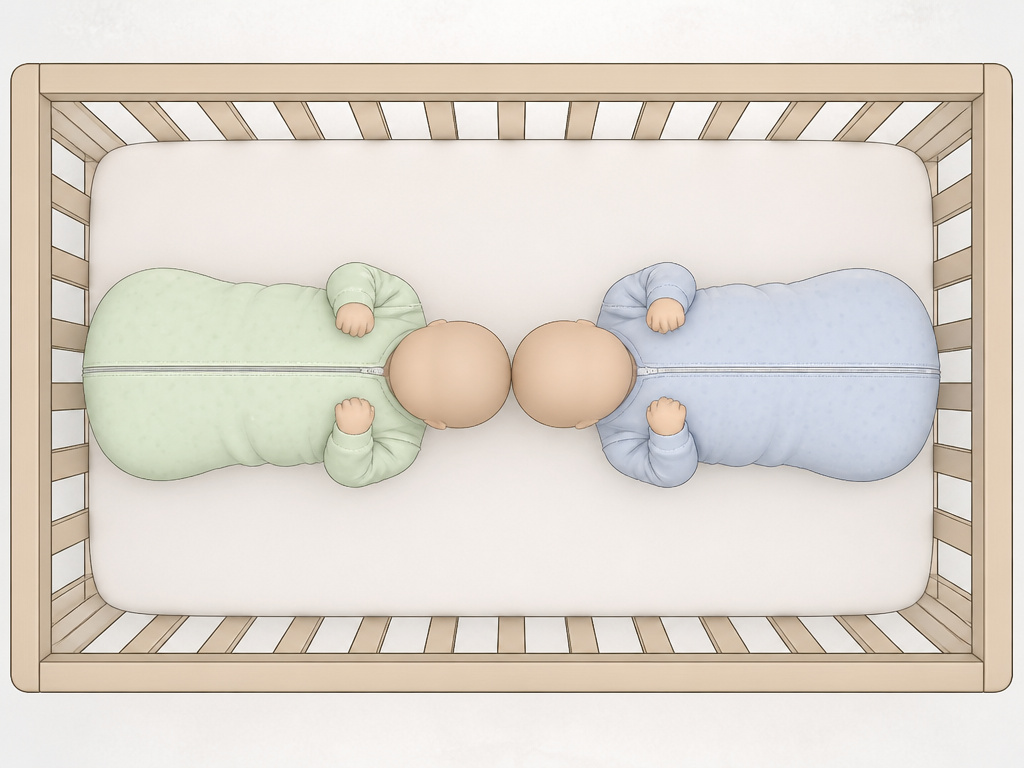
If, after reviewing the warnings, you choose to follow the UK’s permitted path, these are the non-negotiable conditions. Deviating from any one of them shifts the risk from “managed” to “high.”
Rule 1: The Right Sleep Space.
You must use a single, full-size cot with a firm, flat, waterproof crib mattress. The mattress must fit the cot frame with no gaps. A Moses basket, bedside sleeper pod, or small crib is an immediate disqualifier due to space constraints. The cot must be clear of all soft bedding, no pillows, quilts, duvets, or soft toys. Use only a well-fitting baby sleep sack or securely tucked-in blankets for each child.
Rule 2: The Exact Positioning.
There are two accepted layouts, both designed to maximize the distance between faces and minimize the chance of rolling into one another.
- Head-to-Head (Feet at Opposite Ends): Place each baby on their back with the tops of their heads touching (or nearly touching) in the center of the cot. Their bodies extend outward with feet at opposite ends. This is the most commonly recommended position.
- Side-by-Side: Place both babies on their backs, side-by-side, with their feet at the foot (bottom) of the cot. Ensure they are not close enough to touch each other.
Rule 3: The Rolling Deadline.
This rule is absolute and has no exceptions. The moment either twin can independently roll from back to front or front to back, co-bedding must stop. They must be moved to their own separate, safe sleep spaces immediately. The risk of one rolling onto the other, blocking an airway, or becoming trapped is too great. This milestone, not a specific age, is your cutoff date.
Where this goes sideways: Using a soft or ill-fitting mattress. If a baby’s face presses into a dip or gap, the airway can be obstructed in seconds. The essential features of a newborn mattress are firmness and a perfect fit for this exact reason.
The Safer, Recommended Path: Separate Sleep Spaces
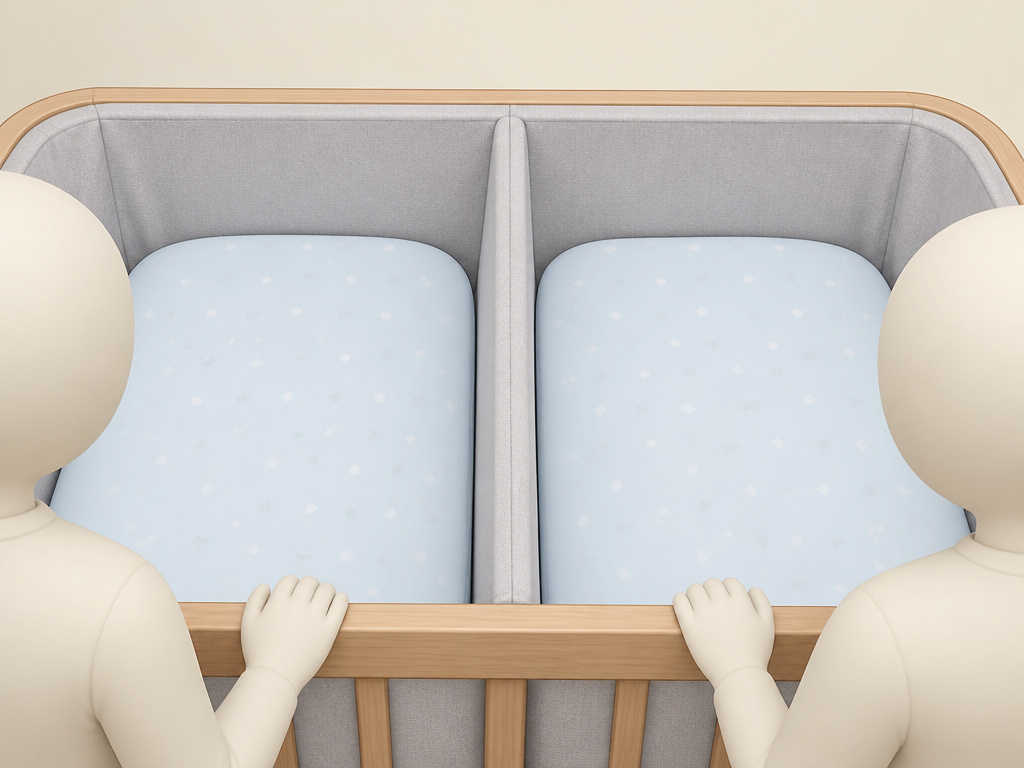
For most parents, especially those in the US or Australia following their local guidance, the decision is clear. The safest path is two separate sleep surfaces in your room for the first six months.
This doesn’t require two massive cribs. The market is built for this.
- Twin Bassinets: Many companies make double bassinets, a single frame holding two separate, firm sleep surfaces with a solid divider between them. This allows proximity without shared space.
- Individual Bedside Sleepers: Two separate bedside cribs or bedside cots attached securely to your bed give each twin their own safe zone while keeping them within arm’s reach.
- Standard Cribs or Infant Beds: If you have the space, two standard cribs placed side-by-side work perfectly. Ensure they meet all modern safety standards.
The advantage of this approach is that it eliminates the specific risks of co-bedding entirely. There’s no debate about positioning, no worry about overlapping sleep sacks, and no looming rolling deadline that forces a sudden change. You follow the same, proven safe sleep options for a newborn, you just do it twice.
When the Hospital Does It: The NICU Exception
Many parents see their premature twins co-bedded in the Neonatal Intensive Care Unit (NICU) and understandably wonder if they should continue at home. The hospital environment is the exception, not the model for home.
In the NICU, co-bedding is a therapeutic tool used under 24/7 electronic monitoring for stable infants. It’s meant to mimic the womb, potentially regulating heart rate and breathing. Nurses meticulously manage positioning, monitor temperature hourly, and the babies are often in open, temperature-controlled incubators.
At home, you lack the monitors, the controlled environment, and the constant professional oversight. The UK’s Lullaby Trust states directly that once discharged, babies “should be ready to sleep in line with the safer sleep advice.” What happens in the NICU stays in the NICU.
Frequently Asked Questions
Is it safe for newborn twins to sleep together in a crib?
According to UK guidance, it can be safe under very strict conditions: a firm, flat cot (not a bassinet), specific head-to-head or side-by-side positioning on their backs, and separation as soon as either can roll. US and Australian authorities uniformly recommend against it, advising separate sleep spaces as the safest option.
What is the safest sleeping position for co-bedded twins?
The two accepted positions are: 1) On their backs, with the tops of their heads together and their feet at opposite ends of the cot, or 2) On their backs, side-by-side with their feet at the foot of the cot. They must not be close enough to touch. Never place them facing each other or in a cuddling position.
Why do some experts say it’s okay and others say it’s dangerous?
The disagreement stems from how different health bodies interpret the same limited research. UK agencies see potential benefits (like bonding) that can outweigh risks if managed precisely. US and Australian agencies focus on the documented physical risks (suffocation, overheating) and the lack of high-quality evidence proving co-bedding is safe, leading them to take a more precautionary, avoidance-based stance.
At what age should twins stop sleeping together?
The correct metric is developmental stage, not age. You must stop co-bedding immediately when either twin can roll over independently, which typically happens between 4 and 6 months. Rolling introduces an unmanageable risk of one baby rolling onto the other.
Can triplets co-bed safely?
Guidance is even more restrictive for triplets. The UK’s NHS states that while very small triplets can be placed side-by-side on their backs in a single cot, the space constraints and risks multiply. Most experts and authorities strongly recommend individual sleep spaces for triplets from the start due to the extreme increase in risk from overcrowding and heat buildup.
Before You Go
The question of whether newborn twins should sleep together has two legitimate answers, dictated by where you live and which risks you are most comfortable managing. The official, evidence-based recommendation from US and Australian bodies is clear: don’t. Use separate safe infant beds.
If you follow the UK’s permitted path, your margin for error is zero. The cot must be large and firm, the positioning exact, and your vigilance absolute, especially for the day the first roll happens. That day, the shared cot ends.
Whichever path you choose, anchor it in the fundamentals: a firm, flat surface, clear of all soft clutter, in your room. Everything else is a modification of that non-negotiable base.
