
Newborn Crib Mattress Height: The Essential Safety Guide
This post contains affiliate links. As an Amazon Associate we earn from qualifying purchases.
Set the crib mattress to the highest possible position for a newborn, with a firm, flat mattress that leaves a gap of less than 3.15 inches (80 mm) between the mattress and any crib side. This gap, measured with a fitted sheet on, is the federal safety standard’s maximum. The highest setting minimizes the distance you must lift your baby while preventing dangerous entrapment before they can roll.
That gap is the whole game. It’s not a suggestion. The Consumer Product Safety Commission (CPSC) codified it as law in 16 CFR Part 1241, and it’s tested with a specific 100% cotton sheet washed twice on hot. A mattress that fits too loosely creates a pocket where an infant’s head or body can wedge, cutting off airflow in silence. This rule exists because those pockets have killed children.
What follows is the breakdown of that 3.15-inch rule, why the highest setting is your only option for a non-mobile newborn, and the three physical checks that beat any manufacturer’s label. We’ll cover when to lower it (the answer is earlier than you think), what makes a mattress truly “firm,” and why a used crib demands a tape measure before you ever put a baby in it.
Key Takeaways
- The federal 3.15-inch corner gap is the legal maximum for safety, measured with a fitted sheet on the mattress.
- Newborns get the highest mattress setting exclusively; this is for parent ergonomics and has zero to do with the baby’s mobility.
- Lower the mattress to the middle level before the baby can sit up unassisted, which can happen as early as 4-5 months.
- A “firm” mattress shouldn’t indent more than a fraction of an inch under hand pressure; memory foam and adjustable-firmness models fail this test.
- Used cribs require a manual and all original hardware; missing parts mean the crib is trash, not a project.
The Exact Height Setting for a Newborn Crib
The crib has three or four height settings for a single reason: to keep the sleeping surface close to the top rail until the baby can move. For a newborn who cannot roll, sit, or push up, the only safe setting is the highest one.
This isn’t about the baby’s safety yet. It’s about yours. A mattress set 30 inches down turns every night feeding into a deep, awkward bend that strains your back. More critically, it increases the chance of fumbling the placement. The highest setting brings the sleep surface within a comfortable, secure reach.
The test for the maximum 3.15-inch corner gap is performed with the mattress on a standardized support and a 100% cotton fitted sheet that has been washed and dried twice on high heat. This ensures the measurement accounts for real-world use, not a bare mattress.
Where this goes sideways: Assuming all “highest” settings are equal. They are not. You must verify the gap yourself.
The CPSC’s rule (16 CFR Part 1241) states a full-size crib mattress must be at least 27 1/4 inches wide by 51 5/8 inches long. But the crib’s interior is larger: 28 inches wide by 52 3/8 inches long, give or take 5/8 of an inch. This difference creates the potential gap. Your job is to ensure it never exceeds 3.15 inches in any corner.
| Measurement Point | Federal Requirement (Minimum/Maximum) | Why It Matters |
|---|---|---|
| Crib Interior Width | 28 ± 5/8 in. (71 ± 1.6 cm) | Defines the space the mattress must fit into. |
| Crib Interior Length | 52 3/8 ± 5/8 in. (133 ± 1.6 cm) | Measured at the mattress support spring level. |
| Mattress Width | At least 27 1/4 in. (690 mm) | A smaller mattress creates a larger, dangerous gap. |
| Mattress Length | At least 51 5/8 in. (1310 mm) | |
| Maximum Corner Gap | 3.15 in. (80.0 mm) | The critical safety limit tested with a fitted sheet. |
Grab a tape measure. Push the mattress firmly into one corner. Stretch a fitted sheet over it. Measure the shortest distance from the sheet-covered mattress edge to the crib’s side in the opposite corner. If it’s over three inches, that mattress does not fit this crib. This check is more reliable than the manufacturer’s “compatible” list.
Why the “Firm and Flat” Rule Isn’t Just About Comfort
The American Academy of Pediatrics (AAP) says “firm and flat” for a mechanical reason. A soft surface conforms to an infant’s face, creating a seal that can cause rebreathing of carbon dioxide or direct suffocation. A newborn lacks the neck strength to turn their head if their nose sinks into a plush layer.
Firmness is a physical property, not a marketing term. Press your hand firmly into the center of the mattress. It should offer immediate, solid resistance. There should be no discernible “give” or molding around your hand. Mattresses with adjustable firmness settings or those made from memory foam are explicitly warned against by the AAP for this reason, they indent.
Flat means exactly that. No incline. After the 2022 recalls of inclined sleepers, the rule is absolute: the sleep surface must be level. Some cribs have adjustable bases that can be inclined for babies with reflux; these are medical devices prescribed by a doctor, not a standard nursery feature.
The firm, flat requirement interacts directly with mattress height. An older, softened mattress may sag in the middle. When you set it at the highest level, the sag can create a hidden slope or pocket at the edges. This defeats the purpose of a flat surface. A quality, firm crib mattress maintains its shape across all support points.
The 3-Step Physical Safety Check (Do This Before the Baby Sleeps Here)
Manufacturer instructions can be vague. Your own verification is concrete. This takes five minutes with a tape measure and your hands.
- Measure the Corner Gap. Use the method above. Push, sheet, measure. This is the non-negotiable pass/fail. If you’re shopping for a new safe crib mattress, bring the tape measure to the store or check the product’s exact specs against your crib’s interior dimensions.
- Test for Firmness and Sag. Remove the sheet. Press down hard in the center and at all four corners. Look and feel for any permanent depression or softening. A slight compression is normal; a lasting indent is a fail. This is especially critical if you’re using a crib mattress pad, the pad must be thin and non-compressing.
- Inspect the Mattress Support. Set the mattress aside. Check the crib’s metal or wooden support platform. It must be intact, with all screws and bolts tight. Push down on it. There should be no wobble, bowing, or flex. A weak support will sag over time, lowering the effective mattress height and creating unsafe gaps at the sides.
Common mistake: Trusting that a new mattress and a new crib are automatically compatible. The 3.15-inch rule is a performance standard, not a design guarantee. Two compliant products can still create a non-compliant gap when paired.
Skip any one of these steps, and you’re trusting a label over physics. The Consumer Product Safety Commission standard exists because labels failed.
When to Lower the Crib Mattress: The Mobility Timeline
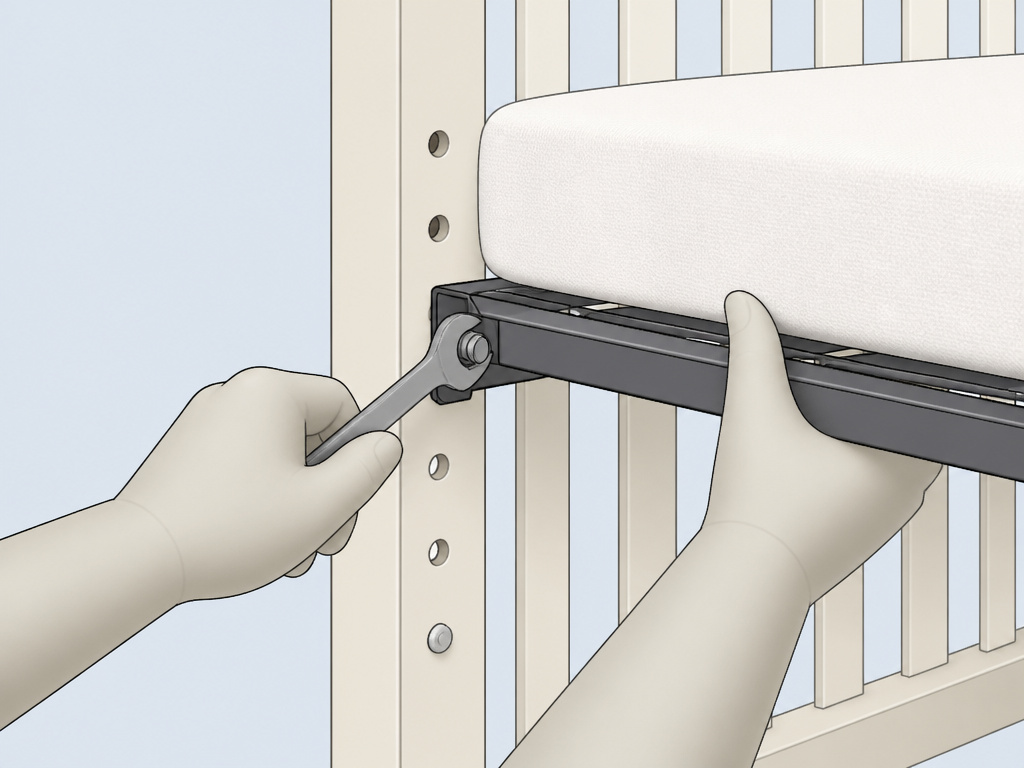
Height adjustment is a defensive move against your baby’s growing abilities. The timeline is driven by milestones, not the calendar.
- Highest Setting: From newborn until the baby can sit up unassisted. This is your only window for the top position.
- Middle Setting: As soon as the baby can sit up, or shows signs of pre-crawling like commando crawling or getting on hands and knees. This usually happens between 4 and 6 months. Do not wait for full crawling.
- Lowest Setting: The moment the baby can pull up to stand. This can happen as early as 8 months. When those little hands grip the crib rail, the mattress must be at the bottom that same day.
The mechanism is simple: leverage. A sitting baby can topple forward. A standing baby can use the rail to hoist themselves up and over. The mattress height directly controls the distance of that potential fall. A baby can climb out of a crib with a mattress set too high; they cannot climb out of a pit.
This timeline is why the AAP recommends against cribs with drop sides. Even if locked, the hardware can fail under the repeated stress of a standing, shaking toddler. Modern fixed-side cribs with adjustable mattress heights are the only safe choice.
Navigating the Used Crib and Mattress Minefield
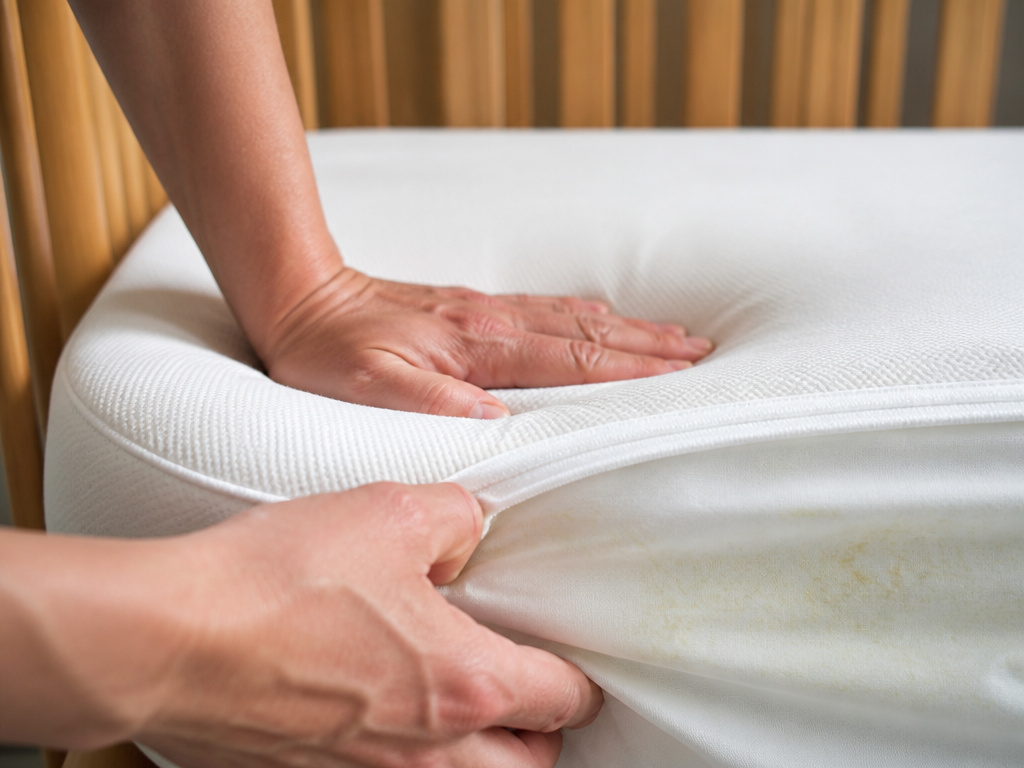
A used crib can be safe, but the burden of proof is entirely on you. The AAP notes that many infant deaths have occurred in cribs with missing hardware or incorrect assembly.
First, check the CPSC crib mattress FAQ for recall lists. Then, you need the original instruction manual. No manual means no safe assembly. All hardware must be present, with no stripped screws or cracked plastic parts. If anything is missing, the crib is not repairable, it’s trash.
A used mattress is a harder sell. You cannot know its history of firmness loss or moisture damage. If you must use one, it must be thoroughly inspected for sag, stains, odors, and tears in the waterproof cover. A quality new mattress protector is mandatory. But the truth is, a new, firm mattress for newborn safety is one of the few non-negotiable purchases.
For non-full-size cribs (mini cribs, portable cribs), the rules tighten. An after-market mattress must be at least as large and as thick as the original and must lay completely flat on the floor of the product. There is no room for improvisation, as these products have less margin for error.
Choosing the Right Mattress: Specs Over Features
The market is full of buzzwords: organic, breathable, dual-firmness. Start with the federal specs, then consider extras.
- Dimensions First. Know your crib’s exact interior measurements. Buy a mattress that lists its precise width and length, aiming to minimize the gap. A 27.5″ x 52″ mattress will fit tighter than a 27.25″ x 51.625″ one in a standard crib.
- Firmness Core. Look for high-density foam or an innerspring core. Avoid fiberfill, polyester batting, or pillow-top layers. The cover should be taut and waterproof. A breathable crib mattress with a 3D mesh core can aid airflow, but the core itself must still be firm.
- Certifications. Look for Greenguard Gold or CertiPUR-US for low VOC emissions. For an organic crib mattress, GOTS or GOLS certification verifies the materials. These are verification, not marketing.
- Fit. It must pass the 3.15-inch gap test in your specific crib. Period.
Brands like Newton, Moonlight Slumber, and Colgate make reliable, firm models that consistently meet these standards. The Newton Breathable Mattress, for example, uses a washable, firm polymer core that is inherently breathable. But even the best mattress fails if it doesn’t fit your crib.
Frequently Asked Questions
Can I use a mattress topper for my newborn’s crib?
No. The AAP is clear: no soft objects or loose bedding. A mattress topper, no matter how thin, adds a compressible layer that can create an unsafe sleeping surface. The only thing between the baby and the mattress should be a tight-fitting sheet.
What if my crib doesn’t have height adjustments?
All modern, safety-compliant full-size cribs have adjustable mattress supports. If your crib does not, it is either a non-full-size crib (like a portable crib) or it is outdated and likely does not meet current full-size crib safety standard requirements. Do not use a fixed-height full-size crib.
How do I know if a mattress is too soft?
Perform the hand press test. If the mattress contours around your hand, it’s too soft. Another test: place the mattress on the floor. If it rocks or bends when you press one edge, the core is insufficiently firm. A proper nursery mattress should feel almost rigid.
Is it safe to use a second-hand crib bumper?
No. Crib bumpers, padded, mesh, or otherwise, are not recommended. They pose risks of strangulation, entrapment, and suffocation. The current crib slat spacing standards (no more than 2 3/8 inches apart) are designed to prevent limb entrapment without any bumper.
When should I move my baby from a bassinet to the crib?
Move your baby to the crib when they show signs of rolling over, or when they reach the bassinet’s height or weight limit, whichever comes first. This is often around 3-4 months. The crib’s highest mattress setting is the correct next step.
Before You Go
Set the mattress at the highest level. Measure the gap with a sheet, under 3.15 inches. Feel for firm, rigid support. That’s the protocol for a newborn’s crib.
The rules are specific because the risks are silent. Entrapment doesn’t make a sound. Rebreathing happens without a struggle. Your defense is a tape measure, a critical eye for firmness, and the discipline to lower the mattress the second your baby shows the first sign of sitting up.
Choose a non-toxic crib mattress from a reputable brand that publishes its dimensions. Pair it with a tight-fitting sheet and a thin, waterproof protector. Then, put the crib in the middle of the room, away from windows and cords, and you’ve built a fortress. The rest is up to them.
