
Unswaddled Sleep for Newborns: The Habituation Risk to Know
This post contains affiliate links. As an Amazon Associate we earn from qualifying purchases.
Yes, newborns can sleep unswaddled. The safest sleep position is always on a firm, flat surface on their back, with no loose blankets, pillows, or toys in the crib. Swaddling is an optional technique, not a requirement for safe sleep. A 2022 systematic review in Frontiers in Pediatrics notes a specific risk: introducing swaddling to an infant not accustomed to it may create conditions unfavorable to arousal, potentially increasing SUDI risk.
The review’s finding reframes the decision. It’s not just about whether you can leave a newborn unswaddled, it’s about understanding the physiological effect of swaddling if you choose to use it, and how to manage the transition away from it safely. The risk isn’t uniform; it clusters around specific scenarios: the swaddle-naïve infant, the baby who starts to roll, and the overly tight wrap.
What follows is a breakdown of the evidence, the three non-negotiable rules for unswaddled sleep, and a step-by-step path for moving from a swaddle to a safer alternative like a sleep sack. You’ll know exactly what to watch for and when to make the switch.
Key Takeaways
- Swaddling is not a safe sleep requirement. An unswaddled newborn sleeping on their back in a bare crib is following AAP guidelines.
- Research indicates swaddling increases quiet sleep duration and reduces sleep-state changes, which may hinder arousal in infants not previously swaddled, a potential SUDI risk factor.
- You must stop swaddling at the first sign of attempted rolling, which can happen as early as 2 months. Continuing to swaddle a rolling baby creates a suffocation hazard.
- A safe swaddle is snug around the chest but loose at the hips and knees to prevent hip dysplasia. Weighted swaddles or sleep sacks are not recommended.
- The safest alternative to swaddling is a fitted, wearable blanket or sleep sack that keeps the baby’s arms free and allows for natural leg movement.
The Evidence: Why “Unswaddled” Isn’t the Same as “Unsafe”
The question isn’t really about safety versus danger. It’s about two different safe paths, one with an optional tool that has specific, documented effects on infant physiology. The blanket advice to “swaddle for better sleep” misses a critical nuance found in the primary research.
A 2022 systematic review published in Frontiers in Pediatrics concluded that swaddling “appears to increase quiet sleep duration and reduces the number of sleep state changes among infants naïve to the intervention.” The authors state that “implementing conditions unfavorable to arousability may increase SUDI risk among infants who have not previously been swaddled.”
This is the core mechanism. Swaddling promotes deeper, quieter sleep by restraining the startle reflex. For a baby already used to this, the change is minimal. For a newborn experiencing it for the first time, the sudden reduction in arousability could be significant during the high-risk period for sleep-related deaths. This doesn’t make swaddling universally dangerous, but it does make the “cold turkey” introduction to a naïve infant a practice to approach with caution.
The official AAP safe sleep policy prioritizes the ABCs: Alone, on their Back, in a bare Crib. Swaddling is addressed as a separate, optional technique with its own rules, it never overrides those ABCs.
The Swaddling Tightness Problem Nobody Measures
Research consistently identifies a major gap: no study effectively measures or controls for swaddle tightness. It’s the variable everyone acknowledges but nobody quantifies. Too loose, and the blanket becomes loose bedding, a suffocation risk. Too tight around the chest, and it can restrict breathing. Too tight around the hips and legs, and it can contribute to hip dysplasia.
The guidance is necessarily vague: “snug but not too tight.” In practice, this means the wrap should be secure enough that it doesn’t unravel, but you should be able to fit two or three fingers between the cloth and the baby’s chest. The legs must have room to bend up and out at the hips.
The 3 Rules for Safe Unswaddled Sleep
If you choose not to swaddle, or need to stop, your protocol simplifies to three unwavering rules. These are not suggestions; they are the barriers between your baby and preventable hazards.
1. Back is Non-Negotiable. Every sleep, every nap, every time. The back-sleeping recommendation is the single most effective public health intervention for reducing SIDS. An unswaddled baby on their back is in the safest possible position. The risk of choking is lower in this position, and it keeps the airway clear.
2. The Crib Must Be Boring. A firm, flat mattress with a fitted sheet. Nothing else. No pillows, quilts, comforters, crib bumpers, stuffed animals, or loose blankets. The baby’s sleep surface should look stark. This eliminates every entrapment and suffocation vector. For warmth, use a wearable blanket or sleep sack of appropriate TOG rating for the room temperature.
3. Alone in Their Own Space. Room-sharing is recommended, keeping the baby’s crib or bassinet in your room for at least the first six months. Bed-sharing is not. Adult beds are soft, have loose bedding, and pose roll-over and entrapment risks. The baby’s sleep space is a safety-engineered zone.
Where this goes sideways: Adding a “just a little” blanket for warmth. A loose blanket can cover a baby’s face within two rolls, and newborn arm movements aren’t coordinated enough to pull it away. The oxygen drop happens silently.
When You Must Stop Swaddling: The Rolling Deadline
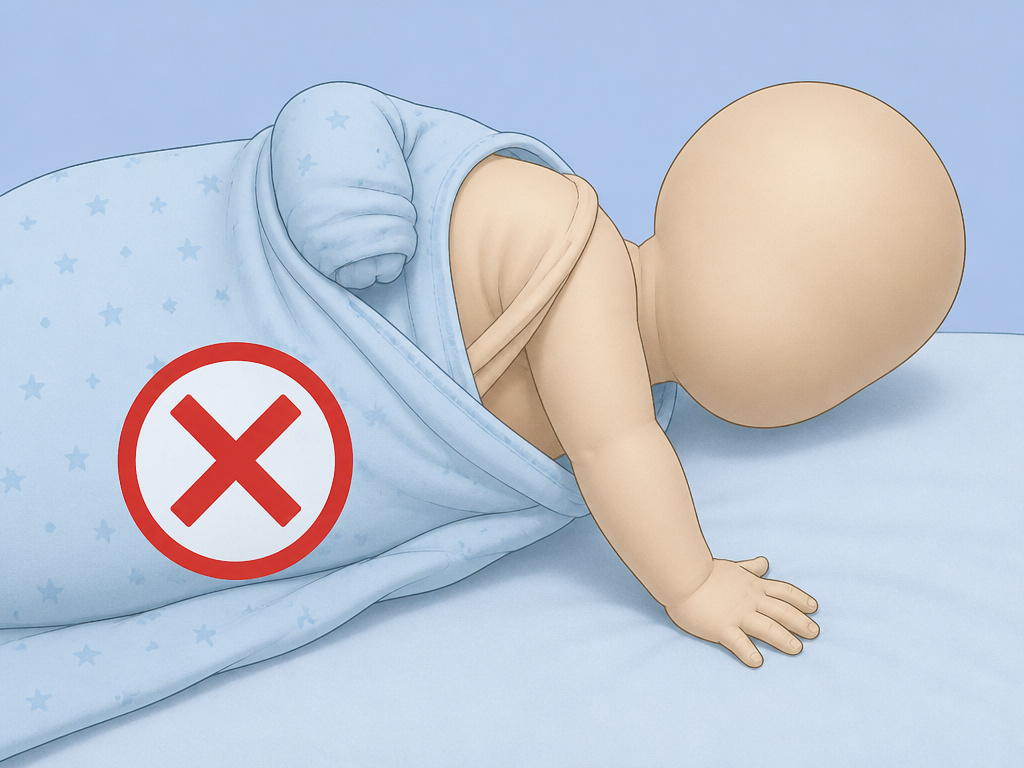
Swaddling becomes actively dangerous at a specific developmental milestone, not a specific age. That milestone is rolling.
| Sign | What It Means | Action Required |
|---|---|---|
| Rocking onto side | Baby is building core strength and practicing the roll motion. | Stop swaddling immediately. Transition to a arms-free sleep sack this week. |
| Partial roll (back to side) | The first successful segment of a full roll. The next attempt could complete it. | Swaddling is no longer safe. The risk of rolling to stomach while swaddled is high. |
| Full roll (back to tummy) | Baby can now get into a prone position independently. | If still swaddling, this is an emergency-level hazard. Arms must be free to push up and reposition. |
Rolling can begin as early as 2 months. Most babies accomplish it between 3 and 4 months. You cannot wait until they roll consistently; you must stop at the first sign of attempt. A swaddled baby who rolls onto their stomach cannot use their arms to push up or turn their head, leading to face-down rebreathing and suffocation.
This is why products like the best wearable blankets for newborns exist. They replace the swaddle’s warmth function without the restraint risk.
The Transition Path: From Swaddle to Sleep Sack

Going from a tight swaddle to nothing can be jarring for a baby accustomed to the containment. The startle reflex will wake them. A phased transition over a week or two is more effective than quitting cold turkey, unless safety demands an immediate stop (like rolling).
- Week 1: One Arm Out. Start with naps. Swaddle your baby normally, but leave one arm out of the wrap. Alternate arms each sleep period. This gets them used to partial movement while still feeling secure.
- Week 2: Both Arms Out. Move to a “arms-free” swaddle technique or switch directly to a sleep sack. The wrap or sack should still be snug around the chest to provide some containment feeling, but both arms have complete freedom.
- The Full Switch. Use a appropriately sized sleep sack or wearable blanket for all sleeps. Ensure it fits well, not so large the baby can slip down inside, not so small it constricts the hips.
During this transition, stick rigidly to the other sleep fundamentals: a dark room, white noise, and a consistent bedtime routine. The external cues become more important as the physical cue of swaddling disappears.
Choosing the Right Transition Product
Not all sleep sacks are equal. The right choice depends on your baby’s age, size, and the season.
- For newborns transitioning early: Look for a sack with optional inner wings or bands that can lightly secure the arms against the chest for a transitional “hands to heart” position before moving to full arm freedom. These are not true swaddles.
- For older infants (3-6+ months): A standard sleeveless or long-sleeve sleep sack with ample room for the legs is ideal. The Halo SleepSack Wearable Blanket is a benchmark in this category for its variety of TOG ratings and secure zipper design.
- Material matters: For comfort and breathability, you can’t beat muslin swaddle blankets. For a stretchy, forgiving transition swaddle that’s harder to overtighten, consider a stretchy swaddle blanket made from a cotton-spandex blend.
Swaddling If You Choose To: Doing It Correctly
If you decide to swaddle, your technique must be flawless. The goal is secure containment that respects physiology. The AAP swaddling safety guide provides the essential framework.
The Hip-Healthy Swaddle
This is the non-negotiable technical skill. The wrap must allow the hips to flex and abduct (legs fall naturally apart). Tight, straight-legged swaddling can force the hip joint into an unstable position, raising the risk of developmental dysplasia.
- Use a large, square blanket. A muslin swaddle blanket is ideal for its size and breathability.
- Fold the top corner down. Place the baby’s shoulders at the fold line.
- Straighten the left arm. Bring the left corner of the blanket across the body, tucking it securely under the right side.
- Bring the bottom corner up. Pull it over the left shoulder, leaving room for the legs to bend. The fabric should be loose around the hips and knees.
- Straighten the right arm. Wrap the right corner across the body and tuck it under the baby’s back on the left side.
You should be able to cup your hand around the baby’s hips inside the swaddle. If you can’t, it’s too tight.
What to Avoid Entirely
- Weighted swaddles or sleep sacks. There is no evidence they are safe, and they may impair chest expansion needed for breathing.
- Swaddling above the neck or covering the head.
- Letting the swaddle become loose during sleep. Check periodically.
- Swaddling for 24 hours a day. Babies need time out of the swaddle for unrestricted movement and development.
Frequently Asked Questions
Can I swaddle my newborn for naps but not at night?
You can, but consistency is easier for everyone. The safe sleep rules apply 24/7. If you swaddle for naps, you must use the same correct technique and stop at the same rolling signs. An unswaddled baby might have shorter nap cycles due to the startle reflex, but this is normal and safe.
My baby hates being swaddled. Is that okay?
It’s more than okay, it’s useful information. Some babies fiercely resist the loss of limb movement. Forcing a swaddle on a resistant baby often leads to a loose, unsafe blanket as they struggle. Follow their lead. Use a sleep sack for newborns for warmth and stick to the ABCs of safe sleep. Their preference for freedom is not a problem to solve.
Are sleep sacks safer than swaddles?
For babies who are not rolling, a well-fitted swaddle and a well-fitted sleep sack are both safe when used correctly. The safety advantage of a sleep sack becomes absolute once rolling begins, as it poses no restraint risk. Sleep sacks also eliminate user error in wrapping tightness. For simplicity and long-term use, a sleep sack is the more versatile choice.
What if my baby startles themselves awake constantly without a swaddle?
This is the Moro reflex, and it’s strongest in the first few months. It’s a normal, healthy neurological sign. While frustrating, it is not harmful. The reflex will integrate on its own by around 4-6 months. During the transition, the phased one-arm-out method helps. You can also try gently holding their arms against their chest for a minute after placing them down drowsy but awake, releasing just before they fall asleep.
Where can I find the best swaddle blankets if I decide to use them?
Focus on material, size, and safety. Our detailed guides review the top options: from general best swaddle blankets to specific picks like swaddles for newborns and the best fabric for swaddle blankets. The right blanket makes correct technique easier.
Before You Go
The answer is clear: newborns can absolutely sleep unswaddled, and it is a safe path when you follow the ABCs. Swaddling is a tool with specific physiological effects, it promotes quiet sleep, which is why it “works.” The swaddling and infant sleep review gives us the crucial detail: introducing that tool to a baby not used to it may dampen their arousal ability during a vulnerable period.
Your decision tree is simple. If you don’t swaddle, commit to a bare crib, a back position, and a sleep sack for warmth. If you do swaddle, master the hip-healthy technique and set a calendar alert for 8 weeks, then watch like a hawk for rolling signs. The moment you see that first rock to the side, the swaddle comes off for good. Move to a wearable blanket and don’t look back. Safety isn’t about choosing the “right” option; it’s about executing your chosen option correctly and knowing the precise moment to change course.
