
Letting Your Newborn Sleep Through the Night: What to Know
This post contains affiliate links. As an Amazon Associate we earn from qualifying purchases.
You cannot let your newborn sleep through the night until they show consistent, good weight gain. Until that milestone, which usually takes a couple of weeks, you must wake them every 3–4 hours to feed. After weight gain is established, it is safe to let them sleep for longer stretches.
That weight-gain checkpoint is the line between a newborn who needs round-the-clock calories and one who can start to self-regulate. Missing it risks underfeeding, which can slow growth and development in those critical first weeks.
What follows is the timeline, the specific signs of “good weight gain,” and the non-negotiable safe sleep rules that apply whether your baby sleeps for two hours or five.
Key Takeaways
- Wake a newborn every 3–4 hours to feed until they show good weight gain, usually within the first couple of weeks.
- “Good weight gain” means a steady climb on the pediatrician’s growth chart, not just a return to birth weight.
- Always place your baby on their back to sleep on a firm, flat surface with only a fitted sheet—no blankets, pillows, or bumpers.
- Room-sharing for at least the first 6 months can reduce the risk of SIDS by as much as 50%, but bed-sharing is never safe.
- Do not use inclined sleepers, loungers, or cardiorespiratory monitors as a substitute for safe sleep practices; they are not proven to reduce risk.
The 3–4 Hour Rule Before Weight Gain
Newborn stomachs are tiny. They hold about 1–2 ounces at birth. That volume, combined with their rapid metabolism, means they need to eat around the clock to fuel growth and maintain blood sugar. Letting them sleep longer than 3–4 hours in the first weeks can lead to underfeeding.
The rule is concrete: wake your baby every 3–4 hours to eat until they show good weight gain. This applies 24 hours a day. “Good weight gain” is the official pivot point. It doesn’t just mean returning to birth weight after the initial drop. It means a consistent, upward trajectory on the pediatrician’s growth chart.
Common mistake: Letting a sleepy newborn skip a feed because they “seem fine.” A baby who is underfed becomes lethargic, which makes them even harder to wake for the next feed. This cycle can impact weight gain within days.
How do you know it’s working? Your pediatrician will tell you. At regular check-ups, they plot your baby’s weight, length, and head circumference. The line should be climbing. Once that pattern is clear, you get the green light to stop waking them for night feeds. For most babies, this happens within the first couple of weeks. For premature babies, it may take longer.
What Does “Sleeping Through the Night” Actually Mean?
Parents dream of an eight-hour stretch. For a newborn, the definition is different. In pediatrics, “sleeping through the night” for a young infant means a solid 5–6 hour block. Some babies might hit this by 2–3 months of age. Many will not.
Their sleep cycles are simply shorter than an adult’s. Expect periods of 1–4 hours of sleep interspersed with feeding, diaper changes, and comfort. This is normal and protective. The long-term data on forcing longer sleep is thin. Pushing a newborn toward a longer schedule before they are physiologically ready often backfires, resulting in an overtired, fussy baby who sleeps worse.
| Baby’s Age | Typical Total Sleep (Hours/Day) | Longest Sleep Stretch You Might See | Is Waking to Feed Still Needed? |
|---|---|---|---|
| Newborn (0–2 weeks) | 14–19 hours | 2–4 hours | Yes, every 3–4 hours until weight gain is established. |
| 2 Weeks – 2 Months | 14–17 hours | 3–6 hours | Maybe. Follow pediatrician’s guidance based on weight. |
| 3–6 Months | 12–15 hours | 5–8 hours | Usually no, unless advised for growth concerns. |
The goal in the first months isn’t uninterrupted sleep. It’s establishing a safe rhythm of feeding and sleeping that supports healthy growth. The sleep will lengthen naturally as your baby’s stomach capacity and neurological development allow.
The Non-Negotiable Safe Sleep Setup
The rules for where and how your newborn sleeps do not change based on how long they sleep. A safe sleep environment is mandatory for every nap and every night. The CDC safe sleep guidelines and the American Academy of Pediatrics guide are unanimous on these points.
Back is best. Always place your baby on their back to sleep. The rate of SIDS has dropped dramatically since this became standard advice in 1992. If your baby can roll from back to stomach and back again on their own, you can leave them in the position they choose. Until then, reposition them onto their back.
The sleep surface must be firm and flat. This means a certified crib, bassinet, or play yard with a tight-fitting mattress and a fitted sheet only. No pillows, quilts, comforters, or stuffed animals. The crib mattress must be specifically designed for that crib with no gaps wider than two fingers between the mattress and the frame.
Where this goes sideways: Using an inclined sleeper or a lounger like a Dock-a-Tot for overnight sleep. These products are not designed for safe, unsupervised sleep. A sleep surface with an incline greater than 10 degrees is unsafe, as a baby’s head can slump forward and block their airway.
Room-share, don’t bed-share. Keep your baby’s sleep space in your room for at least the first 6 months. This practice can reduce the risk of SIDS by as much as 50%. Their sleep space should be separate—a bedside bassinet or a bedside sleeper that attaches securely to your bed is a safe option. Adult beds, couches, and armchairs are dangerous for infant sleep.
Products That Help (And Ones That Don’t)

The market is full of gadgets promising better baby sleep. Very few are backed by the evidence needed for a YMYL (Your Money or Your Life) topic like infant safety.
Helpful: Wearable blankets and swaddles. Since loose blankets are unsafe, a wearable blanket or sleep sack is the solution for warmth. A swaddle blanket can help soothe a young newborn’s startle reflex. Stop swaddling as soon as your baby shows any signs of trying to roll over.
Not Helpful: Cardiorespiratory monitors. Home devices that claim to monitor breathing and heart rate are not proven to reduce the risk of SIDS or other sleep-related deaths. The 2022 safe sleep evidence review states they should not be used as a risk-reduction strategy. They can create a false sense of security and lead parents to overlook the proven, physical safe sleep basics.
Dangerous: Alternative sleep surfaces that aren’t CPSC-certified. Any product marketed for infant sleep must meet the same federal safety standards as a crib or bassinet. If you’re considering a co-sleeper, a portable crib, or a compact bassinet, verify its certification. The best beds for a newborn are those that are simple, sturdy, and certified.
Navigating Night Feedings and Shifting Schedules
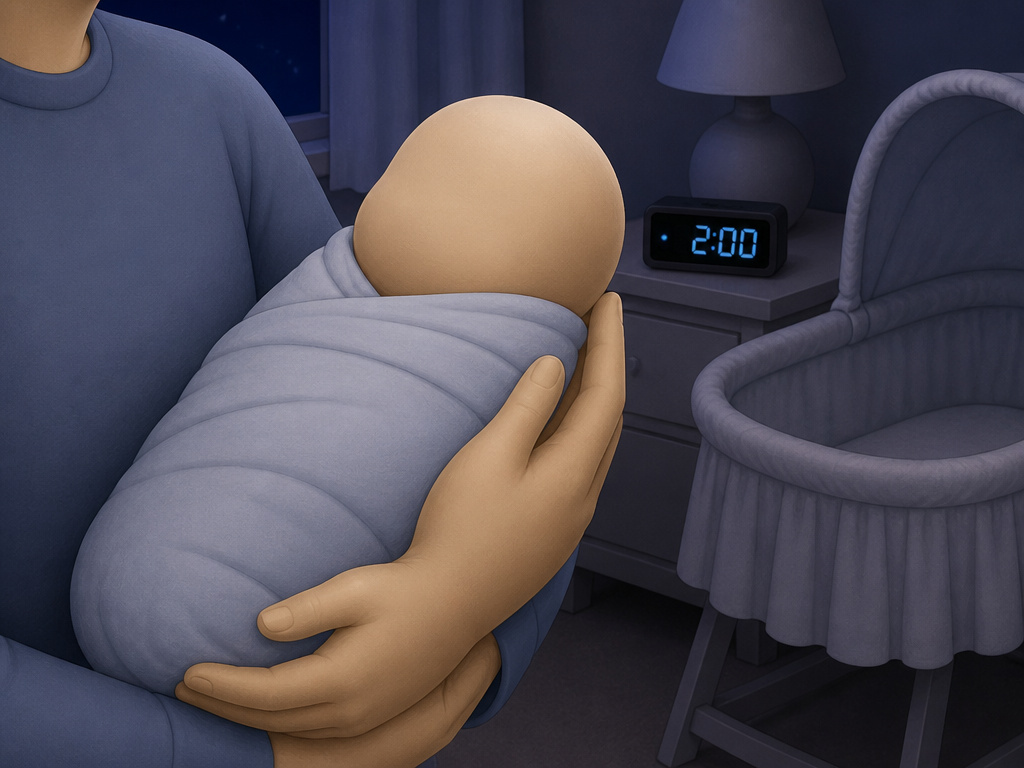
The midnight feed is a reality. Handling it safely matters more than eliminating it quickly.
Keep nights boring. During night feedings and changes, keep the lights dim and interaction minimal. Use a soft voice. This helps reinforce that nighttime is for sleeping, not play. It may take weeks for their circadian rhythm to develop, but this consistency speeds the process.
Have a safe feeding station. If you feed in bed, remove all pillows and blankets from your side before you start. If you fall asleep, place the baby back in their own sleep space immediately upon waking. Research shows the risk of suffocation increases the longer a baby stays in an adult bed. A better move is to feed in a chair with arms, then transfer the baby directly back to their crib or bassinet.
Watch for readiness cues, not the clock. After the initial weight-gain milestone, you can follow your baby’s lead. If they wake hungry at 2 a.m., feed them. If they sleep a 5-hour stretch, that’s okay. The goal is to respond to their needs, not enforce a rigid schedule their body can’t support. The Mayo Clinic newborn sleep guide notes that by 3–4 months, many babies can sleep at least five hours at a time.
The Bottom Line
You can let your newborn sleep for longer stretches at night after they achieve consistent weight gain, a milestone your pediatrician will confirm. Until then, wake them every 3–4 hours to feed. Their sleep environment must be safe every single time: on the back, on a firm flat surface, in your room, with nothing else in the crib. Choose certified safe sleep products like a firm newborn crib mattress and a wearable blanket, and ignore the unproven gadgets. The first few weeks are about survival and safety, not sleep training. The longer stretches will come.
Frequently Asked Questions
How long can a 2-week-old sleep at night?
At two weeks old, a baby might sleep for one 3–4 hour stretch, but you should not let them go longer than 4 hours without feeding until your pediatrician confirms they are gaining weight well. Most still need to eat every 2–3 hours around the clock.
What if my newborn won’t wake up to feed?
If your baby is extremely difficult to rouse for feeds, this is a reason to call your pediatrician immediately. Lethargy can be a sign of underfeeding or other medical issues. Try skin-to-skin contact, a diaper change, and gently stroking their feet or back to encourage waking.
Is it okay for my newborn to sleep 5 hours straight?
Not until they have established good weight gain. For a newborn in the first couple of weeks, a 5-hour stretch is too long and risks caloric deficit. Once your pediatrician gives the all-clear on weight, a 5-hour stretch can be a normal, healthy block of sleep.
Can I let my baby sleep in a swing or car seat overnight?
No. Sitting devices like swings, car seats, and strollers are not safe for unsupervised sleep. If your baby falls asleep in one, move them to a firm, flat sleep surface as soon as you are able. Their airway can become compromised in a semi-reclined position.
Does breastfeeding change the sleep-through-the-night rule?
The feeding frequency rule is the same: wake to feed every 3–4 hours until weight gain is established. Breastfed babies may need to eat slightly more often (every 2–3 hours) as breast milk digests quicker. The safe sleep rules are identical regardless of feeding method.
When can I stop worrying about SIDS?
The risk of SIDS is highest between 1 and 4 months of age, and 90% of cases occur before 6 months. Following all safe sleep recommendations—back sleeping, firm surface, room-sharing, no soft bedding—drastically reduces the risk. Vigilance should remain high for at least the first year.
