
Does a Crib Mattress Fit a Toddler Bed? A Guide to Standards
This post contains affiliate links. As an Amazon Associate we earn from qualifying purchases.
A standard full-size crib mattress must fit a certified toddler bed. The federal safety standard 16 CFR Part 1217, which incorporates ASTM F1821, defines a toddler bed as a bed intended to accommodate a full-size crib mattress with minimum dimensions of 51⅝ inches long by 27¼ inches wide. Any toddler bed manufactured for sale in the U.S. After 2011 is legally required to meet this spec, so your existing crib mattress should drop right in.
That legal requirement is the baseline. The real question isn’t fit, it’s safety. The gap between the mattress and the bed frame is what the regulation exists to eliminate.
What follows: the exact federal dimensions, the OEM thickness rule most parents miss, and the critical difference between a bed that’s merely “sized” for a crib mattress and one that’s legally “intended” for it. By the end, you’ll be able to look at any bed frame and know if it’s a safe toddler bed or a dangerous mismatch.
Key Takeaways
- The law requires a toddler bed to fit a full-size crib mattress measuring at least 51⅝” x 27¼”.
- Mattress thickness is also regulated; most OEMs require a minimum of 4 inches and a maximum of 6 inches to prevent dangerous gaps.
- A twin bed frame is not a toddler bed, even if a crib mattress physically fits inside it. The large gaps created are a fatal entrapment hazard.
- Always check for a permanent label stating compliance with ASTM F1821, this is your guarantee of proper fit and safety testing.
- Using a water mattress, a damaged bed, or substituting parts voids all safety certifications and creates immediate risk.
The Official Dimensions: What the Federal Standard Says
The answer is locked in federal code. The mandatory toddler bed safety standard is published in the Electronic Code of Federal Regulations as 16 CFR Part 1217. This regulation incorporates by reference the ASTM F1821 voluntary standard, which provides the technical blueprint.
A toddler bed is defined as any bed sized to accommodate a full-size crib mattress having minimum dimensions of 51⅝ in. (131 cm) in length and 27¼ in. (690 mm) in width and is intended to provide free access and egress to a child not less than 15 months of age and who weighs no more than 50 pounds (27.7 kg).
This definition does two jobs. It gives you the exact footprint a toddler bed’s interior must match. It also sets the age and weight limits for the product’s intended use. If your crib mattress meets these minimum dimensions, and virtually all standard ones do, it is designed to fit a compliant toddler bed.
The standard isn’t static. It was updated in 2026 to clarify a crucial point in its scope section, changing “sized” to “intended.”
Where this goes sideways: Assuming any bed frame that a crib mattress can sit inside is safe. A twin bed frame is “sized” to hold a crib mattress, but it is not “intended” for one. The resulting gaps between the small mattress and the large frame are wide enough for a child to roll into and become trapped. That’s why the legal definition matters.
Why the “Sized” vs. “Intended” Clarification Changes Everything
The 2026 revision to ASTM F1821 seems like wordplay. It isn’t. The change from “a bed that is sized to accept a full-size crib mattress” to “a bed that is intended to accept a full-size crib mattress” in the standard’s scope was made to shut down a dangerous loophole.
Manufacturers could argue a larger bed frame was merely “sized” for a crib mattress. The new language ties the standard’s requirements, like guardrail placement and mattress retention, exclusively to beds designed for a crib mattress. This means a bed marketed as a “toddler bed” must now pass all safety tests with that specific mattress size. You can’t just sell a small twin bed and call it a toddler bed anymore.
Beyond Length and Width: The Mattress Thickness Rule
Length and width get the attention. Thickness is the silent regulator. If the mattress is too thin, the child can roll under the guardrail. If it’s too thick, they can climb or fall over it.
OEM instruction manuals specify this limit. The Dorel Home manual for models like the WM1646RN states: “Any mattress used in this product must be at least 27-1/4 inches by 51-5/8 inches (69cm by 131cm) with a minimum thickness of 4 inches (10cm) and not exceeding 6 inches (15cm).”
| Mattress Spec | Minimum | Maximum | Why It Matters |
|---|---|---|---|
| Length | 51⅝ in. | N/A | Prevents end gaps |
| Width | 27¼ in. | N/A | Prevents side gaps |
| Thickness | 4 in. | 6 in. | Maintains guardrail & containment effectiveness |
Most standard crib mattresses fall within this 4- to 6-inch range. However, some ultra-thin or dual-height mattresses do not. Measure yours. A mattress under 4 inches deep creates a gap above the guardrail that defeats its purpose.
Common mistake: Using a mattress that’s 7 or 8 inches thick because it’s “plusher.” By 7 inches, the sleeping surface is often level with the top of the guardrail, removing the fall barrier entirely. The child can roll out as easily as they roll over.
How to Verify Your Toddler Bed is Compliant (Before You Buy)
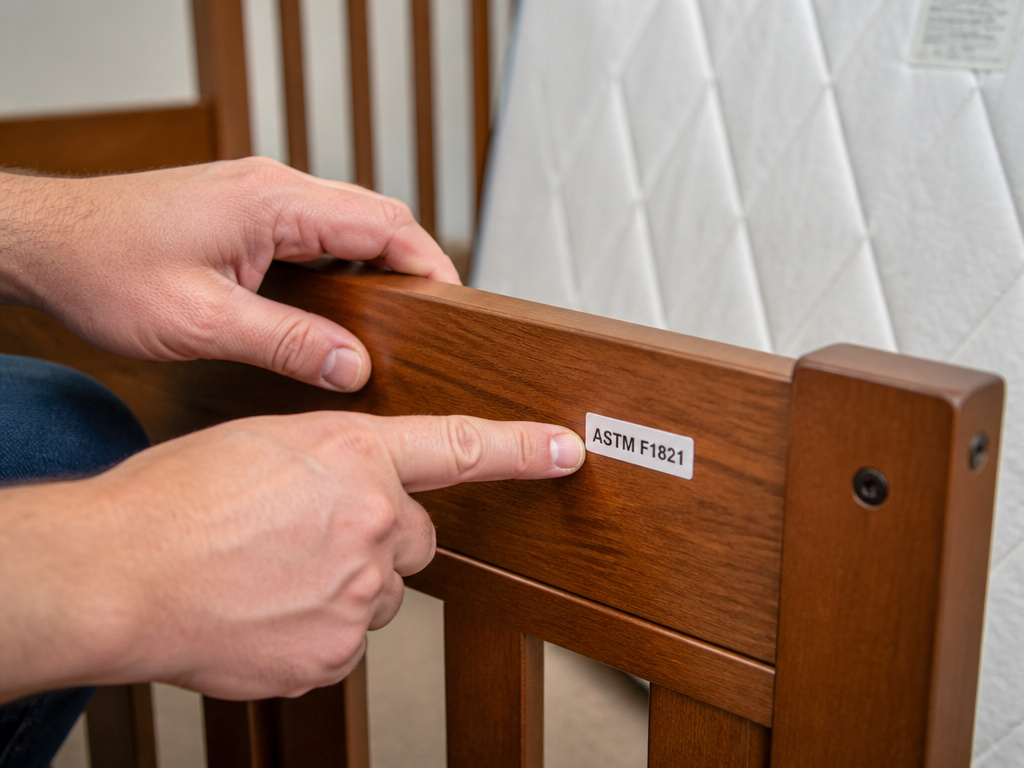
You shouldn’t need a tape measure at the store. The law requires a permanent label on the product itself. Look for it on the headboard, footboard, or side rail.
The label must state compliance with ASTM F1821. The version number will change (F1821-19ε1 for beds made after January 2020, F1821-26 for beds made after August 2026), but the “ASTM F1821” part is non-negotiable. This label is the manufacturer’s legal attestation that the bed has been tested to the federal standard.
If you’re considering a convertible crib to bed, the same rule applies. In its toddler bed configuration, it must have this label or it is not a compliant toddler bed.
The One Tool You Actually Need
Your eyes and the product label are the first check. Your tape measure is the second. When assembling the bed, measure the interior dimensions of the finished frame before the mattress goes in. It should be slightly larger than the mattress minimums, about half an inch total, to allow the mattress to slide in without force, but not so large that it creates a meaningful gap.
This is also the time to inspect for the other safety features the standard mandates: * Guardrails: Must be on both sides if the bed is over 30 inches from the floor. * Mattress Retention: There must be a system (like a rigid board or lip) to keep the mattress from lifting or shifting. * Small Parts: All hardware must remain securely attached and not present a choking hazard.
For a deeper dive on what makes a safe frame, our guide on the best toddler beds for safety and style breaks down these features.
When a Crib Mattress Does NOT Fit a Toddler Bed
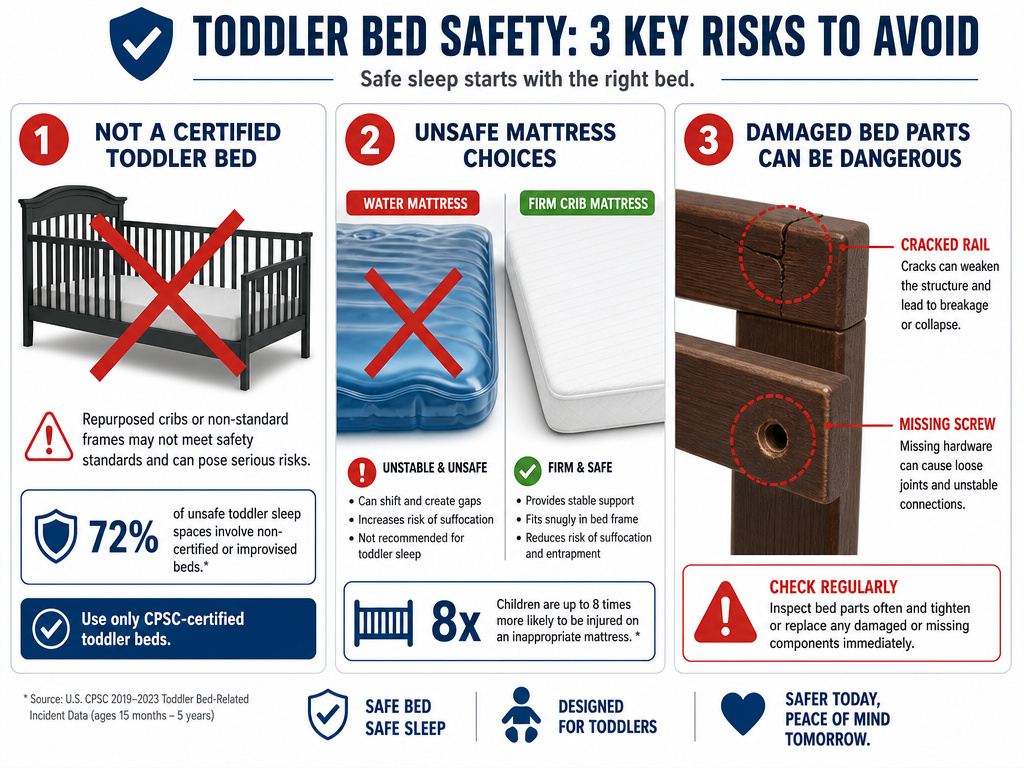
There are three clear scenarios where the fit fails, and each is a hard stop.
1. The bed is not a certified toddler bed. This includes repurposed crib frames without conversion kits, DIY beds, or adult twin beds. The CPSC toddler bed business guidance is clear: beds not meeting the standard are not toddler beds. Using them as such is an unregulated hazard.
2. The mattress is the wrong type. The Dorel manual explicitly warns: “DO NOT use a water mattress with this toddler bed.” Water mattresses are unstable, can create uneven support, and may not meet the firmness requirements for infant sleep. Stick to a standard, firm, crib mattress that meets the dimensions.
3. The bed or mattress is damaged. The OEM warning is blunt: “DO NOT use toddler bed if any parts are missing or broken… DO NOT substitute parts.” A cracked side rail, a missing screw, or a warped mattress support board changes the structural integrity. The ASTM F1821 safety specification explicitly states it does not address incidents from “alteration or unreasonable misuse.” Using damaged equipment is both.
If you’re transitioning to a larger bed, a twin mattress for toddler in a proper twin bed frame with toddler bed rails is a safer path than forcing a crib mattress into a non-compliant frame.
Making the Switch: Safety Checklist
Once you’ve confirmed the fit, follow this sequence. Skip a step, and you undo the safety engineering.
- Assemble the bed completely on the floor, away from windows and cords. Tighten all bolts with the included tool, do not substitute a power drill, which can strip the hardware.
- Install the mattress retention system (usually wooden slats). Space them no more than 2.5 inches apart to prevent entrapment. This is a non-negotiable part of the mattress support system attachment to end structures required by the standard.
- Place your measured, compliant crib mattress into the frame. It should sit flush with the sides with no more than a finger’s width gap anywhere.
- Secure the guardrails. Ensure they are locked in the “up” position and cannot be pushed down by your child’s weight.
- Do a final gap check. Run your hand between the mattress and the guardrails, headboard, and footboard. If you can fit more than two fingers, the mattress is too small or the bed is not compliant.
For the first few nights, use a crib mattress protector and consider placing a soft rug or mats on the floor beside the bed. Even with guardrails, it’s a new sleep space, and falls can happen.
Frequently Asked Questions
Can I use a mini crib mattress in a toddler bed?
No. A mini crib mattress is significantly smaller than the full-size crib mattress dimensions mandated by the standard (typically around 24″ x 38″). The gaps created would be enormous and present a severe entrapment risk. Toddler beds are engineered for one specific mattress size.
My toddler bed is older, from before 2011. Is it safe?
It may not be. The federal rule incorporating ASTM F1821-09 took effect for products manufactured or imported on or after October 20, 2011. Beds made before that date were not required to meet the current standard. Without testing for hazards like guardrail strength, mattress retention, and corner post extensions, it’s impossible to verify its safety. Proceed with extreme caution or replace it.
The mattress fits, but it slides around. What’s wrong?
The mattress retention system has failed. This could be broken slats, a missing center support, or a mattress that’s slightly undersized. First, measure your mattress to confirm it meets the 51⅝” x 27¼” minimum. If it does, inspect the bed’s support system. All parts must be used, and none substituted. A sliding mattress can create a gap at the head or foot of the bed where a child can become trapped.
When should I move from a toddler bed to a twin bed?
Move when your child reaches the toddler bed’s weight limit (50 lbs) or height limit (when the guardrails no longer function as a barrier, typically when the child’s standing height is at the rail’s top). The transition to a twin mattress for toddler in a low-profile twin frame is the next step, using bed safety rails for the first several months.
Before You Go
A crib mattress must fit a toddler bed, that’s the law. The federal standard 16 CFR Part 1217 and the ASTM F1821 specification define the exact dimensions to eliminate dangerous gaps. Your job is to verify two things: the bed’s permanent label shows compliance, and your mattress is the correct thickness (4 to 6 inches).
The trap is assuming any frame that holds the mattress is safe. A twin bed is not a toddler bed. A damaged bed is not a safe bed. A water mattress is never approved. The standard exists for the edge cases that lead to tragedy. Follow it, and the transition is simple. Your child’s existing crib mattress gets a second life in a secure, age-appropriate space. That’s the whole point.
