
Can an Infant Sleep in a Bouncer? The Standard Says No
This post contains affiliate links. As an Amazon Associate we earn from qualifying purchases.
No, an infant should never sleep in a bouncer. The current federal safety standard, 16 CFR Part 1229, which incorporates the ASTM F2167-22 voluntary standard, explicitly states these products are not safe for sleep or unsupervised use. The rule requires warnings that direct caregivers to move a sleeping baby to a firm, flat sleep surface like a crib or bassinet immediately.
That answer is the law for products made after December 19, 2022. It replaced a decade of softer language and manufacturer marketing that sometimes implied short naps were fine. The change came from documented fatalities, babies who suffocated when bouncers tipped on soft surfaces or from positional asphyxia in the reclined seat.
What follows is the regulatory timeline that forced the change, the physical mechanics of why a bouncer is an asphyxia risk, and the specific, safer products designed for supervised rest that don’t carry the same suffocation profile.
Key Takeaways
- The ASTM F2167-22 standard, mandated by U.S. Regulation, now explicitly labels bouncers as “not safe for sleep.”
- CPSC incident data from 2006-2015 showed a statistically significant increase in bouncer-related injuries, including 11 fatalities.
- The primary dangers are suffocation from tipping on soft surfaces and positional asphyxia from the reclined seat design.
- Always move a sleeping infant from any bouncer to a firm, flat sleep surface like a crib or bassinet immediately.
- For supervised rest while you’re awake and nearby, a certified bedside sleeper or bedside bassinet is a safer engineered alternative.
The Updated ASTM Standard Makes the Warning Explicit
The old language was part of the problem. Before 2022, warnings often said to “always use restraints, even if baby falls asleep.” That conditional “even if” framed sleep as a foreseeable, if not ideal, use case. Some product descriptions mentioned “soothing” and “calming” features, implicitly endorsing nap time. The new ASTM F2167-22 standard, which took effect in December 2022, erases that ambiguity.
The substantive revision to the ASTM F2167-22 in the warnings section clarified that the product is not intended or safe for sleep and directs consumers to move the baby to a flat sleep surface if the baby falls asleep in the product.
This isn’t a suggestion. It’s a mandatory warning label requirement for all bouncers manufactured on or after that date. The language is now blunt: “This product is not safe for sleep or unsupervised use. If baby falls asleep, remove baby as soon as possible and place baby on a firm, flat sleep surface such as a crib or bassinet.” You’ll find this verbatim in manuals for current models like the Chicco E-Motion Glider & Bouncer and the Fisher-Price Baby’s Bouncer.
The change was a direct regulatory response to persistent incidents. The official bouncer safety requirements (16 CFR Part 1229) now lock this updated standard into federal law.
Why the Standard Changed: A Decade of Injury Data
The Consumer Product Safety Commission (CPSC) doesn’t rewrite rules on a whim. The shift to explicit “not safe for sleep” language followed a measurable, troubling trend. In their analysis leading to the original 2017 mandatory standard, CPSC staff reviewed data from 2006 to 2015.
They found a statistically significant upward trend in estimated emergency department-treated injuries involving bouncers for infants under one year old. The p-value was 0.006, a strong signal this wasn’t random chance. Deeper incident data from January 2006 to February 2015 detailed 277 reports, including 11 fatalities and 51 injuries.
Where this goes sideways: Treating a bouncer like a portable nap station. The CPSC’s pre-rule data showed unrestrained falls caused skull fractures, and suffocation on soft surfaces happened repeatedly. The injury trend was rising.
The fatalities were the catalyst. They were typically suffocations, often involving two failure modes: the bouncer tipping over on an adult bed or sofa, or the infant’s position in the seat compromising their airway without any visible tipping. The regulator bouncer seat compliance guide now stresses these exact hazards to manufacturers. The standard’s update is the regulatory system closing a loophole that cost lives.
The Physical Mechanics of Risk: Why a Bouncer Isn’t a Sleep Space
A bouncer fails as a sleep environment by design. It violates the “firm, flat, and alone” ABCs of safe sleep. Understanding the physics and physiology explains why the rule is non-negotiable.
First, the surface isn’t flat. Bouncers hold infants in a reclined position. An infant’s head is large and heavy relative to their body. In a recliner, that head can tip forward, chin-to-chest. This position can kink the trachea, a soft, flexible tube. Even a partial kink restricts airflow. An infant’s neck muscles aren’t developed enough to consistently lift and reposition the head out of this dangerous flex. This is positional asphyxia, and it can happen silently.
Second, the structure is unstable. Bouncers have a high center of gravity on a small, often curved, base. Placing one on a soft surface like a bed or pillow creates an uneven, unstable platform. A baby’s movement, a startle reflex, a kick, can shift weight and cause a tip-over. Once tipped, the baby’s face can press into the soft bedding or the bouncer’s own fabric, leading to suffocation.
| Hazard | Mechanism in a Bouncer | Timeline to Crisis |
|---|---|---|
| Positional Asphyxia | Reclined seat causes chin-to-chest head position, kinking the trachea. | Can occur within minutes; no struggle or noise. |
| Tip-Over Suffocation | Unstable base on soft surface (bed, sofa) tips; face is trapped against fabric. | Dependent on movement; can happen suddenly. |
| Fall & Impact | Unrestrained infant wriggles or bounces over the seat’s edge. | Immediate upon fall; risk of skull fracture. |
The warnings address these mechanics directly. “NEVER use on a bed, sofa, cushion, or other soft surface” targets the tip-over risk. “ALWAYS use restraints” aims to prevent falls. But restraints do nothing to prevent positional asphyxia. That’s why the only safe step for a sleeping baby is complete removal.
Bouncer vs. Bassinet: Engineered for Different Jobs
This isn’t about banning a useful product. It’s about using the right tool for the job. A bouncer is engineered for brief, supervised, interactive wake time, a place to put baby while you fold laundry nearby. A bassinet or infant bedside sleeper is engineered for safe sleep, supervised or not.
The difference is in the specs. A safe sleep surface is rigid. Press on a certified crib mattress, it shouldn’t conform to the shape of your hand. That firmness prevents airway obstruction. The sleep space is flat, not reclined, to keep the airway in a neutral alignment. The structure has a wide, stable base and low center of gravity to prevent tipping. These aren’t minor features; they are the foundational engineering controls for infant sleep safety.
Common mistake: Using a bouncer for sleep because it’s “right there” and the baby dozed off. The convenience is real. The risk is real, too. The engineering controls for safe sleep are absent.
If you need a safe place for your baby to nap while you are awake and in the same room, use a product designed for it. A bedside bassinet that meets CPSC safety standards for full-size cribs is that product. It provides the firm, flat surface and stable base a bouncer lacks. For a dedicated, separate sleep space, a safe infant bed with a firm infant mattress is the standard.
If a Baby Falls Asleep in a Bouncer: The Immediate Protocol
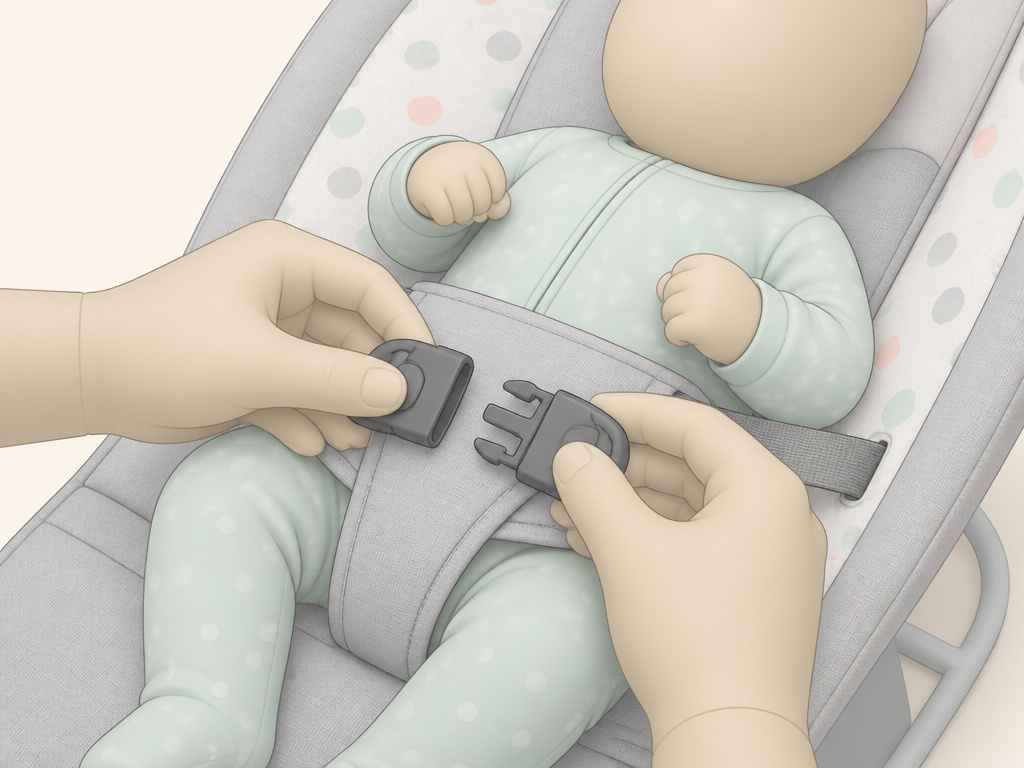
You turned around for two minutes, and now they’re out. It happens to every parent. The protocol isn’t complicated, but it is urgent.
- Stop the motion immediately. If it’s vibrating or bouncing, turn it off.
- Unbuckle the restraints. Do this gently but without delay. Don’t try to move the bouncer with the baby in it.
- Lift the baby out and place them directly on their back on a firm, flat surface. This is a safe baby mattress in a crib, bassinet, or play yard. A blanket on the floor is a safer temporary surface than the bouncer if a crib isn’t in the room.
- Then move the sleep space. If you need the baby closer, move the bassinet to your vicinity, not the baby to an unsafe product.
The entire sequence should take less than a minute. The goal is to minimize the time the infant spends asleep in the risky reclined position. This is the exact behavior the new ASTM F2167-22 warning label is designed to trigger.
Choosing Safer Products for Supervised Rest
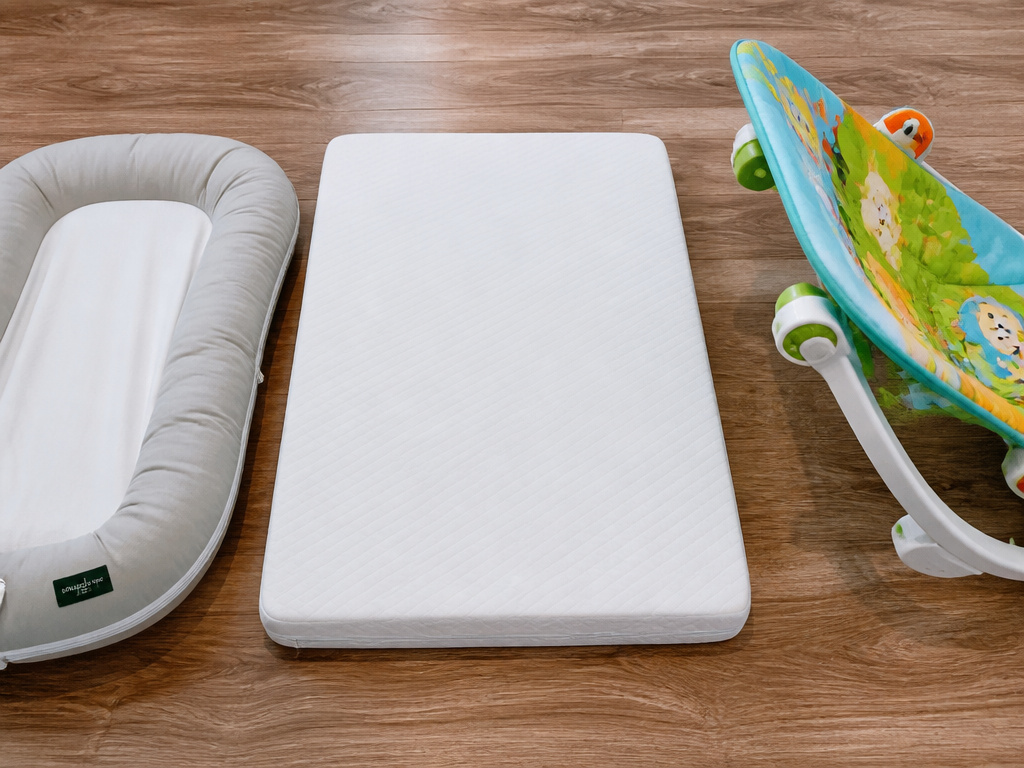
When you want to keep your baby content and nearby while you’re making dinner or answering emails, you have options that aren’t bouncers. Look for products that are essentially portable, firm, flat surfaces.
A play yard or Pack ‘n Play with a firm, thin mattress is the most versatile choice. It’s a contained, flat space that meets safety standards for sleep. For younger infants, a flat lounger (not a reclined nap pod) placed on the floor under direct supervision is a safer alternative for awake time. The best choice for keeping baby right next to you is a bedside sleeper that securely attaches to your bed. These are regulated as cribs, with the requisite firm, flat sleep surface.
For parents concerned about airflow, a breathable crib mattress can offer added peace of mind in a proper sleep space. The key is to match the product’s certified intended use with your need. Need a sleep space? Use a mattress for crib. Need a supervised awake-time container? Use a play yard or a flat, floor-based lounger. The bouncer’s job is extremely narrow: brief, interactive, upright-adjacent time with a fully awake and monitored infant.
Frequently Asked Questions
What does the “not safe for sleep” warning mean on my bouncer?
It means the product does not meet the safety engineering standards required for an infant sleep space. The reclined seat and soft, conforming fabric create a risk of positional asphyxia, and the product’s instability creates a tip-over risk. The warning is a direct result of the updated ASTM F2167 consumer safety specification. If your bouncer has this label, the manufacturer is legally required to state that it is unsafe for any sleep, supervised or not.
My older bouncer doesn’t have that warning. Is it safer?
No. The absence of the warning means it was manufactured before December 2022 under an older version of the standard that used less forceful language. The physical hazards of the product are identical. The newer warning reflects better understanding of the risk, not a change in the product’s inherent safety. You should apply the same strict “no sleep” rule.
Are vibrating bouncers like the Fisher-Price models safer?
No. Vibration is a soothing feature, not a safety feature. It does nothing to mitigate the risks of positional asphyxia or tip-over. All bouncers, regardless of bells, whistles, or vibration patterns, are subject to the same federal infant bouncer safety standard and share the same fundamental unsafe design for sleep.
What is the weight limit for bouncers, and why?
Most bouncers have a 20 lb (9 kg) weight limit or an instruction to stop use when the baby can sit up unassisted. This limit is primarily a stability and structural integrity guard. A heavier, more active infant can more easily shift their weight and cause the bouncer to tip. It also relates to the harness system’s capacity. This limit is for awake-time use only; it does not imply safety for sleep at lower weights.
Can I let my baby nap in a bouncer if I’m watching them?
The standard’s answer is no. Positional asphyxia can be silent, a baby may not struggle or make a sound as their airway becomes blocked. You can be looking directly at them and not see the danger. Supervision does not prevent this mechanical risk. The safe step is always to transfer them to a firm, flat surface like a safe newborn mattress in a crib.
Before You Go
The rule is absolute because the mechanism is physical. A bouncer’s reclined seat can kink an infant’s airway; its unstable base can tip on a soft surface. The updated ASTM F2167-22 standard, now federal law, finally states this plainly: these products are not safe for sleep.
Use your bouncer for what it’s good for, a few minutes of happy bouncing while you’re face-to-face with your awake baby. The moment their eyes close, the clock starts. Lift them out and onto a firm crib mattress or into a bedside bassinet. That simple transfer is the single most important safety habit you can build with this piece of gear.
