
Newborns Wearing Hats to Bed: A Guide to Overheating Hazards
This post contains affiliate links. As an Amazon Associate we earn from qualifying purchases.
No, newborns should not wear hats to bed for routine sleep after the first 24 hours of life. Major health authorities, including the International Society for the Prevention of Infant Death (ISPID), state to avoid hats indoors after 24 hours unless there is a specific medical reason. A hat during sleep traps heat, prevents temperature self-regulation, and increases the risk of overheating, a known factor in Sudden Unexpected Infant Death (SUID).
That 24-hour mark is a hard line. It separates the immediate post-birth period, where a hat helps prevent heat loss, from the ongoing sleep environment where it becomes a hazard. The shift isn’t about comfort. It’s about physiology.
What follows is the breakdown of that rule: the official health authority stance, the exact physical risk a hat creates, the only three exceptions that permit one, and what to use instead for safe warmth. You’ll also get the room temperature numbers that matter and a direct comparison of safe alternatives.
Key Takeaways
- Do not put a hat on a healthy, full-term newborn for sleep after they are 24 hours old. This is the clear directive from global safe sleep organizations.
- Overheating is the core danger. A hat insulates the head, blocking the primary way a baby cools down through sweat evaporation. This thermal stress is a documented SUID risk factor.
- The only exceptions are the first 24 hours post-birth, for medically indicated reasons under doctor supervision, and for specific care of premature infants in a clinical setting.
- Use a wearable blanket or sleep sack for safe warmth. These eliminate loose bedding and allow the baby’s head and face to remain completely uncovered.
- The ideal nursery temperature is between 20°C and 22°C (68°F and 72°F). Dress your baby in one more light layer than you are wearing for comfort in that range.
The Official Rule: Hats Off Indoors After 24 Hours
You will not find wiggle room in the current guidelines. The advice is uniform and precise.
Where this goes sideways: Keeping a hat on a baby indoors past the first day. The ISPID safe sleep recommendations PDF states point 12: “Avoid the use of a hat indoors after 24 hours from birth unless there is a medical reason.”
This is not a suggestion. It is a consensus guideline between countries developed by the International Society for the Prevention of Infant Death. Their document lists 13 key recommendations, and hat use is one of them. It sits alongside “always place infants to sleep on their back” and “keep the infant’s head and face uncovered.”
Other authorities echo this without the specific hourly timeline but with the same force. The New Jersey Department of Health’s safe sleep checklist includes the item: “Are hats kept off infant while indoors? Yes No” and notes “The infant’s head should not be covered indoors.” The Consumer Product Safety Commission (CPSC) champions a “Bare is Best” crib, nothing but a fitted sheet.
The rule exists because the risk profile changes drastically after the first day. In the delivery room and for a short period after, a newborn is wet, exhausted from birth, and working hard to stabilize its core temperature. A hat is a tool in that specific battle. By the time you are home and establishing a sleep routine, that battle is over. The hat’s job is done, and it becomes a liability.
The Physical Reason a Hat is a Risk
A baby’s head is a powerful thermostat. Up to 25% of their body heat is lost through their head. This is by design, it’s a critical cooling mechanism. Putting a hat on during sleep sabotages that system.
The NSW Health safe sleep guidelines explain the mechanism in plain terms: “Too much insulation such as when a baby’s head or face is covered by hats or beanies… May not allow the baby to regulate their temperature or to cool down by evaporation of sweat.”
Let’s break down why that matters.
- Blocked Evaporation: Babies cool themselves primarily by sweating from the head. A hat, especially a knit or fleece one, traps that moisture and heat against the skin. The sweat cannot evaporate, so the cooling process stops.
- Thermal Stress: The baby’s core temperature begins to rise. This state, called thermal stress, forces their little body to work harder, increasing oxygen consumption and metabolic rate.
- Deeper Sleep: Overheating can lead to a deeper, harder-to-arouse sleep. While that sounds good to a tired parent, in the context of infant sleep physiology, a baby who cannot rouse easily is at higher risk.
This isn’t a minor comfort issue. Overheating is a consistently identified risk factor in studies of Sudden Infant Death Syndrome (SIDS). The evidence isn’t about a single incident; it’s about a predictable physiological chain reaction.
TL;DR: A hat during sleep isn’t just warm. It disables the baby’s main cooling system, creating a measurable, dangerous rise in body heat.
The Three Exceptions to the Rule
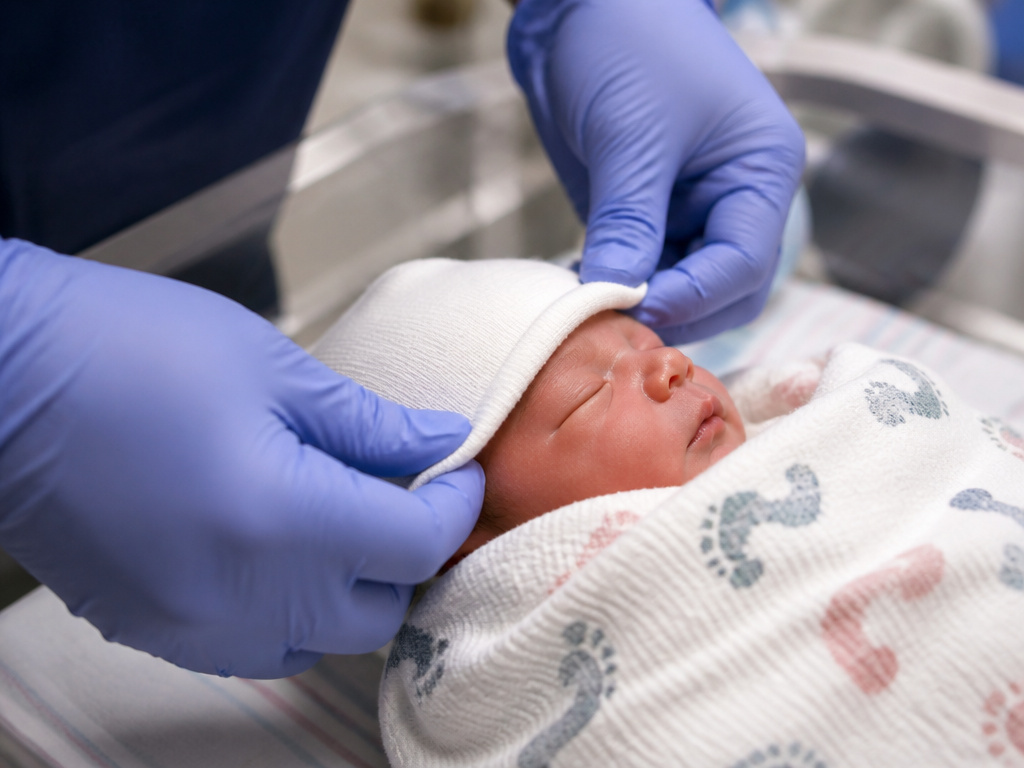
The “no hats” rule has strict, narrow boundaries. Outside of these three scenarios, a sleep hat is not recommended.
| Scenario | Reason | Duration / Limitation |
|---|---|---|
| First 24 Hours Post-Birth | To prevent initial heat loss while the baby’s temperature stabilizes. | Typically only for the first few hours, until temperature is normal. |
| Premature or Low Birth Weight Infants | These infants have extremely poor temperature regulation and high risk of cold stress. | Under direct clinical guidance in a hospital/NICU setting only. |
| Specific Medical Indication | A doctor’s order for a diagnosed condition affecting thermoregulation. | For the exact duration and under the supervision specified by the physician. |
The first exception is why your baby likely wore a cute knit cap in the hospital. Protocols like those from NHS Scotland note “a hat may reduce heat loss in the first 2 hours after birth.” The key phrase there is “first 2 hours.” The European newborn temperature management standard is even more specific for vulnerable preemies, stating a hat should be placed “immediately after delivery” as part of a bundle of warming interventions. This is critical, lifesaving care in a controlled environment.
At home, with a healthy, full-term baby older than a day, those conditions no longer apply. If a healthcare provider suggests a hat for sleep beyond 24 hours, ask for the specific medical reason. It should be documented, not a casual suggestion.
What to Use Instead of a Hat for Warmth
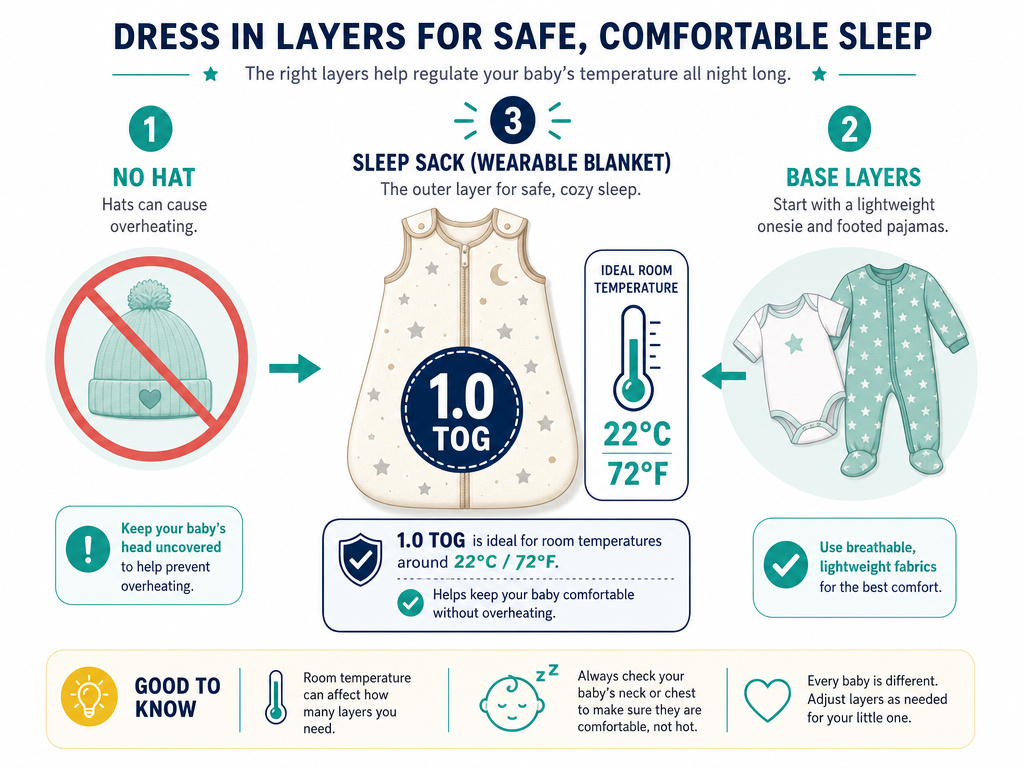
If a hat is off the table, how do you keep your baby warm enough? The answer is not more blankets. Loose bedding is its own suffocation hazard. The solution is layered clothing and the right sleep wearable.
The default choice for safe sleep warmth is a wearable blanket, often called a sleep sack. It is a fitted garment with armholes and a zipper or snaps, worn over the baby’s pajamas. It cannot ride up over the face.
Here’s why it wins: * No Head Coverage: The baby’s head and face remain completely unobstructed. * No Loose Fabric: There are no blankets to kick off or become tangled in. * Easily Adjustable: You can buy them in different thicknesses (measured in TOG) for different seasons.
How to dress your baby for sleep:
- Start with a moisture-wicking base layer like a cotton onesie.
- Add footed pajamas or a sleeper.
- Top with a wearable blanket of appropriate thickness for your room temperature.
Common mistake: Dressing the baby in a hat and then also putting them in a thick sleep sack. This double-insulates the head while the body is already warm, guaranteeing overheating. Pick one system: layered body clothing with a sleep sack, and leave the head bare.
For a quick guide, match the sleep sack TOG to your nursery temperature. A 1.0 TOG sack is ideal for rooms between 20-23°C (68-74°F). For a cooler room (16-20°C / 61-68°F), a 2.5 TOG sack over footed pajamas is better than any hat.
Setting the Right Room Temperature
The perfect nursery temperature makes the “no hat” rule easy to follow. If the room is comfortable, your baby won’t need extreme insulation.
Authoritative sources converge on a narrow range. The European Standards of Care document recommends a delivery room temperature of 23°C–25°C for term infants. For the home sleep environment, a range of 20°C to 22°C (68°F to 72°F) is widely cited as ideal.
How to get it right:
- Use a reliable thermometer. Don’t guess. Place a simple digital thermometer at crib level, away from windows and vents.
- Dress for the room, not the season. A baby in a 72°F room in July needs the same clothing as a baby in a 72°F room in January.
- Watch for signs of overheating. These include damp hair, flushed cheeks, heat rash, rapid breathing, and restlessness. A baby who is too cold will generally be fussy and have cool hands and feet (though cool hands alone are not a reliable sign).
The old “one more layer than you” rule is a decent starting point. If you are comfortable in a t-shirt and pants in the nursery, your baby will likely be comfortable in a onesie, sleeper, and a light wearable blanket. The goal is a comfortable, stable warmth that doesn’t rely on trapping heat at the head.
Hats vs. Wearable Blankets: A Direct Comparison
When you’re deciding how to keep your baby warm, it’s a choice between two systems. One is endorsed by safe sleep guidelines; the other is not.
| Feature | Hat for Sleep | Wearable Blanket / Sleep Sack |
|---|---|---|
| Head & Face Coverage | Covers the head, blocks heat dissipation. | Leaves head and face completely clear. |
| Overheating Risk | High. Traps heat, prevents cooling. | Low. Allows normal temperature regulation. |
| Suffocation Risk | Can slip down over face. | Minimal when sized correctly; cannot cover face. |
| Safe Sleep Guideline Compliance | Not recommended after first 24 hours. | Recommended as a safe alternative to loose blankets. |
| Ease of Use | Can fall off; may need frequent adjustment. | Stays on; simple zip or snap closure. |
The wearable blanket wins on every safety parameter. It addresses the need for warmth without introducing the specific risks associated with head coverings. This is why it has become the standard recommendation over traditional newborn blankets or quilts in the crib.
For the first few months, before rolling begins, a swaddle-style wearable blanket can also provide that snug feeling. Products like the Halo SleepSack Swaddle or the Love to Dream Swaddle UP allow for safe hip positioning and keep arms secure while still leaving the neck and head free. Once a baby shows signs of rolling, you must transition to a arms-free sleep sack.
Frequently Asked Questions
Why did the hospital put a hat on my newborn then?
Hospitals use hats in the immediate post-birth period to prevent rapid heat loss, which is a genuine risk in the first few hours of life. The baby is wet, tired, and transitioning to regulating its own temperature. This is a temporary, monitored intervention. The hospital’ goal is to get the baby’s temperature stable, after which the hat should be removed. They are following the “first 24 hours” exception.
What if my baby’s head feels cold to the touch?
Cool head is normal and safe. It means your baby’s cooling system is working. The back of the neck or chest is a better indicator of core temperature. If the nape of the neck feels warm and dry, your baby is likely comfortable. Cold hands and feet are also normal due to immature circulation. Dressing a baby because their hands are cool is a common reason for overdressing.
Are there any safe hats for sleep?
No. There is no type of hat, knit, muslin, “breathable” mesh, that is approved for routine sleep after the first day. The problem is the category, not the material. Any fabric covering the head during sleep inhibits the baby’s ability to regulate temperature through evaporation. The safe alternative is not a different hat; it’s a wearable blanket that warms the body while leaving the head free.
How do I know if my baby is overheating?
Check for these physical signs during a sleep check: damp or sweaty hair (especially at the nape of the neck), flushed red cheeks, heat rash (tiny red bumps on the chest or neck), and unusually rapid breathing. An overheated baby may also be restless or sleeping very deeply. If you see these signs, remove a layer of clothing, ensure the room is cool, and offer a feed.
What about outdoors or in a cold car seat?
The rules change completely when you are outside in cool weather or in a temperature-uncontrolled environment like a car. In these cases, a hat is essential for warmth. The key is to remove the hat once you come indoors or into a warm vehicle. Never let a baby sleep in a car seat with a coat on; dress them in thin layers and use a blanket over the buckled harness, and remove the hat once the car is warm.
Before You Go
The sleep hat question is a clear line. For healthy, full-term babies over 24 hours old, the answer from every major health authority is no. The risk of overheating and its link to sleep-related infant deaths is too well-established.
Your tools for safe warmth are a well-controlled room (20-22°C), light layers of clothing, and a wearable blanket. This system keeps the crib bare, the face clear, and your baby’s own cooling mechanisms fully operational. It’s one less thing to worry about in the exhausting, wonderful blur of newborn life. Trust the guidelines, skip the hat, and know you’re creating the safest possible sleep environment.
