
Why Do Babies Like to Sleep on Their Stomach? The Real Truth
This post contains affiliate links. As an Amazon Associate we earn from qualifying purchases.
Babies may prefer sleeping on their stomach because it induces a deeper, less arousable sleep state and can feel more secure, but this position carries a dramatically higher risk of Sudden Infant Death Syndrome (SIDS). The American Academy of Pediatrics states the risk is exceptionally high, with an odds ratio of 8.7, for infants placed on their side who then roll to their stomach. Safe sleep means placing them on their back, on a firm, flat surface, for every sleep until age one.
That preference for a deeper sleep is the problem. An infant who sleeps too soundly has a diminished arousal response, which is a critical protective mechanism against breathing disruptions or overheating during sleep. The stomach position physically makes it harder for a baby to wake up, even when their body signals danger.
What follows is a breakdown of the mechanics behind the preference, the concrete data on why it’s unsafe, and the specific, non-negotiable steps to create a safe sleep environment that works with your baby’s development, not against it.
Key Takeaways
- Stomach sleeping suppresses a baby’s natural arousal response, leading to dangerously deep sleep that increases SIDS risk.
- The side sleep position is unstable and carries a risk similar to stomach sleeping; infants placed on their side are 8.7 times more likely to be found on their stomach.
- Products with an incline greater than 10 degrees are unsafe for infant sleep and should never be used.
- Room sharing with your baby on a separate, firm surface reduces the risk of sleep-related death by as much as 50%.
- Once a baby can independently roll both ways, you don’t need to reposition them, but the sleep environment must remain absolutely clear of soft bedding.
The Mechanics Behind the Preference
Babies don’t choose the stomach position for comfort in the way adults do. The drive is neurological and reflexive. When placed prone, pressure on the front of the body can trigger a calming, secure sensation, similar to being held. This can quiet the startle reflex and reduce spontaneous limb movements, making sleep feel less interrupted.
The core issue is what this does to sleep architecture. Multiple physiologic studies confirm that infants are less likely to arouse from sleep when they are in the prone position. The ability to wake up in response to a stressor, like a blanket covering the face, overheating, or a dip in oxygen, is a lifesaving reflex. A stomach-sleeping baby sleeps so soundly that this alarm system is effectively muted.
Where this goes sideways: Mistaking a baby’s longer, quieter stretch of sleep on their stomach for “better” sleep. It’s deeper, not better. That depth is the hazard, because it masks the infant’s inability to rouse from a dangerous situation.
This is about a baby’s nervous system responding to physical cues in a way that inadvertently switches off its own safeguards. Your job is to keep those safeguards online by controlling the sleep position and environment.
The Hidden Risks of Side Sleeping
Most parents know “back is best,” but the danger of side sleeping is just as severe and far less understood. The side position is inherently unstable. An infant’s center of gravity makes rolling from side to stomach significantly easier than rolling from back to stomach.
The data from the AAP’s 2022 evidence review is stark. In one U.S. Study, the SIDS risk associated with the side position was similar in magnitude to that associated with the prone position. The population-attributable risk, meaning the proportion of SIDS cases in the population linked to this factor, has been reported as higher for side sleeping than for stomach sleeping.
The side sleep position is inherently unstable, and the probability of an infant rolling to the prone position from the side sleep position is significantly greater than rolling prone from the back. Furthermore, the risk of SIDS is exceptionally high for infants who are placed on the side and found on the stomach (odds ratio, 8.7). , 2022 AAP Technical Report
This turns a common compromise, “I’ll just prop them on their side”, into one of the most dangerous choices you can make. It directly facilitates the move to the riskiest position. There is no safe alternative to the back. For every sleep, by every caregiver, the rule is absolute.
When Rolling Begins: The Developmental Shift
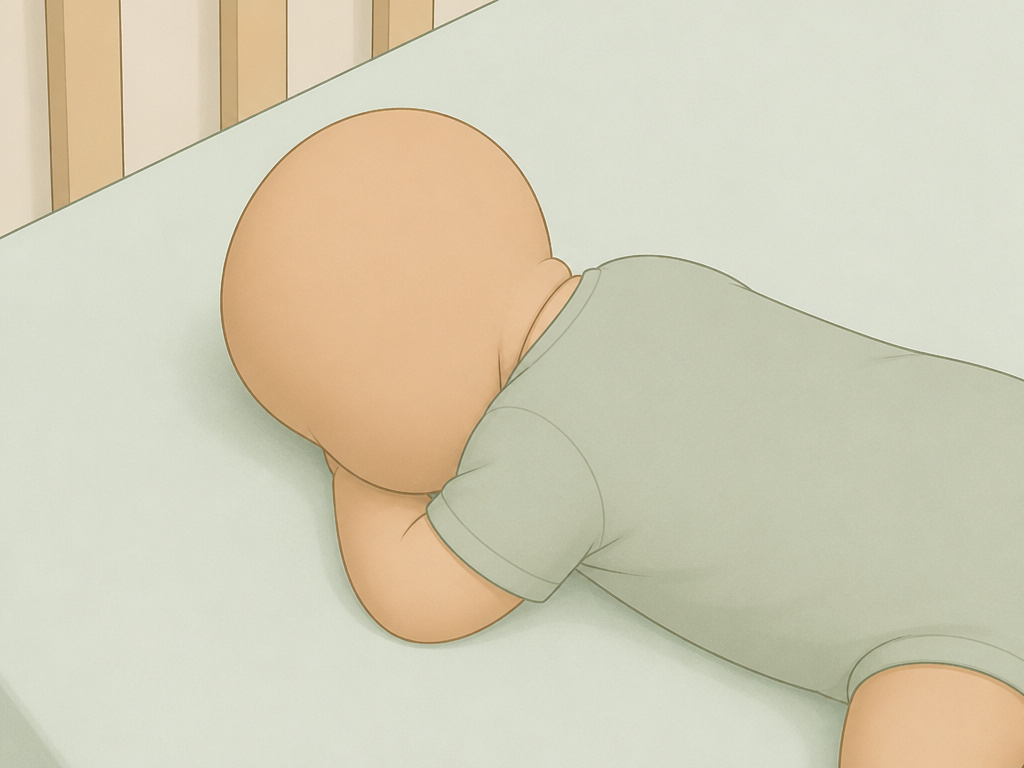 This is where parent anxiety typically peaks. You’ve been diligent about back sleeping for months, and suddenly your four-month-old is rolling onto their stomach mid-nap. The instinct is to flip them back over repeatedly, all night long.
Here’s the official guidance: once an infant can independently roll from back to stomach and stomach to back, you do not need to reposition them. This milestone usually appears between 4 and 6 months. The ability to roll both ways demonstrates increased muscle strength and neurological maturity. They have the motor skills to move their head and body to find a clear airway.
The critical shift is in the sleep environment, not the baby’s position. Before rolling begins, the crib must be a firm, flat fortress. This means: – A CPSC-approved crib or bedside bassinet. – A firm, flat baby mattress with a tight-fitting sheet, no gaps. – Absolutely nothing else in the crib: no pillows, blankets, stuffed animals, or bumper pads.
If the crib is empty, a baby who rolls onto their stomach is rolling onto a safe, breathable surface. The hazard was never the firm mattress; it was the soft bedding that could obstruct breathing. This is why investing in a quality, firm nursery mattress and breathable crib sheets is a non-negotiable safety purchase, not a comfort one.
Debunking the Choking and Rebreathing Myths
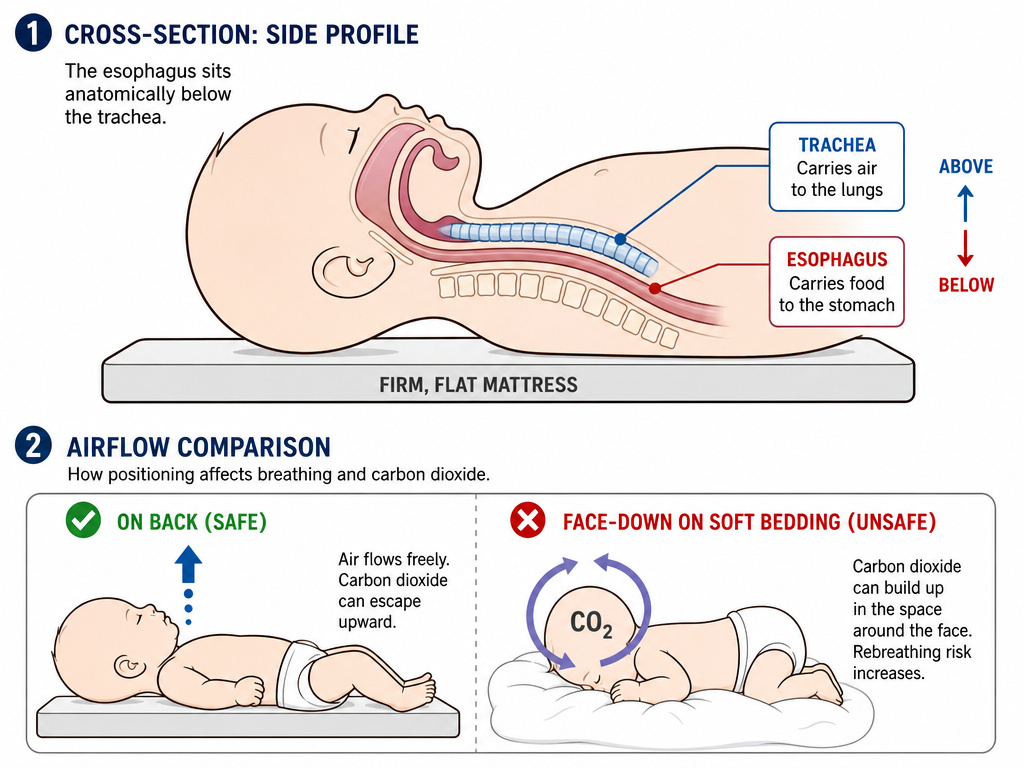 Two persistent fears drive parents to avoid the back-sleeping rule: choking and rebreathing. Both are contradicted by evidence.
Choking/Aspiration: Parents of infants with gastroesophageal reflux (GER) are especially worried. The AAP concurs with pediatric gastroenterology specialists that the back position on a flat surface does not increase the risk of choking or aspiration, even for babies with GER. The esophagus is below the trachea; anatomy works in favor of the supine position. Coughing and gagging are normal protective reflexes, not signs of choking.
Rebreathing: The theory is that a baby on their back will rebreathe their own carbon dioxide if near soft bedding. The problem is the bedding. A baby on their stomach, face down on a soft mattress, pillow, or blanket, is at direct, immediate risk of rebreathing.A baby on their back on a firm, flat surface has a clear airway upward. The solution is to remove the soft objects, not change the baby’s position.
| Myth | Reality | The Safe Action |
|---|---|---|
| “Back sleeping causes choking.” | Anatomy and studies show no increased aspiration risk. | Keep baby supine, even with reflux. |
| “Side sleeping is a safe compromise.” | It’s unstable and doubles the risk of rolling prone. | Use back only. No props or positioners. |
| “A little incline helps with congestion.” | Inclines over 10° are unsafe and increase suffocation risk. | Use a firm, flat mattress. Use a humidifier. |
| “They sleep longer on their stomach.” | They sleep deeper because arousal is suppressed. | Prioritize safe sleep over sleep duration. |
Building the Safest Possible Sleep Environment
Safety is a system, not a single rule. The “ABCs” of safe sleep. Alone, on their Back, in a Crib, are the foundation, but the specifics matter.
The Crib & Mattress: It must be a bare, safety-approved space. Check the Consumer Product Safety Commission (CPSC) website for recalls on any used crib. The mattress must be firm and flat, with no more than a two-finger width gap between the mattress and crib frame. A breathable crib mattress can add an extra layer of airflow protection, but it must still be firm.
Bedding & Clothing: Use only a fitted sheet designed for the specific mattress. Consider bamboo crib sheets for their temperature-regulation and breathability, especially for babies with sensitive skin or eczema-friendly sheets. Dress the baby in a wearable sleep sack or footed pajamas instead of using loose blankets.
Room Sharing: This is a powerful, evidence-based protector. Having the baby’s crib or bedside sleeper bassinet in your room for at least the first six months reduces the risk of SIDS by as much as 50%. It makes feeding easier and allows you to notice any distress quickly. The key is sharing a room, not a sleep surface. Adult beds are not safe for infants.
Before you start: Never use inclined sleepers, loungers, or car seats for routine sleep. None of the inclined products tested by the CPSC were found safe for infant sleep. A flat surface is the only safe surface.
Frequently Asked Questions
Why does my baby fight being put on their back?
It’s common. Some babies startle more easily on their back, and they miss the contained feeling of the womb. A tightly swaddle (until rolling signs appear) can mimic that security. Using a firm, flat surface and ensuring they are not overdressed also helps. The startle reflex diminishes with time, and they will adjust.
What if my baby only falls asleep on my chest?
This is a tough one. Chest sleeping on a awake, alert adult is different from unsupervised sleep on a soft surface. The danger comes when the adult falls asleep. The safest practice is to transfer the baby to their back in their own sleep space as soon as you feel drowsy. Using an infant bedside sleeper allows for close contact while maintaining a separate, safe surface.
Are sleep positioners or wedges safe to keep them on their back?
No. The AAP and CPSC warn against any product that claims to keep a baby in a specific position. These products pose a suffocation risk and have been involved in infant deaths. The only safe way to keep a baby on their back is to place them on their back in an empty crib.
How do I know if my baby is ready to stop swaddling?
The moment you see any signs of attempted rolling, even during awake time, stop swaddling immediately. This can happen as early as 8 weeks. Transition to a wearable sleep sack that allows for free arm and leg movement so they can use their limbs to reposition themselves.
My baby rolled onto their stomach in the crib. Do I need a monitor that alerts me?
The monitor isn’t the primary safety tool, the empty crib is. If they can roll both ways, they can get themselves out of a prone position if needed. A clear crib means there’s nothing to get trapped against. Monitors can offer peace of mind, but they do not prevent SIDS. Focus your investment on the sleep environment first: a firm crib mattress guide and proper sheets for infant sleep.
The Bottom Line
A baby’s preference for stomach sleeping is a biological trap, it feels secure but disables their natural defenses. The numbers from the 2022 AAP safe sleep evidence review are not theoretical; an 8.7x higher risk is a statistic built from tragic, real outcomes.
Your role isn’t to fight their developmental preferences forever, but to shepherd them through the vulnerable period with unwavering environmental control. That means a firm, flat, empty crib for every sleep. It means trusting the AAP safe sleep policy guide over well-meaning but outdated advice. It means understanding that the deeper sleep you see on their stomach is the very reason you must gently, consistently place them on their back.
The goal is a safe sleeping baby. The path there is clear, backed by decades of evidence, and it starts with their back on a firm mattress.Everything else follows from that.
