
Why Your Newborn Sleeps with Arms Up: Causes and Safety Info
This post contains affiliate links. As an Amazon Associate we earn from qualifying purchases.
Newborns sleep with their arms up primarily due to the Moro reflex, an immature nervous system, and a natural self-soothing posture. This “cactus” or “starfish” pose is a normal part of newborn physiology and is generally safe when the baby is placed on their back in a bare, firm crib. The reflex typically fades between 3 and 6 months, often leaving the arms-up position as a comfort habit.
That reflex is just the surface. The real question isn’t why the arms go up, but what that posture tells you about your baby’s sleep state, nervous system development, and the safety of their sleep environment. This guide walks through the three core reasons, separates normal from noteworthy, and gives you the specific evidence on why back-sleeping with arms free is the stability standard.
What follows: the reflex mechanics, the safety rules that override cute poses, the data on supine sleep and nervous system stability, and how to choose between a swaddle, a sleep sack, or arms-out freedom.
Key Takeaways
- The Moro reflex is the primary driver for arms-up jerks in the first 3-6 months; it’s an involuntary startle response to sensation or sleep-stage shifts.
- Back sleeping (supine position) is non-negotiable for safe sleep and is linked to better autonomic nervous system stability, shown by higher heart rate variability metrics in studies.
- Arms-up is often a self-soothing comfort position, allowing hands-to-mouth access, which is a key self-regulation skill newborns develop.
- Stop swaddling at the first sign of rolling attempts (often 2-4 months); a well-fitted sleep sack is the safer choice for an arms-up sleeper.
- Reposition a sleeping baby’s head and body every 3-4 hours to prevent positional plagiocephaly, a flat spot that can develop from constant supine pressure.
The Moro Reflex & Startle Response
You put your sleeping newborn down. Ten minutes later, a jerk, arms fly out, fingers splay, then pull back in. That’s the Moro reflex in action. It’s not a sign of bad sleep. It’s a hardwired, involuntary alarm system.
The Moro reflex is a normal newborn reflex triggered by sudden sounds, the feeling of being lowered, or shifts between sleep stages. It involves rapid arm extension, fingers splaying open, followed by a pulling back in, sometimes with a brief cry.
This reflex exists for a reason. It’s a primitive protective response. For a newborn with no head or trunk control, that jerk is an attempt to regain balance and grasp for stability. The trigger is often a change in vestibular sensation, the feeling of falling as they are laid down, or even the internal transition from a deeper to a lighter sleep phase.
The reflex peaks in the first month and usually integrates between 3 and 6 months as the brain matures and motor control improves. If your baby’s arms-up moments are accompanied by this distinct jerk-and-recoil pattern, you’re seeing classic Moro activity.
Where this goes sideways: Mistaking the Moro reflex for a need to be swaddled tightly past the rolling stage. Swaddling can suppress the startle, but it becomes a suffocation hazard the moment a baby can roll to their stomach. The reflex fades on its own timeline; swaddling is a temporary tool, not a long-term solution.
Physiological Flexion & the Womb Habit
Not every arms-up pose is a startle. Sometimes, it’s just comfort, a default setting.
Before birth, a term baby spends months curled in a tight ball. This “physiological flexion” is their natural posture. After birth, gravity takes over, and their limbs slowly unfurl. The arms-up, elbows-bent “cactus” pose is a middle ground between the tight fetal tuck and full extension. It’s a low-energy resting state for underdeveloped muscles.
For preterm infants, this is different. They often lack the muscle tone to maintain this flexed position against gravity. That’s why in the NICU, they receive nesting support to hold them in a midline, flexed posture. The European newborn positioning standards note that supportive positioning is reduced only when an infant can maintain midline posture independently.
For a healthy term baby at home, the arms-up pose is simply their body’s path of least resistance. It feels familiar. It’s also functional. Hands near the face allow for early self-soothing.
| Arm Position | Likely Cause | What It Looks Like |
|---|---|---|
| “Cactus” Pose | Physiological Flexion / Comfort | Elbows bent, hands floating near cheeks or ears. |
| “Starfish” Pose | Deep Sleep / Relaxation | Arms extended out to sides, palms up, fully relaxed. |
| Jerky Extension | Active Moro Reflex | Sudden, symmetrical arm fling outward, then pull-in. |
| Asymmetrical (One Arm Up) | Possible Head-Turning Preference | One arm up, head consistently turned to that side. |
If one arm is consistently up while the other is down, check for a head-turning preference. Constant head rotation to one side can lead to flat spots and muscle tightness.
The Self-Soothing Connection
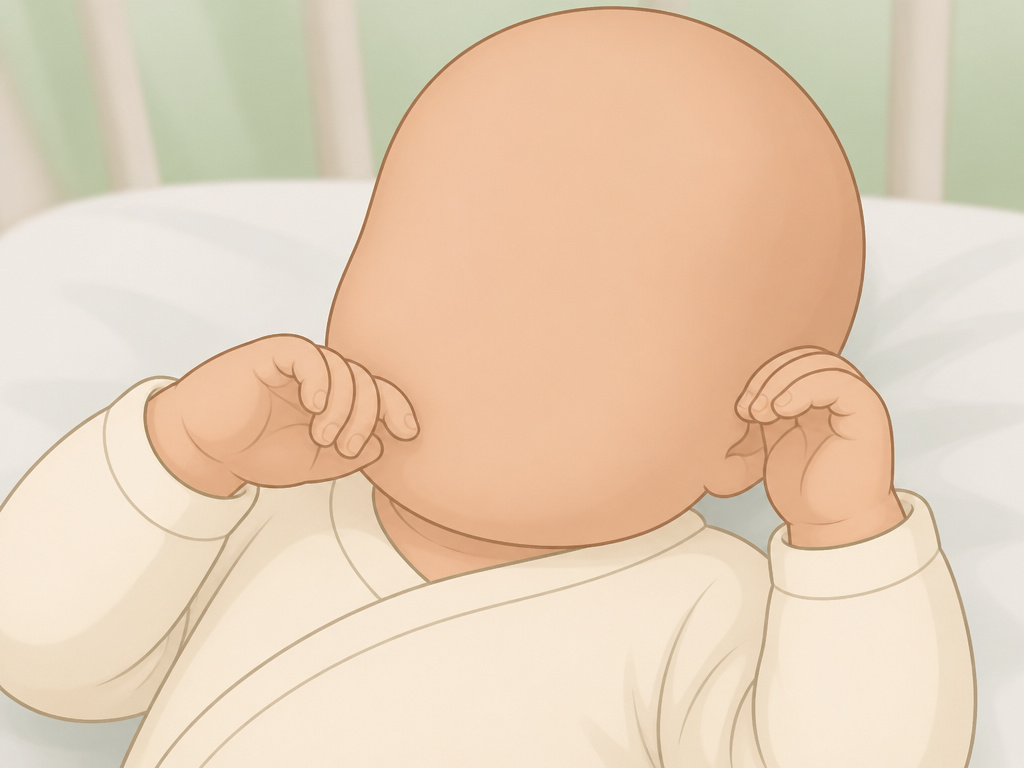
Around 2-3 months, the Moro reflex begins to fade. Yet many babies keep their arms up. Now, it’s often intentional.
Hands-to-mouth is one of the first reliable self-regulation tools a baby discovers. The sucking reflex is powerful, and even gumming their own fist provides calming sensory input. An arms-up posture simply makes the hands more accessible. A baby who startles themselves awake might resettle by finding their mouth, not by crying for you.
This is a positive developmental sign. It means your baby is learning to connect a need (comfort) with an action (bringing hands to mouth). It’s the precursor to self-soothing.
Common mistake: Immediately intervening when you hear a brief stir. If your baby is arms-up and grizzling but not fully crying, pause. They might be in the process of resettling themselves. Jumping in too fast interrupts that learning.
Swaddling, while effective for newborns, blocks this skill. That’s why the transition out of a swaddle, to a sleep sack or arms-free wearable blanket, can be rough. The startles return just as the baby is trying to learn self-soothing. The adjustment period is real, but it’s necessary.
Safe Sleep with Arms Up: The Non-Negotiables
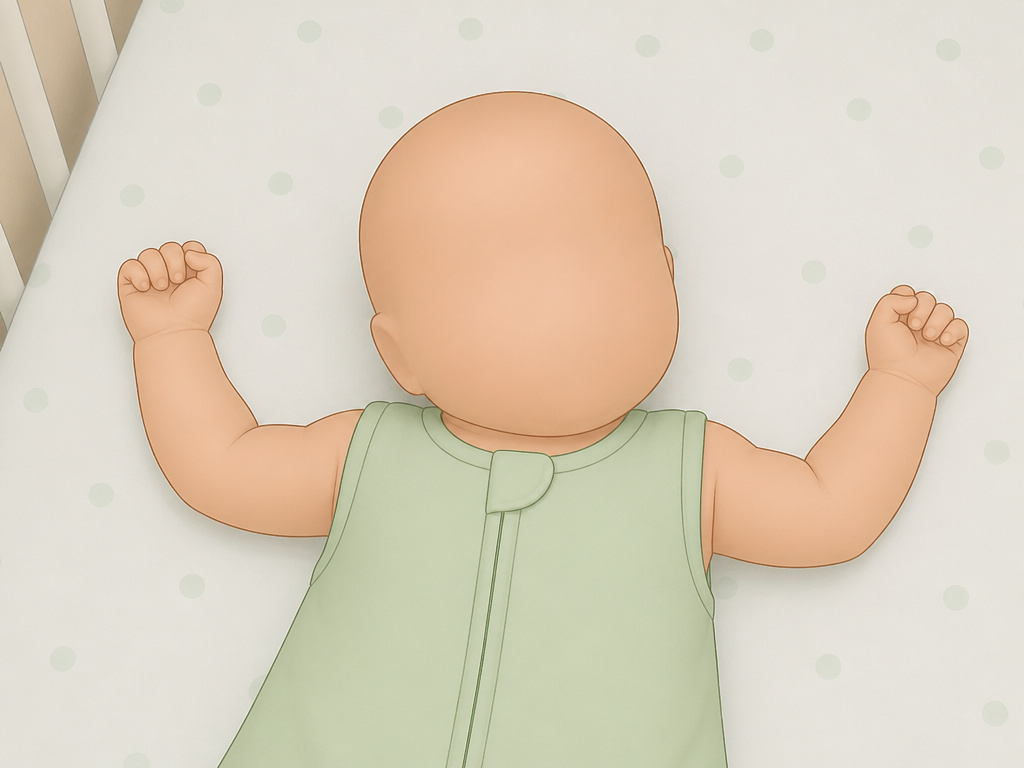
The pose itself isn’t risky. The sleep environment is. Safe sleep rules apply regardless of whether your baby is a starfish or a curled-up bug.
Back to sleep, always. This is the single most critical rule. The supine position reduces the risk of Sudden Infant Death Syndrome (SIDS). A peer-reviewed SIDS risk analysis found the supine position associated with an odds ratio of 0.39 for SUDI compared to non-supine positions. That’s a substantial reduction.
Clear the crib. No pillows, blankets, stuffed animals, or bumper pads. An arms-up baby can easily bat a loose blanket over their face. Use a firm, flat mattress with only a fitted sheet.
Choose the right wearable. For an arms-up sleeper, a well-fitted sleep sack is ideal. It provides warmth without loose fabric. Ensure the neck hole is snug enough that the baby cannot slip down inside. If you use a swaddle, it must be arms-out or discontinued by 8 weeks or at the first sign of rolling.
Monitor head shape. The supine position is safest but can pressure the back of the skull. Reposition the baby’s head (left one sleep, right the next) and encourage supervised tummy time while awake. Clinical guidelines recommend repositioning at least 3-4 hourly over a 24-hour period.
The goal isn’t to change the arm position. It’s to make the space safe for any position they naturally assume.
Swaddle, Sack, or Free Arms?
Your choice of sleep garment directly interacts with the arms-up behavior. Each has a place on the timeline.
| Option | Best For | Risk If Used Too Long |
|---|---|---|
| Traditional Swaddle (Arms Down) | Newborns (0-8 weeks) with strong Moro reflex. | Rolling risk, hip dysplasia if too tight, impedes self-soothing development. |
| Swaddle Transition Product (Arms Up/Out) | Babies 2-4 months showing rolling signs or fighting the swaddle. | Can be outgrown quickly; may not contain startle as effectively. |
| Sleep Sack / Wearable Blanket | All ages once swaddling stops; the default safe choice. | Overheating if too thick for room temp; tripping hazard once baby stands in crib. |
| Arms-Free in Footed Pajamas | Older infants (6+ months) in climate-controlled rooms. | May not provide enough warmth; baby can get legs stuck in crib slats. |
The default pick for most parents after the newborn phase is a cotton or muslin sleep sack. It’s the safest, most versatile option that allows for full arm movement. Brands like Halo and Burts Bees make reliable, breathable sacks.
If you’re using a swaddle blanket, the exit strategy matters more than the entrance. Transition to a sleep sack before rolling begins, not after. A cold-turkey switch often leads to a rough few nights, but it’s non-negotiable for safety.
When to Pause and Consider a Check-Up
Arms-up sleep is almost always benign. Almost. Trust your instincts if something feels off.
Contact your pediatrician if you notice: * Asymmetry: One arm consistently up and tight, the other limp or down. * Extreme stiffness: The arms are rigidly extended for long periods, even during awake, calm times. * Missing milestones: No attempts to bring hands to mouth by 3 months, or no diminishing of the Moro jerk by 5-6 months. * Associated distress: The arm movements seem painful, or the baby cries consistently when assuming the position.
For preterm infants or babies with medical complexities, always follow the specific guidance from their care team. The European Standards of Care for Newborn Health emphasize that positioning support must be individualized based on gestational age and clinical condition.
Frequently Asked Questions
Is it OK if my newborn only sleeps with arms up?
Yes, it is generally okay. It’s a common, normal posture. The priority is that they are placed on their back to sleep in a safe, empty crib. Their arms will find a comfortable position naturally.
Does sleeping with arms up mean my baby is cold?
Not necessarily. Babies often sleep with arms up regardless of temperature. A better gauge of cold is the temperature on their chest or the back of their neck. If they are cold, their hands and feet will feel cool, but the core will be warm. Use an appropriately TOG-rated sleep sack for warmth instead of loose blankets.
Should I try to put my baby’s arms down?
No. Gently placing a sleeping baby’s arms down will likely trigger a startle and wake them. It’s an unnecessary intervention. Their chosen position is usually the most comfortable and stable for them at that moment.
How long do babies sleep with their arms up?
The reflexive, jerky arms-up (Moro) typically fades between 3-6 months. The comfortable, self-soothing arms-up pose can continue as a sleep habit well into toddlerhood and even adulthood. Many people still sleep with arms overhead.
Can sleeping with arms up cause flat head?
The arms-up position itself doesn’t cause a flat head (positional plagiocephaly). The constant pressure on the back of the skull from exclusive supine sleeping can. This is why alternating the head’s direction and providing ample tummy time while awake are crucial parts of the routine, as important as choosing safe blankets for newborns.
The Bottom Line
Your newborn’s arms-up sleep is a sign of a working nervous system, not a problem to solve. The Moro reflex will run its course. The comfort pose will likely stay. Your job is to steward the environment around that natural behavior.
Commit to the safe sleep triad: back, bare, and firm. Choose a sleep sack over loose blankets. Watch for rolling and ditch the swaddle on time. The evidence is clear: the supine position offers the best protection, and within that safe space, your baby’s starfish sprawl is just them getting good rest.
