
How to Use a U Shaped Pillow for Baby: A Complete Tutorial
This post contains affiliate links. As an Amazon Associate we earn from qualifying purchases.
To use a U shaped pillow for a baby correctly, place it around your waist with the opening facing you. Position the infant so their head is at the level of your chest, whether breastfeeding or bottle feeding. The pillow supports the baby’s weight, aligns their airway, and relieves strain on your arms and back. This tool is for supervised feeding only. The new federal safety standard 16 CFR Part 1242, effective in 2025, bans its use for infant sleep, lounging, or as a restraint.
That standard is a mandatory rule written after a documented review of infant deaths. The gap between correct use and fatal misuse is a matter of inches and minutes.
What follows is the mechanics of safe positioning, the specifics of the new regulation, and the exact scenarios where a U-shaped pillow becomes a hazard instead of a help. By the end, you will know how to use it, when to put it away, and what to look for on the label.
Key Takeaways
- A U-shaped nursing pillow is a feeding tool only. It is never for sleep, lounging, or propping.
- The new CPSC standard 16 CFR Part 1242 mandates that these pillows cannot restrain an infant; they must fail a specific infant containment test.
- Correct positioning means the baby’s head is at your chest level. This aligns their airway and prevents slumping.
- For bottle feeding, hold the bottle horizontally to minimize air intake while the pillow supports the baby’s body.
- Always inspect a pillow for damage before use, and never use one if the cover is loose or the filling is lumpy.
The One Rule That Changes Everything
The U-shaped pillow on your couch is now a federally regulated infant product. The Consumer Product Safety Commission (CPSC) voted 5-0 to approve a new mandatory standard, 16 CFR Part 1242, to address suffocation, entrapment, and fall risks. This rule has a 180-day effective date for all pillows manufactured after its publication.
The standard defines a nursing pillow as a product intended to position and support an infant close to a caregiver’s body only while breastfeeding or bottle feeding. Its purpose is singular. Any marketing or design that suggests a dual use for infant lounging or sleeping is now illegal under this federal safety rule announcement.
The regulation includes a critical physical test. The pillow must be conditioned at 73°F and 50% humidity, then checked to ensure no surface within the caregiver opening can contact a 9-inch diameter head probe. This test proves the pillow cannot trap or restrain an infant’s head. If a pillow can cradle a baby’s head in that space, it fails.
This directly addresses the hazard documented in research. A CDC study on U-shaped pillows covering 2004 to 2015 linked 171 infant deaths to the presence of these pillows in the sleep environment. In the explained suffocation cases, obstruction occurred either by the pillow itself or by the infant rolling off it into another soft object. The data forced the rule.
| Old Misconception | New Federal Rule (16 CFR Part 1242) | Why the Change Matters |
|---|---|---|
| “Multi-use lounger” | Single-use feeding aid only | Eliminates design ambiguity that leads to sleep use |
| “Helps baby sit up” | No infant restraint allowed | Preents positional asphyxiation from slumping |
| “Soft nest for napping” | Explicit sleep prohibition | Addresses the primary documented suffocation hazard |
| Unregulated labeling | Mandatory warnings & instructions | Ensures every caregiver receives the same safety information |
Your pillow’s manual is now a legal document. The official PART 1242 text requires that instructional literature be easy to read, include all warnings, and detail correct use, assembly, and cleaning. If your pillow’s instructions are missing, the product is not compliant. Do not use it.
Step-by-Step Setup for Safe Feeding
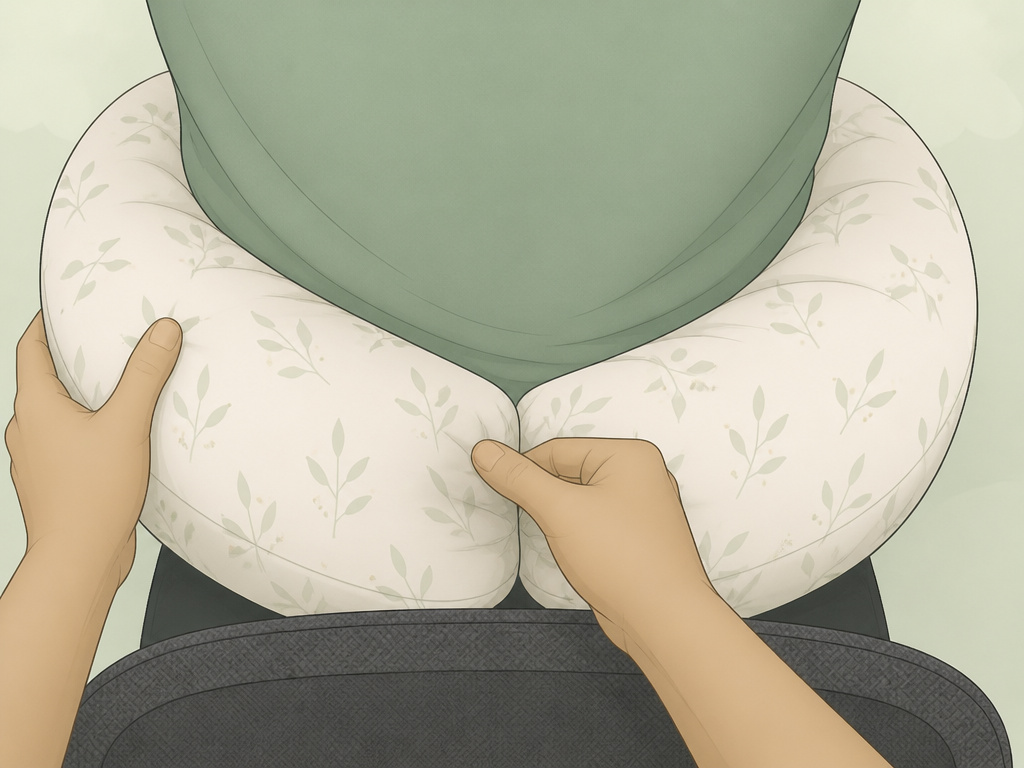
The value of this tool is entirely in the setup. A wrong start means a strained back, a fussy baby, and a higher risk of incorrect use later.
Before First Use: The Non-Negotiable Check
Unpack the pillow and look for loose threads, broken seams, or weak spots in the fabric. Check the filling through the cover—it should be evenly distributed with no hard lumps. The cover’s zipper or closure must be secure. Always wash the removable cover according to the label’s instructions before the first use. A new pillow can have manufacturing residues.
Positioning Yourself and the Pillow
- Sit in a firm, supportive chair or on a stable bed surface. Your back needs support.
- Place the pillow around your waist with the opening facing you. The curved sides should rest against your hips and abdomen.
- Adjust the pillow so the front center is snug against your body. There should be no large gap where the baby could slip down.
- Lean back slightly to let the pillow and chair share the baby’s weight. Do not hunch forward.
Common mistake: Placing the pillow on a soft sofa or recliner. The surface underneath must be firm and flat to prevent the pillow from tipping or shifting.
Now you are ready for the baby.
Breastfeeding vs. Bottle Feeding: Head and Hand Placement
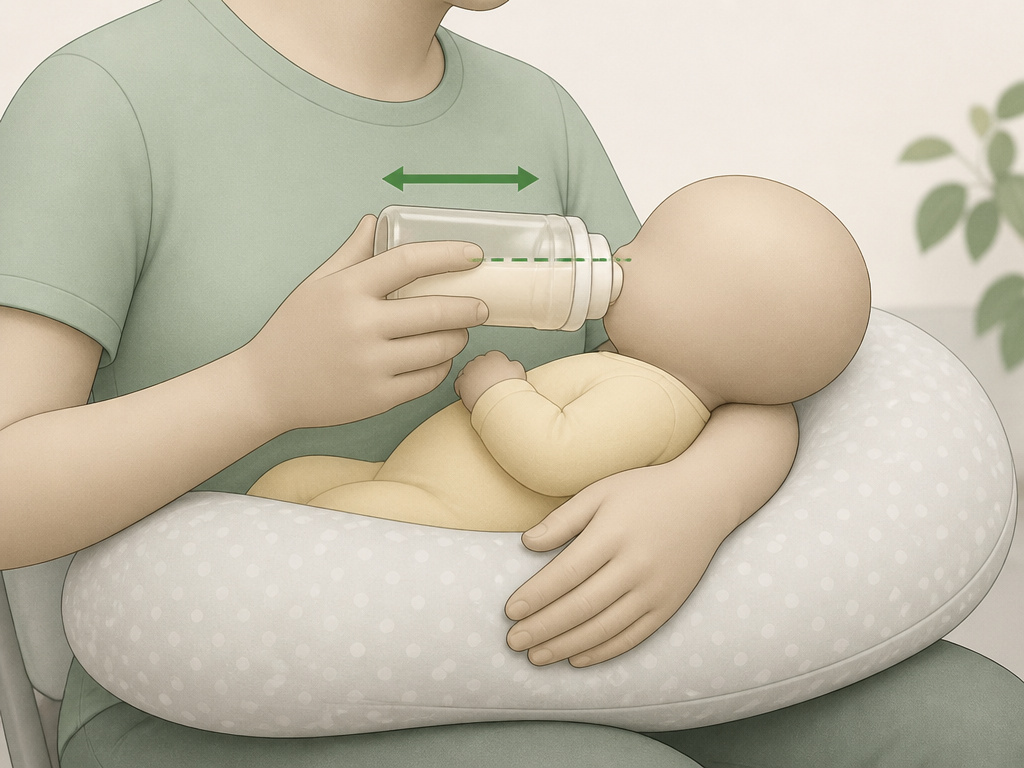
The core principle is identical for both feeding methods: the baby’s head must be at the level of your chest. This alignment keeps their ear, shoulder, and hip in a straight line, which opens their airway. The pillow’s job is to bring the baby to the correct height so you are not holding dead weight.
For Breastfeeding:
Lift your baby and place them on their side on the pillow, tummy-to-tummy with you. Their head should rest in the crook of your arm, not sink into the pillow’s center. Use your forearm to support their spine and your hand to support their bottom. The pillow elevates their entire body. If you need to bring your breast to them, you are too low—add a folded blanket under the pillow for height.
The manual for the Totsy Baby B09CTTJMFZ model states this clearly: “place the baby on the pillow so that their head is at the level of your chest. The pillow will help you maintain the correct position and relieve your arms and back.”
For Bottle Feeding:
Position the baby similarly on the pillow, turned slightly toward you. Support their head with the crook of your arm. With your other hand, hold the bottle. Here is the specific instruction most miss: hold the bottle horizontally.
Tipping the bottle vertically forces the milk to flow too fast. A horizontal hold lets the baby control the pace and swallow less air, which cuts down on gas and spit-up. The pillow holds the baby; you just manage the bottle.
Switch arms halfway through the feeding to give your muscles a break and encourage even development for the baby.
What a U-Shaped Pillow Is NOT Designed For
This is where the safety boundary is drawn. Understanding the “never” list is as important as mastering the “how-to.”
- NOT for Sleep: This is the absolute rule. Never place a sleeping baby on or near the pillow. The soft, encircling shape creates a suffocation risk if the baby turns face-down. The documented deaths are stark evidence. A sleeping infant goes directly into a crib, bassinet, or other approved, flat, firm sleep space.
- NOT a Lounger or Sofa: Do not place the pillow on a couch, adult bed, or table and lay the baby in it unsupervised. This is a fall hazard. An infant can wiggle and roll off the elevated surface in seconds.
- NOT a Prop for Sitting: The pillow does not provide the core strength support an infant needs to sit. Using it to prop a baby upright can cause them to slump forward, chin-to-chest, restricting breathing.
- NOT a Tummy Time Aid: While some pillows for tummy time are designed with specific firmness and slopes, a U-shaped nursing pillow is too soft and high. It does not provide the stable, slightly elevated surface needed for proper neck and shoulder strengthening.
These banned uses are why the CPSC created a separate category called “infant support cushions.” A product marketed as a “nursing pillow with a dual use for lounging” now falls under stricter rules. Your U-shaped pillow is a single-task tool.
Choosing and Maintaining Your Pillow
Not all pillows are equal, even under the new rule. Your choice and care determine its safety over time.
What to Look For When Buying
First, check for a label that includes the manufacturer’s name, model number, and a U.S. Contact address and phone number. This is a requirement of the ASTM F3669-24 standard, which is incorporated into the federal rule. It signals a compliant manufacturer.
Look for a pillow with a removable, machine-washable cover. Spit-up and leaks are inevitable. A cover that must be spot-cleaned only is a practical nightmare. The filling should be firm enough to support the baby’s weight without collapsing but soft enough to be comfortable. Memory foam that holds an indent is a red flag—it can trap an infant’s face.
Some parents seek out specialized pillows for flat head (positional plagiocephaly). A U-shaped nursing pillow is for feeding. Using it incorrectly to try to prevent flat head can create the very sleep risks the standard forbids.
Maintenance and Retirement Schedule
Wash the cover regularly, but check the pillow’s core. If the inner foam or fiberfill gets wet, it can mildew and break down. Most cores cannot be washed. If the pillow loses its shape, develops a permanent sag, or the cover fabric wears thin, replace it. A lumpy pillow does not provide even support.
A typical pillow lasts through one child’s feeding stage. Do not save it for years for a future sibling if it has been compressed in storage. The materials degrade.
Frequently Asked Questions
Can my baby nap on a nursing pillow if I’m watching them?
No. Supervision does not prevent suffocation. It can happen silently in under a minute. The soft, enclosed space of the pillow is the hazard itself. Always transfer a sleeping baby to a firm, flat, approved sleep surface.
What’s the difference between a nursing pillow and a baby lounger?
Nursing pillow is defined and regulated as a feeding support tool. A baby lounger pillow is an infant support cushion with a raised perimeter designed for reclining. Under the new rules, any product that tries to be both faces stricter testing and labeling. For safety, use products only for their intended, singular purpose.
How do I know if my pillow is safe under the new standard?
Check the manufacturer’s website or contact them directly. Pillows manufactured after the rule’s effective date (180 days after Federal Register publication in 2025) must comply. Look for reference to compliance with 16 CFR Part 1242 or ASTM F3669-24 on the product page or label.
My baby slides into the middle of the pillow. What am I doing wrong?
The pillow is likely too loose around your waist, or you are not sitting back far enough. Tighten the pillow by pulling the ends closer behind your back. Ensure you are leaning against chair support so the baby’s weight is pushed into you and the pillow, not downward into the gap.
Can I use a regular pillow instead?
You should not. A regular bed pillow is not shaped to fit around your body, lacks the firm, even support needed, and carries no safety warnings or testing for infant use. It is a greater risk for incorrect positioning and overheating.
Before You Go
A U-shaped pillow is a simple tool with a serious purpose. Its correct use relieves physical strain and promotes effective feeding. Its incorrect use has a documented cost.
The mechanics are straightforward: snug fit around you, baby’s head at chest height, horizontal bottle hold. The rule is non-negotiable: feeding only, never sleep. This is the line that separates a helpful accessory from a recalled hazard.
Your vigilance is the final safety feature. Check the pillow before each use, watch the baby’s position, and put it away the moment the feeding is done. That routine turns a regulated product into a trusted part of your feeding journey.
