
Assessing Dream on Me Baby Bed Quality, Safety, and Recalls
This post contains affiliate links. As an Amazon Associate we earn from qualifying purchases.
Dream on Me makes baby beds that meet current federal safety standards on paper, but their history includes multiple CPSC recalls for entrapment, suffocation, and flammability hazards across cribs, bassinets, and mattresses. Quality is a split decision: newer convertible cribs like the Niko 5-in-1 follow the manuals, but you must verify every mattress fit and avoid any recalled or older drop-side models.
The manuals get the specs right. The federal register spells out the exact interior crib dimensions and mattress sizes that prevent head entrapment. Dream on Me’s current instruction sheets copy those numbers verbatim. That’s the baseline.
What follows is not a simple yes or no. It’s a timeline of what broke, when, and whether the company’s current designs have closed those gaps. We’ll walk through the recalls, the standards, and the one measurement that matters more than any brand name.
Key Takeaways
- Dream on Me has faced at least five CPSC recalls since 2011, involving drop-side cribs, bassinets, bed rails, and mattresses that failed flammability tests.
- Their current convertible crib manuals specify correct ASTM-standard mattress dimensions (51-5/8″ L x 27-1/4″ W) to prevent dangerous gaps, a critical sign of updated design.
- A “quality baby bed” is defined by a perfect mattress-to-crib gap of less than 1-3/8 inches; an ill-fitting mattress, regardless of the crib brand, creates a suffocation risk.
- The brand’s history necessitates checking your specific model number against CPSC recall lists before use, especially for products made before 2010.
- For a safe sleep surface, prioritize a certified, firm crib mattress that fits your crib exactly over the brand of the crib itself.
The Short Answer: It’s Complicated
Is Dream on Me a quality baby bed? The answer lives in two different decades. From about 2006 to 2015, the answer was often “no,” documented by federal recalls. Today, for their newer convertible cribs, the answer is “they can be, if you follow every rule.”
Before you start: Always check the CPSC recall database for your specific model number. Never use a crib with a missing or loose fastener. The mattress must fit with less than two fingers’ width of gap on any side. These aren’t suggestions; they are the barriers between a safe sleep and a documented hazard.
The shift happened when federal law changed. The CPSC crib recall notice from May 2011 targeted over 22,000 Dream on Me drop-side cribs. The moving side could detach, creating a gap where an infant could get trapped. That design is now illegal.
Modern Dream on Me cribs, like the Niko 5-in-1, are fixed-side. Their instruction manuals are dense with warnings that parrot current ASTM and CPSC language. The quality question now hinges on execution and vigilance, not just design intent.
Breaking Down the Dream on Me Record
To judge quality, you look at what broke and why. Dream on Me’s record is a case study in the hazards that prompted stricter federal rules.
The Recall Timeline: 2011 to 2018
The company’s recalls cluster around specific, critical failures. This isn’t about cosmetic issues; it’s about life safety.
| Year | Product Recalled | Core Hazard | What Happened |
|---|---|---|---|
| 2011 | Drop-Side Cribs (Models 612, 613, etc.) | Entrapment, Suffocation, Fall | The drop-side could detach, creating a dangerous gap. 69 incidents reported. |
| 2012 | Children’s Bed Rails | Suffocation, Strangulation | Rails could create a gap against the mattress where an infant could become trapped. |
| 2013 | Cradle Gliders (Model 640 series) | Infant Fall | Support board could disengage. One infant fell to the floor. |
| 2015 | 2-in-1 Bassinet to Cradle | Collapse | Wire frame bracket failed, causing the fabric sleep area to collapse with an infant inside. |
| 2017/18 | Crib & Toddler Bed Mattresses (Model 849) | Flammability | Violated federal mattress flammability standard (16 CFR part 1633). |
The 2011 crib recall is the most telling. The CPSC reported 69 incidents with those models. A one-year-old got a nose scratch. An eight-month-old had a minor head injury. The mechanism, a failing plastic tracking guide on the drop-side, is why that design is banned.
The 2018 mattress flammability standard violation recall is different. It wasn’t a design flaw in the crib, but a failure in a separate component: the mattress. It shows that judging a “baby bed” requires looking at the whole system, crib and sleep surface.
What the Manuals Say Today
Pull up the current manual for a Dream on Me Niko or Eden 5-in-1 crib. The warnings are extensive, and the specs are precise.
From the Niko 5-in-1 manual (Item No: 656):
“CAUTION: Any mattress used in this crib must be at least 27-1/4 inches (690mm) by 51-5/8 inches (1310mm), with a thickness not exceeding 6 inches (150mm).”
That’s not a random number. It’s pulled directly from the federal standard ASTM F2933–21 for full-size crib mattresses. The manual also states the toddler bed conversion requires a mattress of those dimensions, for a child at least 15 months old and under 50 lbs.
This is how a company demonstrates updated quality: by adhering to and explicitly citing the consensus safety standard. The manual is their contract. If the crib is built to those interior dimensions, it should work.
The Mattress Question: Where Quality Actually Matters
The crib frame is just a container. The single most important factor for safety and quality is the mattress that goes inside it. This is true for any brand, but Dream on Me’s mattress recall makes it non-negotiable.
A quality baby bed is a system where the crib and mattress meet one non-negotiable specification: the gap.
The 1-3/8 Inch Rule
Federal data defines the hazard. An infant’s head can become entrapped in a gap between the mattress and the crib side. The standard works to keep that gap under 1-3/8 inches.
Here’s the mechanical reason why. A full-size crib’s interior must be 28 ± 5⁄8 inches wide. A full-size mattress must be at least 27-1⁄4 inches wide. Do the math. The maximum possible gap is roughly 1-3⁄8 inches on each side if the mattress is perfectly centered. A mattress at the minimum width in a crib at the maximum interior width creates that worst-case scenario.
Where this goes sideways: Using a mattress thicker than 6 inches, or a soft one that compresses easily. The gap might measure fine when empty, but a sleeping infant’s weight can depress the mattress, creating a pocket at the side. Their face can press into that pocket, and they may not have the neck strength to pull free.
This is why the Dream on Me manual states the 6-inch thickness maximum. It’s also why their own recalled mattress was a problem, it violated a separate but equally critical safety standard.
Choosing a Safe Sleep Surface
You cannot assume a Dream on Me mattress is safe, even if sold with the crib. You must verify.
- Check for Certification: Look for a label stating it meets ASTM F2933–21 (for crib mattresses) and 16 CFR part 1633 (flammability).
- Measure the Fit: Before using any mattress, place it in the crib. Press down firmly in the center. Now measure the gap at the side. If it’s clearly wider than two of your fingers pressed together, it’s too big.
- Prioritize Firmness: A quality infant mattress is very firm. It should not conform to the shape of your hand when you press on it.
Your goal is to create a seamless, flat, firm surface. The brand of the crib frame is secondary to this fit. This is the principle behind every solid safe baby mattress recommendation.
Dream on Me Cribs vs. The Competition
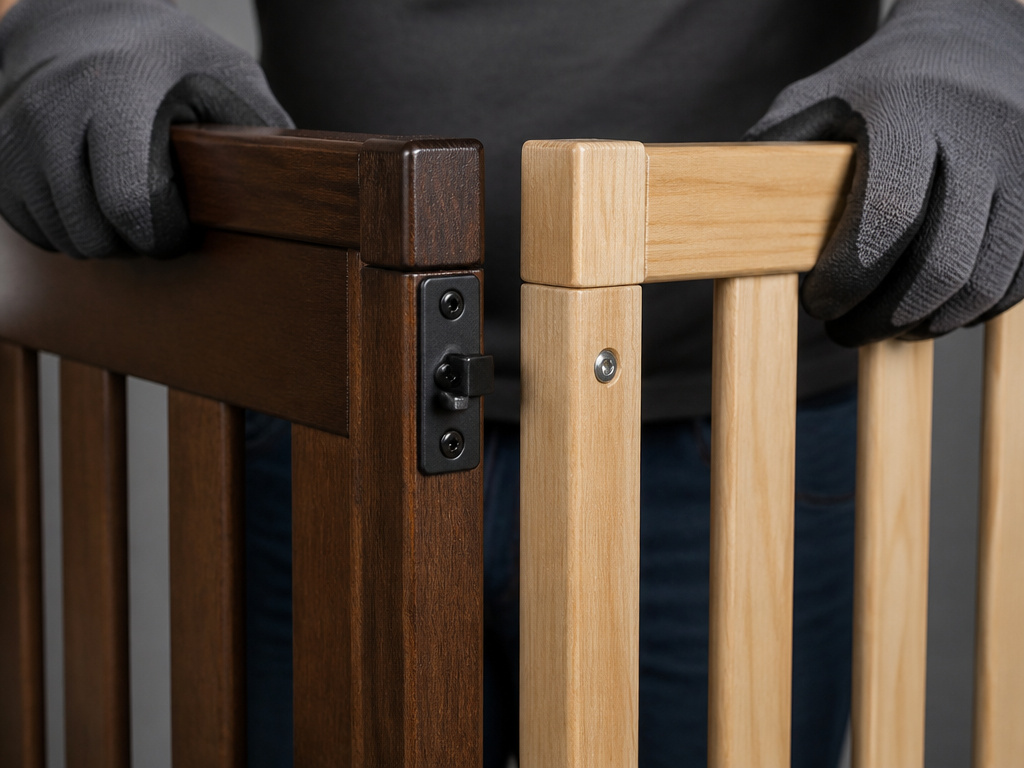
So where does that leave a Dream on Me crib compared to other brands? The difference isn’t in the stated specs, it’s in the historical baggage and the details of construction.
| Consideration | Dream on Me | Typical Higher-End Brand (e.g., Babyletto, Pottery Barn Kids) |
|---|---|---|
| Price Point | Budget to mid-range. | Mid to high-range. |
| Safety Standards | Meets current ASTM/CPSC standards. | Meets current ASTM/CPSC standards. |
| Historical Recalls | Multiple, significant recalls (2011-2018). | Varies, but many have cleaner recent histories. |
| Construction Materials | Often solid pine or engineered wood. | Often solid hardwood (oak, maple). |
| Finish & Hardware | Functional finishes; hardware can feel lighter. | Typically heavier-gauge hardware; more finish options. |
| Convertibility | Many 4-in-1 or 5-in-1 options. | Similar conversion options common. |
The verdict: A current Dream on Me convertible crib is a functional, standards-compliant box. A higher-end brand often buys you more durable materials, more consistent finish quality, and a lower-probability history of major recalls. For a parent who can budget for it, that history matters. For a parent on a strict budget who will meticulously check the mattress fit and model numbers, a new Dream on Me crib can be a safe part of a quality baby bedding setup.
How to Vet a Specific Dream on Me Product
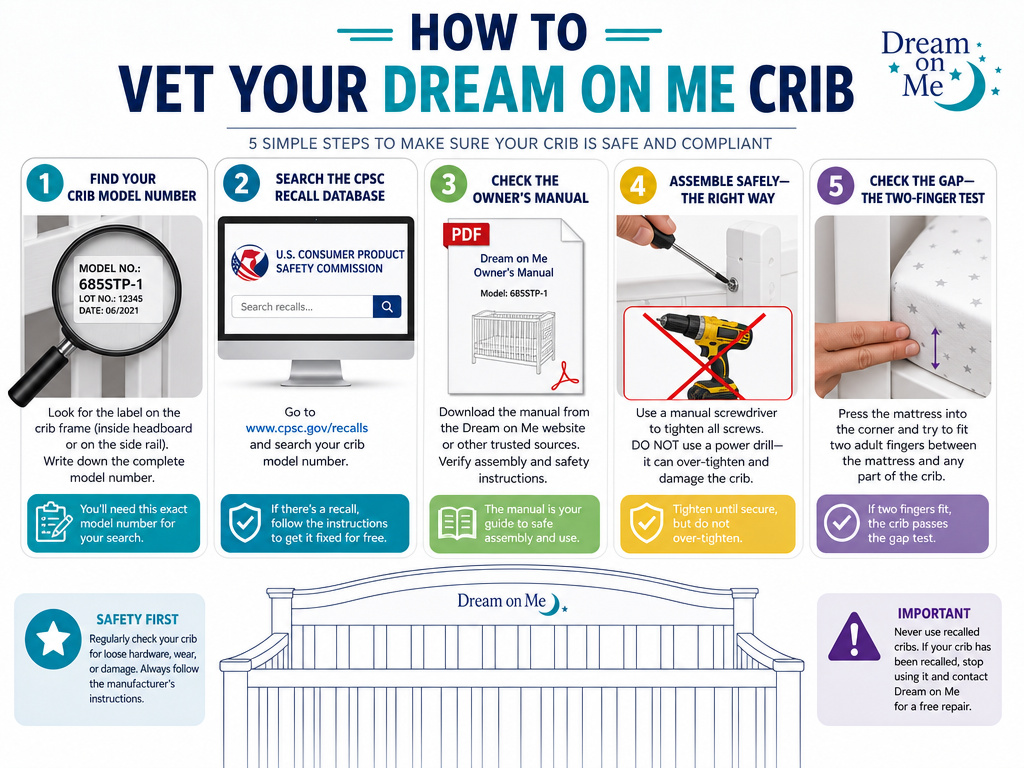
If you own one or are considering buying one, this is your action plan. Quality is something you verify, not assume.
Step 1: Find the Model Number.
It’s on a label, usually on the inside of an end panel or on the mattress board. For older products, it might be on a tag under the mattress pad. Write it down.
Step 2: Cross-Check the CPSC Database.
Go to the CPSC recalls website. Search for “Dream on Me” and your model number. This is non-negotiable for any product made before 2015. The 2015 bassinet-to-cradle recall notice involved a collapsing frame, a risk you cannot see by just looking at it.
Step 3: Download the Official Manual.
Don’t use a crib without its specific manual. Get it from the Dream on Me website. Read the mattress dimension warnings and the assembly torque instructions.
Step 4: Assemble with Care. No Power Tools.
The manuals explicitly say “Do Not Use Power Drills or Drivers.” Power tools can strip the screw holes in the wood, creating loose joints that a child can rock. Hand-tighten with a screwdriver, and check all fasteners monthly.
Step 5: Perform the Mattress Gap Test.
With the crib fully assembled and the mattress you plan to use installed, do the two-finger test on all four sides. If you can fit more than two fingers in the gap, you need a different mattress. This step is more critical than the brand name stamped on the crib.
Following these steps moves you from asking “Is this brand quality?” to asserting “I have made this specific bed safe.”
Frequently Asked Questions
Are Dream on Me cribs safe now?
Their current fixed-side convertible cribs, when used with a certified, correctly fitting mattress and assembled exactly per the manual, meet mandatory federal safety standards. Safety also depends on your diligence in checking for recalls and ensuring a proper mattress fit.
What Dream on Me products were recalled?
Major recalls included specific models of drop-side cribs (2011), bed rails (2012), cradle gliders (2013), a 2-in-1 bassinet (2015), and crib/toddler mattresses (2018). Always verify your exact model number against the CPSC database.
Is a Dream on Me mattress good?
You cannot generalize. A specific Dream on Me mattress model (849) was recalled for violating federal flammability standards. You should select a crib mattress based on its independent certifications (ASTM F2933–21, flammability standard) and perfect fit in your crib, not the Dream on Me brand name.
What size mattress fits a Dream on Me crib?
Most full-size Dream on Me cribs require a standard full-size crib mattress: at least 27-1/4 inches wide by 51-5/8 inches long, and no thicker than 6 inches. Always confirm in your specific model’s manual, as this is required for safe crib sheets for infants to fit correctly.
Can I use a Dream on Me crib for a toddler?
Yes, if it’s a convertible model and you use the proper toddler rail conversion kit (often sold separately). The manual states the child must be at least 15 months old and under 50 lbs. The mattress must still be a standard full-size crib mattress.
Before You Go
Dream on Me is not a universally “quality” brand. Its history is too marked by serious recalls for that. But it is a brand that now produces cribs which, on paper, meet the code.
The real measure of quality is what happens in your nursery. It’s the model number you checked, the manual you followed, and the millimeter-perfect gap between that mattress and the crib rail. That gap is the final judge. A cheap crib with a perfectly fitted, certified mattress is safer than an expensive crib with a soft, ill-fitting one.
Your job is to build the system. Start with a firm, certified nursery mattress that meets ASTM F2933–21. Then find a crib. Dream on Me or otherwise, that holds it with no more than a 1-3/8 inch gap on any side. Assemble it by hand, check the hardware monthly, and keep the sleep space bare. That’s how you get quality, regardless of the name on the headboard.
